Real Pet Rabbit Care Starts Where the Hutch Ends

Pet rabbit care starts with floor space: the UK’s 3m × 2m × 1m standard next to the US 8 + 24 sq ft guideline, plus what to do with the hutch you own.
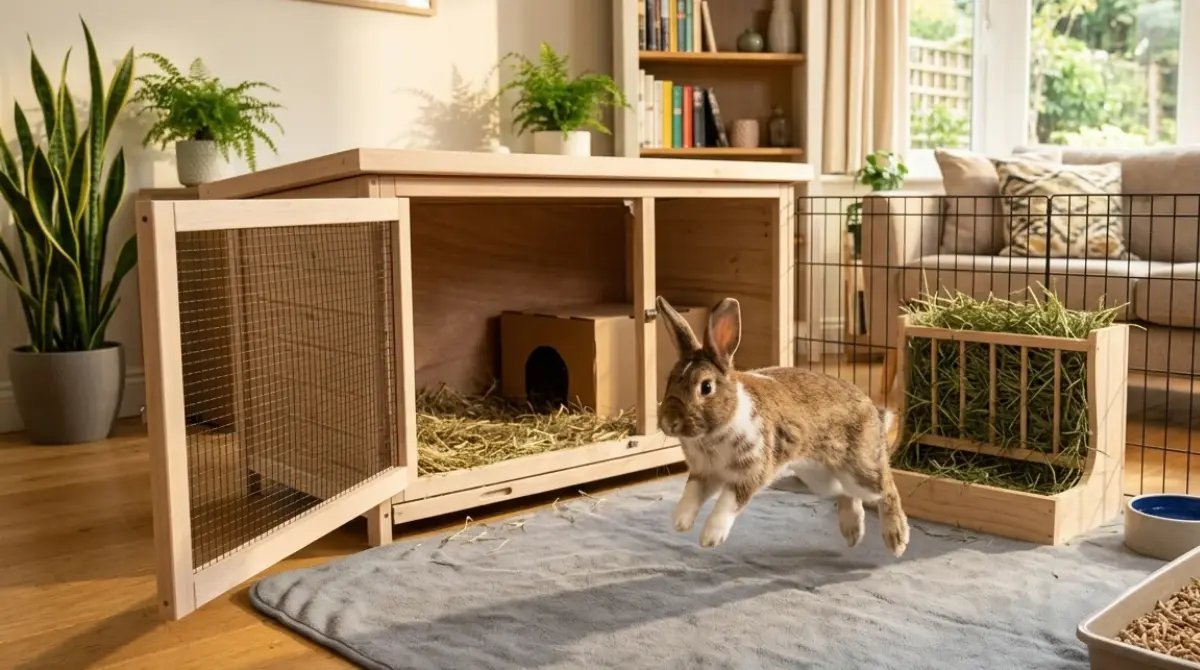
Table of Contents
🚨 Vet Now: If your rabbit hasn’t eaten or passed droppings for more than about 8 hours, or is drooling, very lethargic or breathing fast and shallow after being somewhere hot, call a rabbit-savvy vet today. Details are in the heat and health section below.
Is a hutch enough for a pet rabbit? Start here
No. A hutch can work as a rabbit’s bedroom, but not as its whole home. Rabbits need room to run, stand upright and stretch out, plus a rabbit companion, with the hutch opening onto that space at all times.
That idea isn’t ours: “A Hutch Is Not Enough” is the long-running campaign of the UK’s Rabbit Welfare Association & Fund (RWAF), and the US House Rabbit Society agrees.
Everything here applies to the domestic rabbit. Find your situation:
- Still deciding: start with what a hutch can’t give a rabbit.
- Buying for a child: Merck notes rabbits are often better pets for older teens and adults, because rough handling can injure a rabbit’s spine.
- Your rabbit lives in a hutch now: that’s how most hutches are sold. Jump to turning a hutch into a bedroom.
- New this week: read the setup and diet sections first.
- Small space or renting: the House Rabbit Society standard and the indoor pen suit you.
- Something seems wrong right now: go straight to the heat and health section.
🩺 Health Note: This is general information, not a substitute for an exam by a vet experienced with rabbits. Rabbits hide illness, so a rabbit that hasn’t eaten or passed droppings for more than about 8 hours, or seems unwell after heat exposure, needs a vet the same day.
What a hutch can’t give a rabbit (and why it matters)
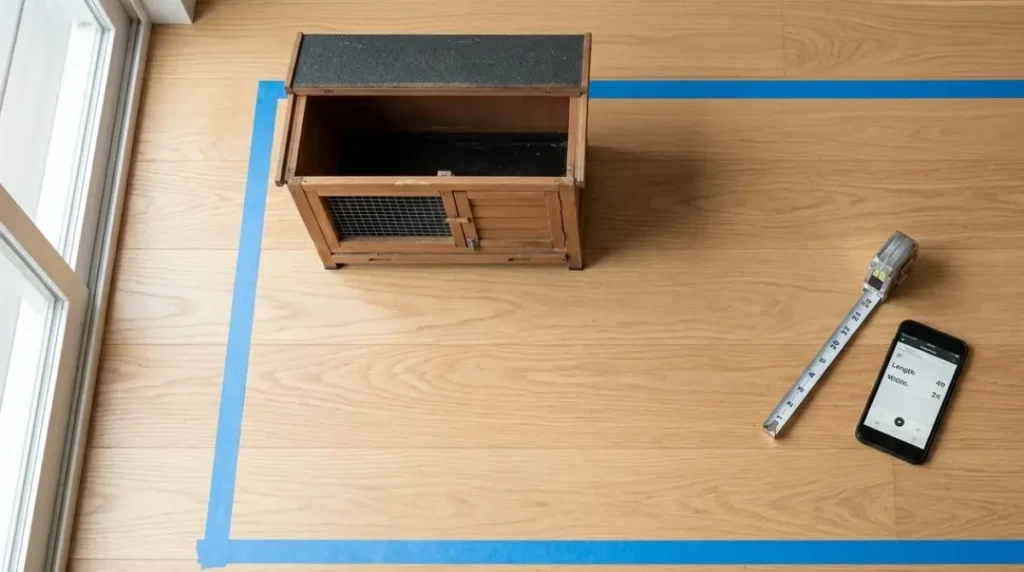
Here’s what a small hutch stops a rabbit (domestic rabbits only) from doing.
Running, stretching and standing up
The RWAF lists what rabbits need to do daily: run, jump, stretch up, dig and forage. A rabbit should be able to stand on its back legs without its ears touching the roof. The RWAF’s example of a common pet-shop hutch, 4ft × 1.5ft, gives about 0.54 m² (roughly 6 sq ft) of floor.
🔍 Why It Works: Merck calls exercise essential to a rabbit’s physical and emotional health. The RWAF warns that inactive rabbits can become obese, raising disease risk and shortening lives.
Weather, hiding and company
A small outdoor hutch leaves a rabbit exposed to wind, rain and sun. After one night of rain, the RWAF notes, wet bedding can force a rabbit into the sleeping area it also uses as a toilet. Company is covered below.
Is it cruel to keep a rabbit in a hutch?
Welfare groups treat keeping a rabbit only in a small hutch as a serious welfare problem; in the UK, the RWAF ties it to the Animal Welfare Act 2006. The fix isn’t to throw the hutch away. It’s to stop the hutch being the rabbit’s whole world.
🔄 Outdated Advice: “A hutch is a complete rabbit home.” Current guidance treats it as a bedroom opening onto a larger space the rabbit can always reach (RWAF; House Rabbit Society).
How much space does a rabbit need? Two standards compared
It depends on which standard you follow. The UK’s RWAF recommends one continuous space of at least 3m × 2m × 1m high (about 9’10” × 6’7″ × 3’3″) for two rabbits, available at all times. The US House Rabbit Society suggests at least 8 sq ft of enclosure plus 24 sq ft of exercise space, with several hours of run time daily.
| Standard | Living space | Height | When it applies | Key detail |
|---|---|---|---|---|
| RWAF (UK) | 3m × 2m single footprint (about 64.6 sq ft), sleeping area included | 1m (3’3″) | At all times | Same minimum for one rabbit or two |
| House Rabbit Society (US) | ≥8 sq ft base + ≥24 sq ft exercise space, for 1–2 rabbits | Not specified | Exercise space ≥5 hours a day | Base 4–6× the rabbit’s stretched length |
| Merck Veterinary Manual | Cage for one rabbit: 18×24 in (small), 24×30 in (medium–large), 30×36 in (giant) | Open pens: sides ≥4 ft | Plus daily time out | A cage minimum, not a whole home |
| Pet-shop hutch (RWAF example) | 4ft × 1.5ft (about 6 sq ft) | Varies | — | About 9% of the RWAF footprint |
Sources: RWAF; House Rabbit Society; Merck (reviewed July 2026). Conversions are ours.
The RWAF standard: one continuous 3m × 2m × 1m space
The RWAF minimum is one block of space; tunnels don’t count. The 3m length lets rabbits run, not just hop, so an 8 × 8 ft pen still falls short. The sleeping area or hutch inside should be at least 6ft × 2ft, per the RWAF’s minimum space recommendations.
The House Rabbit Society standard: a base plus exercise space
HRS uses two zones: a base of at least 8 sq ft (4–6 times your rabbit’s stretched-out length; some chapters say 16 sq ft), plus at least 24 sq ft of exercise space for at least 5 hours a day. HRS says rabbits don’t need cages and recommends exercise pens; see the House Rabbit Society’s rabbit care library.
🔍 Why It Works: RWAF sets the space for a rabbit living there full time; HRS sets a base for a rabbit that also gets hours of free-run time daily. If that run time isn’t reliable, aim for the RWAF space.
🔄 Outdated Advice: “HRS says 8 sq ft, so a 4×2 ft cage is ideal.” That drops the 24 sq ft of exercise space and 5+ daily hours that come with it.
What both look like on a real floor (the tape test)
Numbers are easy to underestimate, so mark them out.
✅ Do This: Tape a 9’10” × 6’7″ rectangle for the RWAF footprint. Inside it, tape a 4 × 2 ft box (HRS base) and a 4 × 6 ft area beside it (HRS exercise space). Set your hutch down and see which outline it fills.
Does a hutch’s upper floor count?
No. The RWAF says the upper floor of a two-storey hutch doesn’t count toward the footprint, so measure the ground floor only.
One rabbit or two: does it change the space?
Not under the RWAF standard: one rabbit needs the same minimum as a pair. Merck notes multiple rabbits and giant breeds need more.
What enough looks like: pens, rooms, and sheds

Three setups give a domestic rabbit enough space, each keeping any hutch as a bedroom.
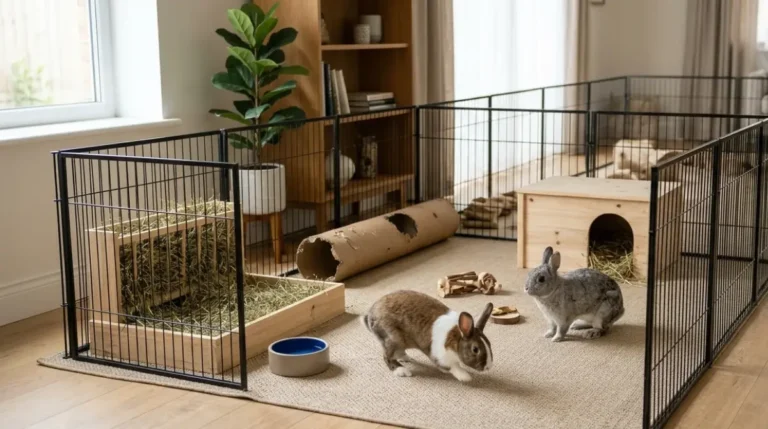
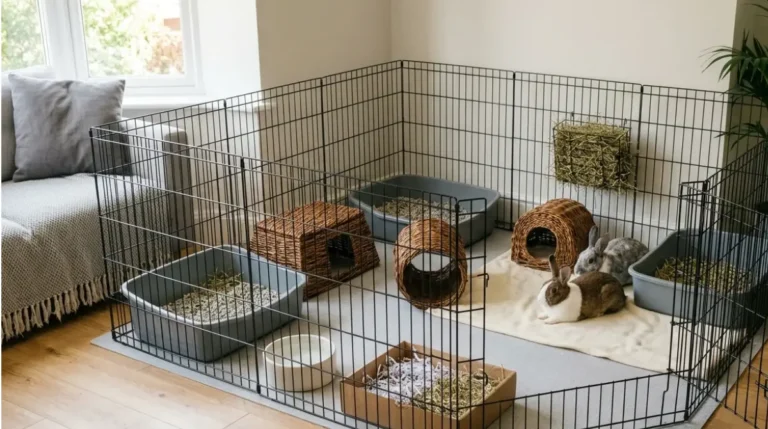
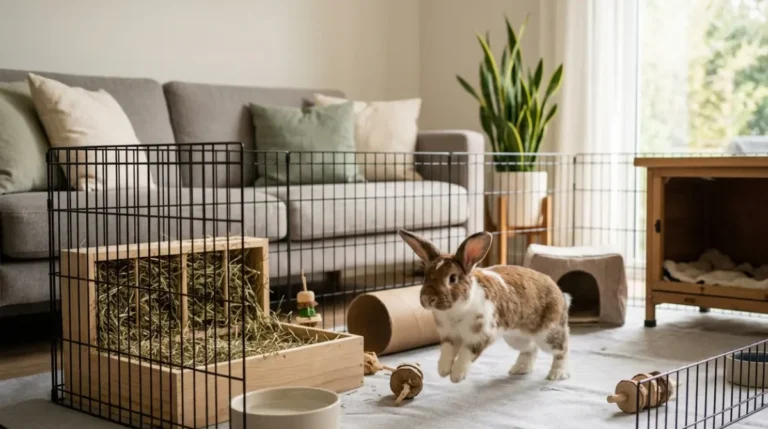
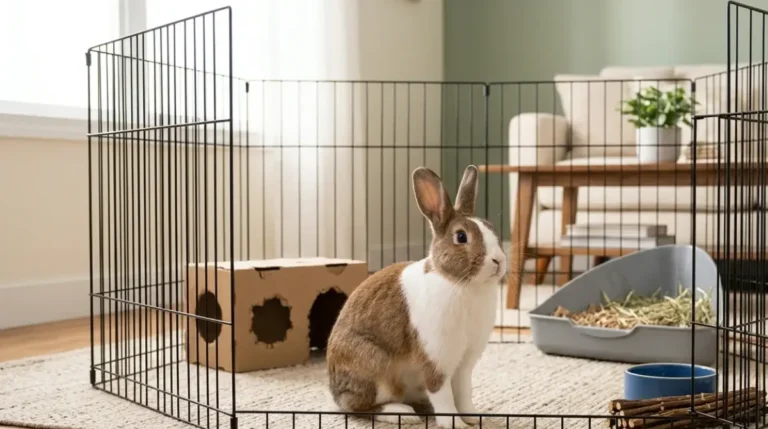
Indoor exercise pen: the most popular setup
An exercise pen (x-pen) is a set of folding panels you arrange to fit your room, and HRS recommends one over a cage. Height matters: Merck advises open-pen sides of at least 4 ft to prevent escape, and the RWAF sets a 1m minimum.
A rabbit-proofed room or free roam
HRS says an untrained rabbit should stay in a pen or closed room when you’re out or asleep. Free roam can follow once it’s trained and the space is rabbit-proofed, with cords protected and gaps blocked. Merck warns chewed wires are dangerous, and VCA adds removing toxic houseplants.
Outdoors: a shed or hutch with a permanently attached run
The RWAF suggests a converted shed, or a hutch inside a bigger enclosure with an always-open attached run. Merck adds airflow, shade, predator protection and a spot you pass daily.
Inside the space: flooring, litter, hay, hides
- Flooring: HRS calls wire floors dangerous for feet and VCA advises avoiding them; Merck accepts them only with a smooth resting area. A solid, washable floor satisfies all three.
- Litter: paper pellets, paper pulp or hay, which Merck calls safe if eaten.
- Hay, water and hides: a hay rack off the floor, fresh water always, and cardboard boxes or tunnels to hide in (Merck).
⚠️ Watch Out: Merck advises against wood shavings, corncob, clay and clumping litter, which can block the gut if swallowed. Sawdust and shavings also make poor bedding because their dust irritates airways.
Indoors or outdoors — which is safer?
Merck says rabbits generally do better indoors in a climate-controlled, ventilated space, and VCA notes outdoor housing adds heatstroke and predator risks.
Already have a hutch? How to turn it into a bedroom
Make your rabbit’s hutch the bedroom of a bigger setup:
- Measure the ground floor only; upper levels don’t count (RWAF).
- Attach a run or pen your rabbit can reach at all times.
- Size the combined space to the standard that fits your routine.
- Cover any wire floor with a solid, washable surface.
- Move the setup into shade with airflow, somewhere you pass daily, or bring it indoors.
Measure what you really have
Measure the ground floor’s inside length, width and height, and compare them with the space table. If your rabbit can’t stand upright inside, the run must carry most of the living space.
Attach a run your rabbit can always reach
The RWAF sees a hutch as a bedroom permanently attached to a large run; an hour a day in the run doesn’t meet that standard.
Fix wire floors and damp bedding
Cover wire floors with a solid resting surface, as HRS, VCA and Merck recommend. Outdoors, check bedding after rain so it doesn’t push your rabbit into its toilet corner.
Why one rabbit in a hutch is two problems
Being alone is the other half of the hutch problem. This section covers domestic rabbits only.
Can a rabbit live alone?
The RWAF advises keeping rabbits in at least friendly pairs, and says a single rabbit still needs the same space. PDSA’s 2025 Animal Wellbeing (PAW) Report found 46% of UK rabbits live alone, over 320,000; we found no comparable US figure.
A PDSA vet nurse notes that rabbits are prey animals that hide distress, so loneliness often goes unnoticed. PDSA’s guide to creating the ideal home for your rabbits treats a companion as part of the home.
Which pairs work best
The RWAF and UK veterinary groups say neutered pairs, often male and female, tend to work best. Merck warns adult rabbits can fight severely, notes neutering can help, and suggests housing them side by side before putting them together.
💡 Keeper Tip: Before adding a second rabbit, ask a rabbit-savvy vet about neutering timing and a health check. Rescues often have bonded pairs to adopt.
Why not a guinea pig?
PDSA’s vet nurses call housing rabbits with guinea pigs a common mistake, and the RWAF advises against it. If your rabbit needs company, the answer is another rabbit.
What should a rabbit eat? Hay first, then greens
For adult domestic rabbits, the RWAF recommends:
- Hay or grass: about 85%, available at all times
- Leafy greens: about 10%
- Pellets or nuggets: about 5%, not muesli
The daily ratio vets recommend
The RWAF bases this on veterinary advice. The Royal Veterinary College’s exotics service puts grass hay or grass at 75–80%, with greens making up most of the rest. Splits differ slightly, but hay always comes first.
🔍 Why It Works: Rabbit teeth grow constantly, and Merck explains that chewing hay helps wear them down. PetMD’s vet-written guide also lists poor diet as a common cause of GI stasis, covered below.
Is muesli bad for rabbits?
Yes. The RWAF advises against muesli-style food, which it links to dental disease, and UK government guidance notes rabbits pick out the tastiest bits. PDSA’s 2025 PAW Report found 42% of muesli-fed rabbits get unlimited access or three-plus tablespoons a day.
Changing food safely
Switch slowly: the RVC advises over a few weeks, and UK government guidance warns sudden changes can make a rabbit very ill. Ask your vet about diets for young, pregnant, elderly or unwell rabbits.
Heat, cold, and the signs that need a vet today
🚨 Vet Now: A rabbit that hasn’t eaten or passed droppings for more than about 8 hours needs a rabbit-savvy vet today, not tomorrow. So does a rabbit that’s drooling, very lethargic or breathing fast and shallow after being somewhere hot.
This is general guidance for domestic rabbits; your vet makes treatment decisions.
Not eating or not pooping: call the vet
PetMD’s vet-written guide says more than eight hours without eating or passing droppings is abnormal, and treats GI stasis, where the gut slows or stops, as an emergency. Other vet sources say 6–12 hours, so don’t wait. Note when your rabbit last ate and pooped, and don’t treat at home without your vet’s direction.
What temperature is too hot for a rabbit?
Merck notes long exposure above 80°F (27°C) can make rabbits sick, and hot, humid conditions can kill, especially in enclosed hutches. Its veterinary rule of thumb: °F plus % humidity shouldn’t top 150 (80°F at 70% is the limit).
The British Veterinary Association lists these signs of heatstroke in rabbits: drooling, lethargy, short shallow breaths, red warm ears, a wet nose and seizures. Move your rabbit somewhere cool, shaded and ventilated, call your vet immediately, and follow their instructions.
Outdoor rabbits in winter
Rabbits handle cold better than heat, but Merck notes they do poorly below 50°F (10°C), can get frostbite, and should come inside during temperature extremes.
Do indoor rabbits need vaccines?
In the US, ask your vet: the House Rabbit Society reports RHDV2 is now endemic, spreads easily through the environment and kills most rabbits it infects. Since mid-2025, single-dose vials of Medgene’s USDA-authorized vaccine let vets vaccinate one rabbit at a time. UK vaccines differ, so ask locally.
For more depth, read the Merck Veterinary Manual’s guide to providing a home for a rabbit, and find a rabbit-savvy vet near you through the House Rabbit Society.
What a proper rabbit setup really costs
Here’s what a welfare-standard indoor pen setup for two rabbits cost us.
Our setup, itemized
| Item | What we bought | Price paid | Where / when | Key detail |
|---|---|---|---|---|
| Exercise pen | [model, panel height] | [$] | [retailer, date] | [footprint achieved] |
| Flooring | [type, size] | [$] | [retailer, date] | Solid, washable |
| Litter box + paper litter | [size, brand] | [$] | [retailer, date] | Safe if eaten (Merck) |
| Grass hay | [type, weight] | [$] | [retailer, date] | Hay first (RWAF) |
| Hides, bowls, hay rack | [items] | [$] | [retailer, date] | Rack off the floor (Merck) |
| Total | [$] |
Where you can save (and where you can’t)
You can save on how you build the space: pen panels, a cleaned secondhand pen or a vinyl floor remnant can meet the standards for less than a premium hutch. You can’t save on floor area, unlimited hay, a neutered companion or an emergency vet fund.
Rabbit housing questions owners ask most
1. Is it cruel to keep a rabbit in a hutch?
A rabbit kept only in a small hutch can’t run, stand fully or escape weather. Use the hutch as a bedroom attached to bigger space.
2. How much space do two rabbits need?
The RWAF says 3m × 2m × 1m of continuous space for two rabbits; HRS suggests 8 sq ft plus 24 sq ft of exercise space.
3. Does the top floor of a hutch count as space?
No. The RWAF says a two-storey hutch’s upper floor doesn’t count toward a rabbit’s footprint, so measure the ground floor only.
4. Is an x-pen better than a cage for a rabbit?
House Rabbit Society recommends an x-pen over a cage for rabbits, because a pen gives more floor space and can grow with your budget.
5. Can a rabbit live alone?
Welfare groups advise against it. A rabbit should live with a compatible rabbit, and a single rabbit still needs the same full space.
6. Is muesli bad for rabbits?
Yes. The RWAF advises against muesli for rabbits because it’s linked to dental disease. Feed unlimited hay, leafy greens and a few plain pellets.
7. What temperature is too hot for rabbits?
Merck says long exposure above 80°F (27°C) can make rabbits sick, especially in hot, humid hutches. If your rabbit drools, seems lethargic or breathes fast and shallow, call a vet now.
8. Is a rabbit not eating an emergency?
Yes. A rabbit not eating or pooping for more than about 8 hours may have GI stasis. Call a rabbit-savvy vet today.
Where to start this week with your rabbit
If you’re reading this with a rabbit in a hutch, you’re already doing what matters: checking that your rabbit has what it needs.
Your one next step
If you change only one thing this week, give your rabbit space it can always reach; the hutch can stay as the bedroom. Then read:
- how to set up a rabbit exercise pen
- turning an old hutch into a bedroom with a run
- how to introduce two rabbits safely
Get the rabbit setup checklist and first-week care printable .
Know your rabbit’s normal eating and pooping: a change lasting more than about 8 hours means a same-day vet call. Find a rabbit-savvy vet now, since exotics vets aren’t everywhere.