How much space a rabbit needs, and how to measure yours

Rabbit space comes down to three measurements. A 4 x 4 ft pen gives about a quarter of the UK footprint; a 10 x 7 ft layout clears it.
Table of Contents
Care guidance checked on October 28, 2026.
A pair of rabbits needs one connected space at least 9’10” long, 6’7″ wide and 3’3″ high (3m x 2m x 1m), open to them day and night, under Rabbit Welfare Association & Fund space guidance. One rabbit needs the same amount, and PDSA rounds the figure to 10 ft x 6 ft x 3 ft for a pair.
Three measurements show whether a setup passes: the longest straight side, the width and the clear height. If your rabbit lives in a hutch today, why a hutch on its own isn’t enough explains what the extra space is for. Square footage alone can make a small setup look adequate.
Where the published minimums disagree
UK charities and US rescues measure different things. The UK figures describe the space rabbits live in around the clock; the House Rabbit Society figure is a home base used alongside daily play.
| Source | Minimum | Applies to | Time in that space |
|---|---|---|---|
| RWAF (UK) | 9’10” x 6’7″ x 3’3″ (3m x 2m x 1m), one connected block | Two average-size rabbits; one rabbit needs the same | All day, every day |
| PDSA (UK) | 10 ft x 6 ft x 3 ft (3m x 2m x 1m) | A pair; larger rabbits need more | Exercise area open all the time |
| Scottish Government (2018) | 10 ft x 6 ft x 3 ft in total, including a 6 x 2 x 2 ft shelter and an 8 x 6 x 3 ft run | Two average-size rabbits | Run ideally attached for constant access |
| House Rabbit Society (US) | 4 ft x 4 ft pen (16 sq ft, 1.49 m²); rest area at least 4 times the rabbit’s size | Most rabbits | Plus 4 or more hours of play daily |
| Merck Veterinary Manual (US) | Cage: 18 x 24 in (46 x 61 cm) small, 24 x 30 in (61 x 76 cm) medium to large, 30 x 36 in (76 x 91 cm) giant | One rabbit | Plus daily supervised time out |
Sources: RWAF, PDSA, Scottish Government pet rabbit welfare guidance, House Rabbit Society housing page, Merck Veterinary Manual.
Why US figures look so much smaller
The HRS pen is a base, with much of the rabbit’s exercise happening outside it. Its housing page says the smaller the rest space, the more time the rabbit needs out of it for play. A 4 x 4 ft pen gives about a quarter of the UK footprint, and HRS pairs it with four or more hours of play every day.
Note: The US figures depend on that play happening daily. If your rabbit can’t count on four hours out of the pen, plan for the UK all-day footprint.
Some pet sites credit the RWAF with an 8 sq ft or 8 x 4 ft minimum. The charity’s published figure is the 3m x 2m footprint in the table.
Measure the longest straight side first
Start with a tape measure laid flat along one side of the space, inside the walls or panels, at floor level.

- Length: the longest straight side needs at least 9’10” (3 m). RWAF sets this length so rabbits can run instead of taking a few hops.
- Width: the side at a right angle needs at least 6’7″ (2 m). A 6 ft side meets PDSA’s 10 x 6 ft figure and comes up 6.7 in (17 cm) short of RWAF’s metric one.
- Height: the clear height to any roof needs at least 3’3″ (1 m) for RWAF, which wants room for jumping and binkies, the twisting leap of a happy rabbit. PDSA and the Scottish Government use 3 ft (91 cm).
Area alone doesn’t settle it. RWAF points out that an 8 x 8 ft space covers 64 sq ft and still lacks the 3m length. Its corner-to-corner line is about 11.3 ft (3.45 m), yet RWAF counts the space as short, so take the length along a side.
The space also has to be one connected block that the rabbits can reach around the clock.
What counts as floor space for a rabbit?
Ground level only. The upper floor of a two-story hutch is left out of the footprint, and so are raised platforms and connecting tunnels, even though RWAF encourages them as enrichment.
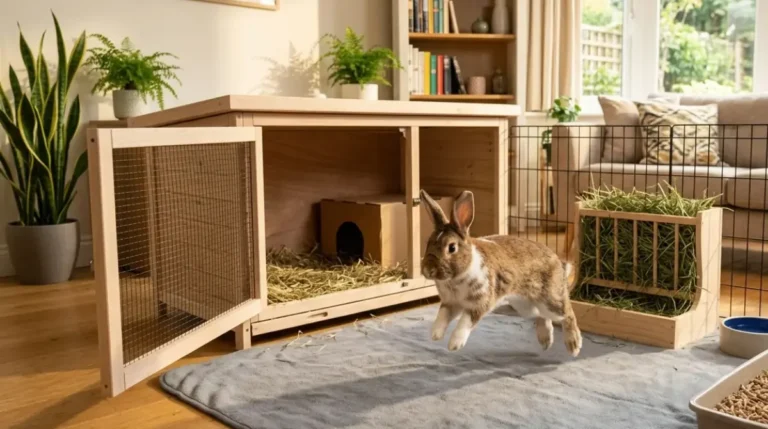
A hutch can sit inside the space as sleeping quarters, at a minimum of 6 x 2 x 2 ft (1.8 x 0.6 x 0.6 m), and its floor counts toward the footprint. A hutch is never the sole or main home (RWAF). Using a hutch as the bedroom of a larger setup covers how to connect one.
Supervised free-range time in the house adds space on top of the minimum. It doesn’t replace any of it.
Before you buy: compare only the ground floor of a hutch listing with 9’10” x 6’7″ (3m x 2m).
Common hutches and pens, converted and checked
A 4 x 1.5 ft pet-shop hutch covers 6 sq ft (0.56 m²), under a tenth of the UK minimum. The table converts the setups owners most often start with.
| Setup | Floor area | Longest side | Meets RWAF 9’10” x 6’7″? |
|---|---|---|---|
| Pet-shop hutch, 4 x 1.5 ft | 6 sq ft (0.56 m²) | 4 ft (1.22 m) | No, about 9% of the area |
| RWAF hutch minimum, 6 x 2 ft | 12 sq ft (1.11 m²) | 6 ft (1.83 m) | No, bedroom only |
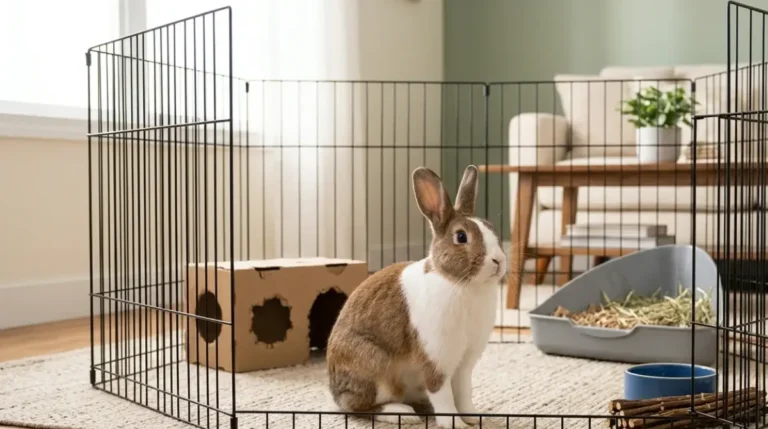
| One exercise pen, 4 x 4 ft | 16 sq ft (1.49 m²) | 4 ft (1.22 m) | No, about 25% |
| Two pens joined, 4 x 8 ft | 32 sq ft (2.97 m²) | 8 ft (2.44 m) | No, about 22 in (56 cm) short on length |
| 8 x 8 ft | 64 sq ft (5.95 m²) | 8 ft (2.44 m) | No, length short |
| 10 x 6 ft | 60 sq ft (5.57 m²) | 10 ft (3.05 m) | Length yes, 6.7 in (17 cm) short on width |
| 10 x 7 ft | 70 sq ft (6.50 m²) | 10 ft (3.05 m) | Yes |
| RWAF minimum, 3m x 2m | 64.6 sq ft (6 m²) | 9’10” (3 m) | Yes |
Floor area is length times width; metric conversions use 1 ft = 0.3048 m. Minimum figures from the RWAF space recommendations.
The 10 x 6 ft row is where the UK sources part ways. It meets PDSA and the Scottish Government on paper and misses RWAF’s 2m width by a few inches, while a 10 x 7 ft layout clears all three.
Giant rabbits need a longer run
Scottish Government guidance puts a giant rabbit’s hop at up to 4.5 ft (1.37 m) and says housing for rabbits that size has to be much bigger.
Hop length and the run
The same guidance asks for room for three big hops from one end of the shelter to the other. For a giant, three hops come to about 13.5 ft (4.11 m), well past the 9’10” length. The published minimums are written for average-size rabbits (RWAF), so for a Flemish Giant or a similar breed, plan the long side around three of its own hops.
How tall your rabbit stands
Medium-size rabbits are likely to need at least 75 cm (about 30 in) of height to stand fully without their ears touching the roof (Scottish Government). That is taller than the 2 ft (61 cm) height in the sleeping-quarters minimum, so a rabbit sitting up needs the taller main space. To check your own rabbit, note the height of its ear tips while it sits up on its hind legs and compare that with the lowest point of any roof.
Merck’s giant-breed cage height of 16 to 18 in (41 to 46 cm) is a cage minimum paired with daily time out. For open pens, Merck sets sides of at least 4 ft (1.2 m) to stop escapes.
Tape 9’10” by 6’7″ on the floor before you buy
Painter’s tape shows the footprint before any money is spent. Run 9’10” (3 m) along one wall and 6’7″ (2 m) out from it, or about 13.5 ft (4.11 m) along the wall for a giant breed.
If the outline doesn’t fit, the measurement that failed tells you what to change, and for most pens and hutches it is the length. Any hutch you already own can stay inside the outline as the bedroom. For the pen itself, how many x-pen panels make that footprint gives counts for each layout, and setting the pen up in a room corner covers placement and flooring.