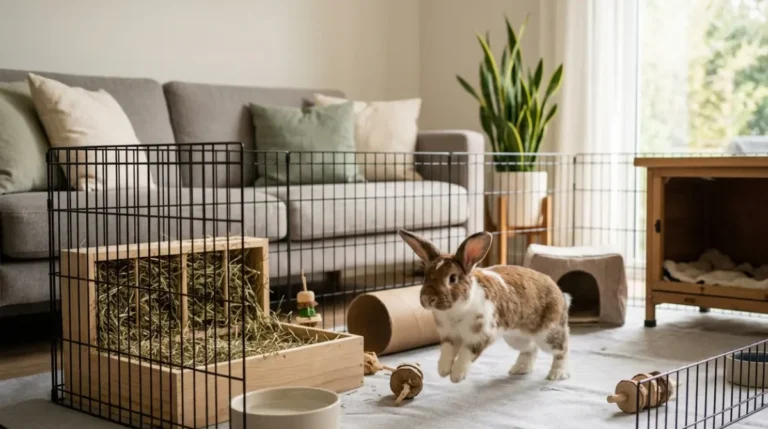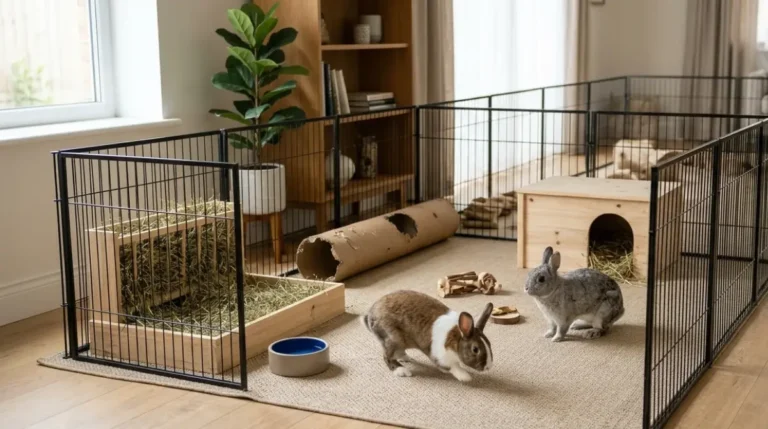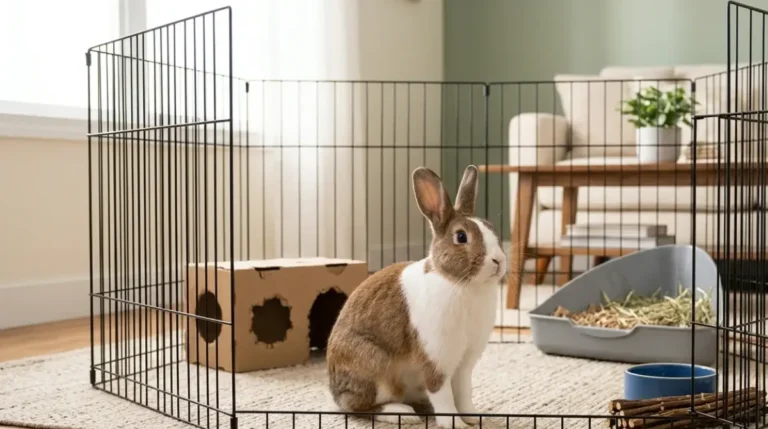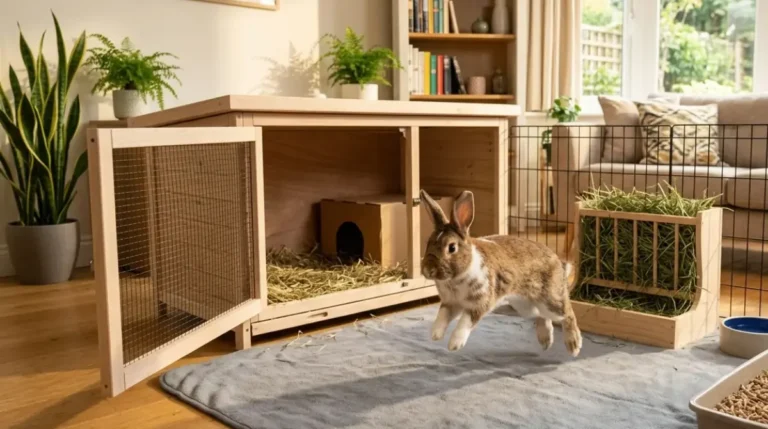
Indoor rabbit pen setup, from the floor up

Indoor rabbit pen setup for a pair takes nine 24-inch panels in a room corner to reach the UK 3 x 2 m footprint, with the floor laid before any panel.
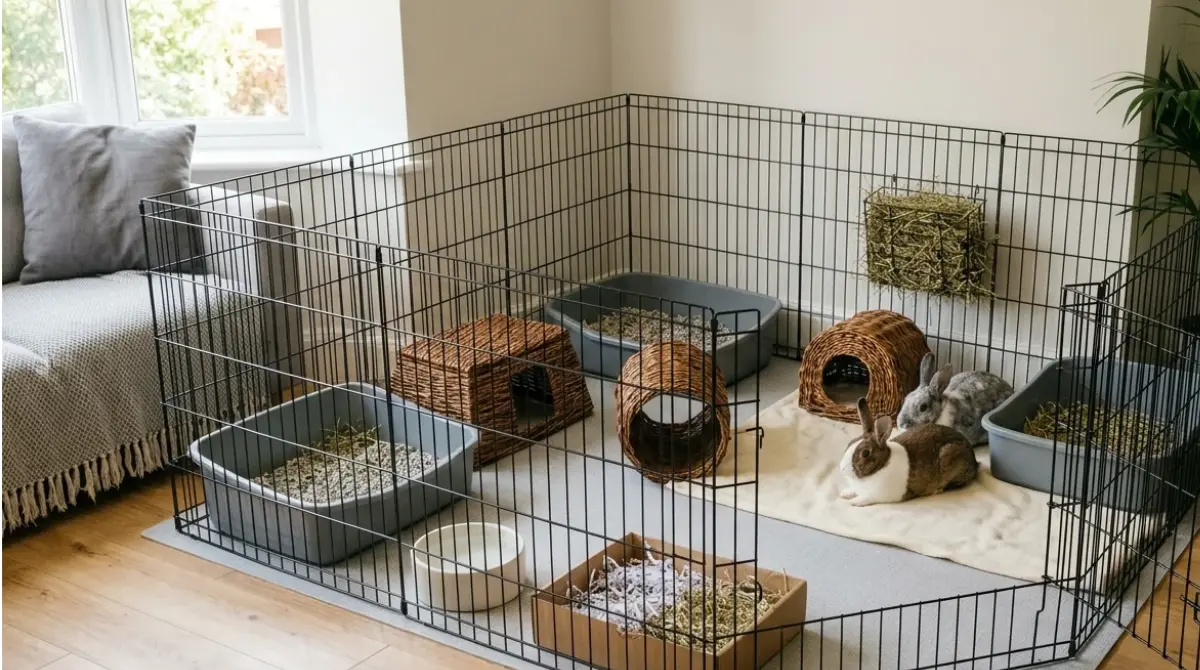
Table of Contents
Care guidance checked on October 28, 2026.
Two rabbits need one unbroken floor of at least 9’10” x 6’7″ (3 x 2 m) under UK welfare guidance. With standard 24-inch pen panels, that takes 9 panels in a room corner, 13 along one wall or 18 standing free. Every one of those panels stands on a solid, non-slip floor, so the floor goes down first.
Panels you need for each room layout
Nine panels is the smallest count that encloses the full footprint, and only in a corner. The Rabbit Welfare Association & Fund (RWAF) space recommendations ask for one single block of floor, at least 1 m (3’3″) high, open to the rabbits at all times. The 3 m length is what lets rabbits break into a run, and a single rabbit needs the same space as a pair.
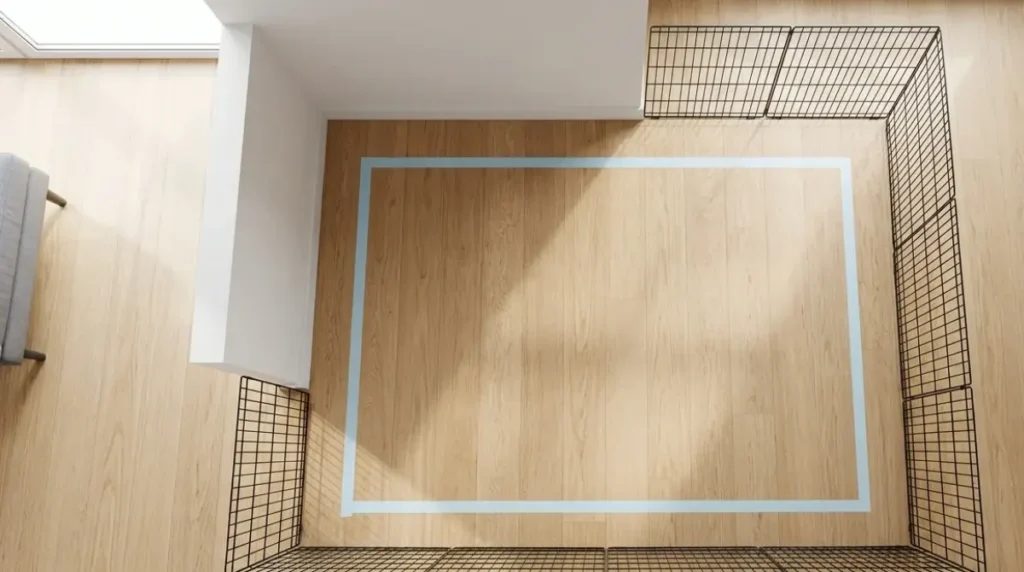
Standard exercise pen panels are 24 inches wide (The Rabbit Haven; MidWest’s 8-panel pen listing gives eight of them, 16 feet of fence in all). That means 6’7″ has to round up to 8 feet. The pen you build is 10 x 8 feet: five panels long, four deep.
| Layout | 24-inch panels | 8-panel pens to buy | Floor enclosed | Meets the RWAF footprint |
|---|---|---|---|---|
| One pen, squared | 8 | 1 | 4 x 4 ft (16 sq ft) | No |
| One pen in a room corner | 8 | 1 | Up to 8 x 8 ft (64 sq ft) | No, longest side 8 ft (2.4 m) |
| Room corner | 9 | 2 | 10 x 8 ft (80 sq ft, 7.4 m²) | Yes |
| Long side against one wall | 13 | 2 | 10 x 8 ft | Yes |
| Freestanding | 18 | 3 | 10 x 8 ft | Yes |
Footprint from the RWAF; panel width from The Rabbit Haven and MidWest’s listing. Each side is rounded up to whole 2-foot panels.
The second row is the near miss. One pen opened into a corner covers 64 square feet, almost the area of the RWAF footprint. But its longest side stops at 8 feet (2.4 m), short of the 3 m run. A ninth panel from a second pen fixes that. The leftover panels don’t have to come off, because The Rabbit Haven overlaps two or three panels and clips them together to shorten a side.
US guidance works differently, with a smaller home base and daily free-roam time on top; how the UK and US rabbit space standards compare sets the two side by side.
Lay the floor before the panels
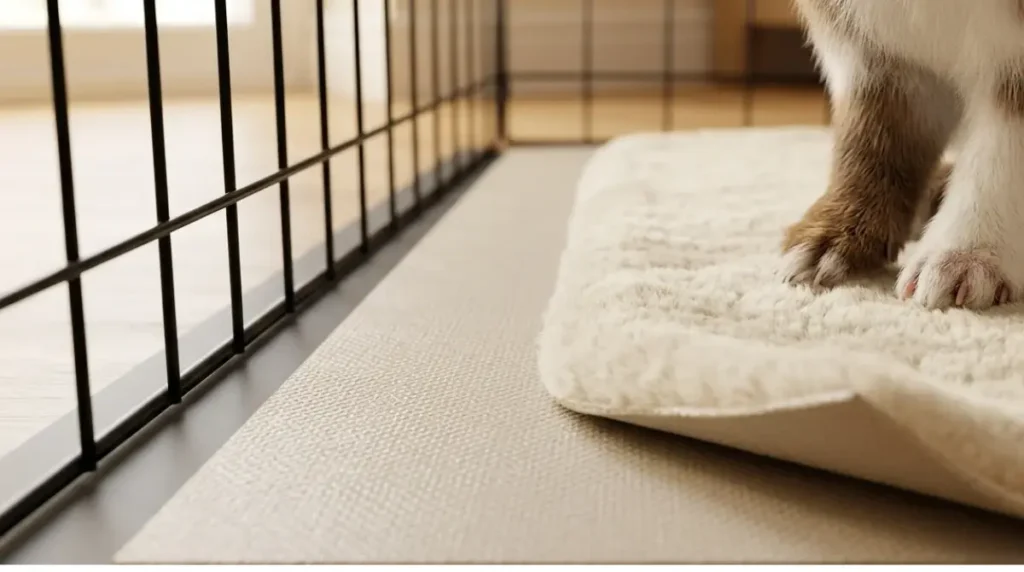
Tape out the footprint first, then build up from it. Rabbits have furry feet with no pads, so they slip on smooth surfaces (RWAF indoor housing advice). Shiny laminate and tiles are slippery and stressful for them, and mesh flooring causes problems with their feet (RSPCA advice on keeping rabbits indoors).
- Mark 9’10” x 6’7″ on the floor with tape, in the corner or along the wall you plan to use.
- Lay a waterproof base, such as a sheet of lino or a shower-curtain liner, cut large enough that the panels can stand on it (The Rabbit Haven).
- Give the surface grip: non-slip or textured lino with fleece or vet bed on top (RWAF).
- Stand the panels on the base and clip every joint.
- Turn the door panel toward the side you reach in from to change the litter trays.
Carpet on its own is no shortcut. Some carpets can burn rabbits’ feet, and a non-slip lino offcut or a blanket laid over the carpet avoids that (RWAF).
Note: Mats and rugs suit rabbits that leave fabric alone (RWAF). If yours chews them, switch the pen to textured lino and check the litter trays daily for anything it has swallowed.
Why do rabbits get stuck in puppy pen bars?
The RWAF warns that rabbits in puppy pens and dog crates can trap a leg, or a head, between the bars, and its fix is to cover the bars with mesh. For small rabbits, the San Diego House Rabbit Society reinforces pen bars with grids that have tighter spacing. Measure the gap between the wires on your own pen. If a rabbit’s head could fit through, add mesh before the rabbits move in.
Before you buy: check that the door opens sideways, and ask the seller how wide the gap between wires is, or measure it in the store.
The door matters as much as the bars. A gate that swings open to the side keeps feet from catching as rabbits hop in and out, and it should be wide enough to pass a large litter tray through (San Diego House Rabbit Society).
Height comes last. A 1 m (3’3″) height lets rabbits jump and binky (RWAF), while 30-inch pens suit most rabbits and 36-inch pens suit jumpers (The Rabbit Haven). A rabbit that still clears the top can have a removable lid made from shade cloth (San Diego House Rabbit Society). The full range of heights, and the rabbits each one suits, is laid out in choosing a rabbit pen and how tall it should be.
Trays, hides and hay: counts for a pair
If two rabbits share the pen, the RSPCA’s count of one per rabbit plus one extra means three hides and three litter trays. The sleeping area also needs room for both to rest together.
| Item | For a pair | What to check | Source |
|---|---|---|---|
| Hides | 3 | An entrance and an exit, one at each end | RSPCA, RWAF |
| Litter trays | 3 | Placed away from where they sleep | RSPCA |
| Litter | In every tray | Paper-based and non-clumping; nothing clay-based or pine | RSPCA, RWAF |
| Hay | Always available | A pile next to each tray | RWAF |
| Sleeping area | 1 | Room for both rabbits together | RSPCA |
Sources: RSPCA advice on keeping rabbits indoors; RWAF indoor housing advice.
Hay sits beside the trays because rabbits like to eat and toilet at the same time. Start each tray in the spot the rabbits have already chosen to go (RWAF).
A hutch you already own can be the sleeping area, as long as its door stays open into the pen. Using a hutch as the bedroom inside a pen covers the minimum hutch size.
Picking the spot in the room
Between 50 and 68°F (10 and 20°C) is the ideal range for rabbits. The pen belongs out of drafts and away from radiators or fires, in a quiet part of the home (RSPCA). If the room runs warm in summer, learn the heat signs that need a same-day vet. A sunroom or conservatory can get very hot in summer, which rules it out unless you can control the temperature (RWAF).
Cables and baseboards get chewed first
Anything a rabbit can reach through or over the panels counts as part of the pen. Exposed cables draw rabbits much as roots do when they burrow, so cover them with cable protector or route them out of reach (RWAF). Baseboards and door frames are rabbit favorites too, and a pen built along a wall puts them inside chewing range.
Treat every houseplant as poisonous, because so many are, and keep them where no leaf or petal can drop into the pen (RWAF, RSPCA). Cats and dogs stay outside the panels unless you are there to supervise (RSPCA).
A dig box of shredded paper inside the pen gives rabbits somewhere to dig, and busy rabbits are less likely to chew fixtures and fittings (RSPCA).
The first 48 hours in a new pen
For the first two days, leave new rabbits inside the enclosure so they can get used to new sounds and smells and learn where the trays are (RSPCA). Familiar-smelling toys and used but unsoiled bedding help them settle. Bedding from rabbits you kept before has the opposite effect, because the scent of unfamiliar rabbits stresses them (RSPCA).
Rabbits moving in from outdoors carry a winter coat and can find a heated house too warm. Bring them into an unheated room first and raise the temperature slowly; once they come in for winter, they stay in until spring (RWAF).
Check the trays every day while they settle (RWAF). A rabbit that stops passing droppings can become a medical emergency (RSPCA), so call a vet experienced with rabbits that same day.