The Best Rabbit Hutch Is a Bedroom, Not Your Bunny’s Home

Best rabbit hutch shopping? Even a 6 x 2 ft hutch is just the bedroom. See the space your rabbit needs and the pen that gives it.
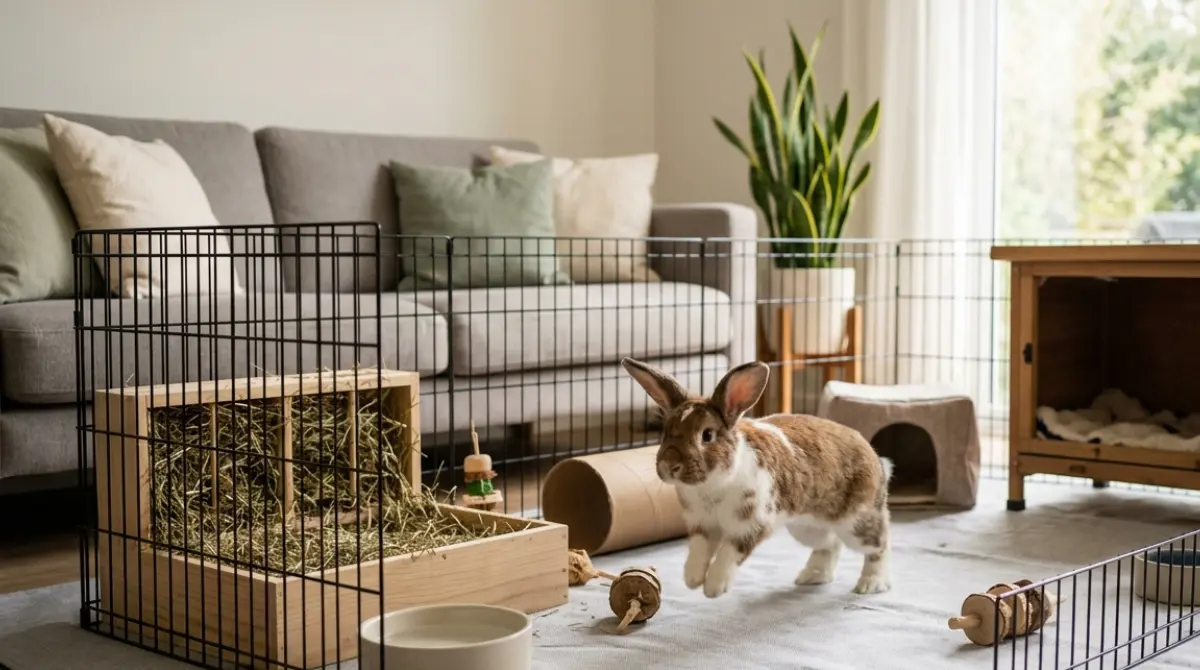
Table of Contents
The best rabbit hutch is the one used as a bedroom
If you’re shopping for the best rabbit hutch, here’s our honest answer first: no hutch works as a rabbit’s whole home. The Rabbit Welfare Association & Fund (RWAF) says a hutch should never be a rabbit’s only or main accommodation, and it doesn’t endorse any hutch brand.
Our short answer
Buy the space first, then the bedroom. For most indoor rabbits, that means an exercise pen, with any hutch used as a sleeping area that opens onto it.
Jump to your situation
- Indoor rabbit: read why we recommend a pen, then what to look for when you buy one.
- Outdoor rabbit: go to the outdoor section for heat, predator, and disease risks.
- Already own a hutch: skip to the last section. You don’t need to throw it out.
🩺 Health Note: This article includes general information about heat and disease risks for outdoor rabbits. It is not a substitute for an exam by a vet experienced with rabbits. If your rabbit seems overheated or unwell, contact a rabbit-savvy vet right away.
Why a hutch alone isn’t enough
Rabbits need room to run, jump, and stand fully upright, and a hutch on its own can’t give them that. That’s the core reason a hutch isn’t enough for a pet rabbit.
The upper floor doesn’t count
RWAF is explicit: the upper level of a two-story hutch doesn’t count toward a rabbit’s floor space, and neither do platforms or tunnels. Its minimum hutch size of 6 × 2 × 2 ft applies only to sleeping quarters inside a much larger space.
🔄 Outdated Advice: “A two-story hutch doubles the space.” Only the ground footprint counts, according to RWAF’s space recommendations. Measure the floor, not the levels.
What cramped housing does to rabbits
A University of Bristol study of pet rabbit pairs found stress hormone levels were highest in pairs kept in small hutches with restricted run access. Its findings now inform RSPCA housing advice. Wire floors add a second risk: sore hocks (pododermatitis), painful sores on the hind feet.
How much space does a rabbit actually need?

The two most-cited standards agree that a rabbit needs far more than a hutch, but they measure the space differently.
| Standard | Minimum space | Time in that space | Key Detail |
|---|---|---|---|
| RWAF (UK) | 3 m × 2 m footprint, 1 m high (≈ 9’10” × 6’7″ × 3’3″) for an average-size pair | All day, every day | The 3 m length must be one unbroken run |
| House Rabbit Society (US) | 4 × 4 ft exercise pen as home base | Plus 4+ hours of active play outside it daily | The smaller the rest space, the more time out |
| RWAF hutch minimum | 6 × 2 × 2 ft | Must open onto the larger space | Bedroom only, never the main home |
Sources: RWAF space recommendations; House Rabbit Society housing guidance.
📊 Tested / Spec: Calculated from the sourced dimensions above. RWAF’s footprint is 6 m², about 64.6 sq ft. That’s roughly four times a 4 × 4 ft pen (16 sq ft) and more than five times a 6 × 2 ft hutch (12 sq ft).
The UK standard: 3m × 2m × 1m, all the time
RWAF says this space must be available at all times, indoors or outdoors, as one continuous block. An 8 × 8 ft area gives 64 sq ft, but it still falls short because it lacks the 3 m length rabbits need to run.
The US approach: a pen plus daily free-roam time
The House Rabbit Society’s housing guidance calls a 4 × 4 ft pen with free-roam access an ideal setup for most rabbits. It pairs that pen with at least four hours of active play each day.
One rabbit or two?
RWAF says a single rabbit still needs the same minimum space as a pair. These figures are for average-size rabbits, and giant breeds need more. For the full breakdown, see our guide to rabbit space requirements in the US and UK.
Why we recommend an exercise pen instead
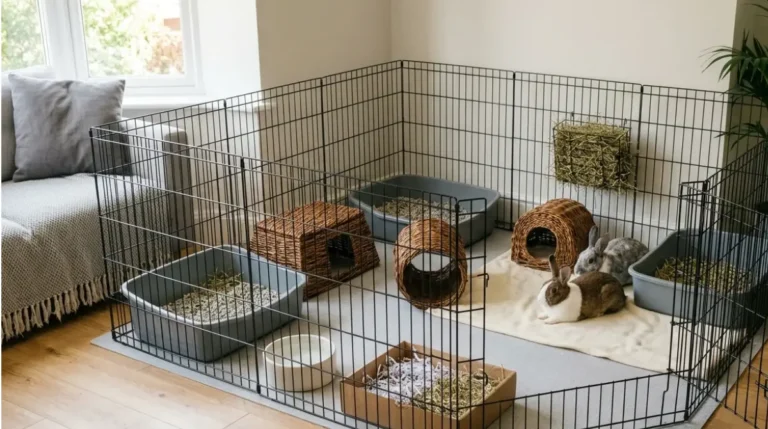
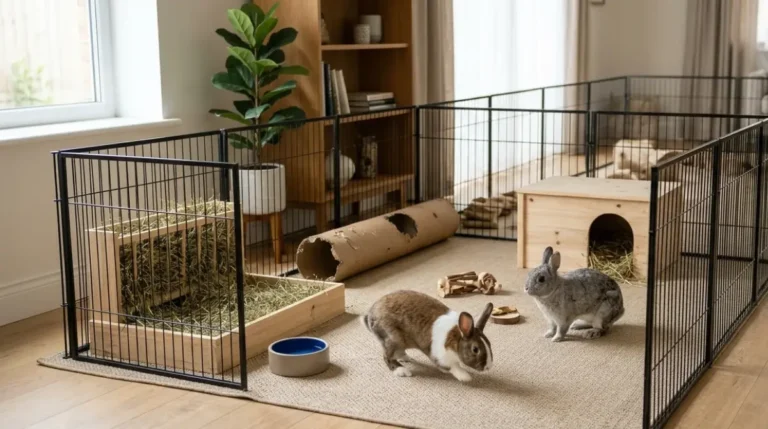
For indoor rabbits, an exercise pen is the simplest way to give more room than any hutch. The House Rabbit Society notes that metal pens have become the most popular rabbit housing in recent years.
Hutch vs pen at a glance
| Feature | Typical hutch | Exercise pen |
|---|---|---|
| Floor space | Fixed; upper levels don’t count | Expands by adding panels |
| Flooring | Often wire or a tray | You choose a solid, cushioned floor |
| Meets HRS or RWAF guidance? | Rarely on its own | Can, depending on panel count |
| Best For | A bedroom inside a larger space | Most indoor homes |
The trade-offs nobody mentions
House Rabbit Society habitat guidance flags real downsides. Children and energetic rabbits can shift or tip a pen, and an open top gives cats easy access.
⚠️ Watch Out: Jumpers can clear a low pen. If your rabbit leaps, choose taller panels or a secure lid, and supervise other pets around an open-top pen.
What to look for in a rabbit pen setup
A good rabbit exercise pen setup comes down to enough floor space, tall enough walls, a solid floor, and the right furnishings. We haven’t hands-on tested specific pen models for this article yet. The criteria below come from welfare guidance, and we’ll add tested picks once our trials are done.
Height and panels
Count enough panels to reach your target footprint from the table above. RWAF recommends living space at least 1 m (about 39 in) high so rabbits can jump and binky. Our guide to rabbit pen setup with panels walks through layouts.
Floor: never bare wire
The House Rabbit Society recommends a blanket or other cushioned flooring, with a sheet of vinyl underneath to protect your floor. Bare wire puts your rabbit at risk of sore hocks.
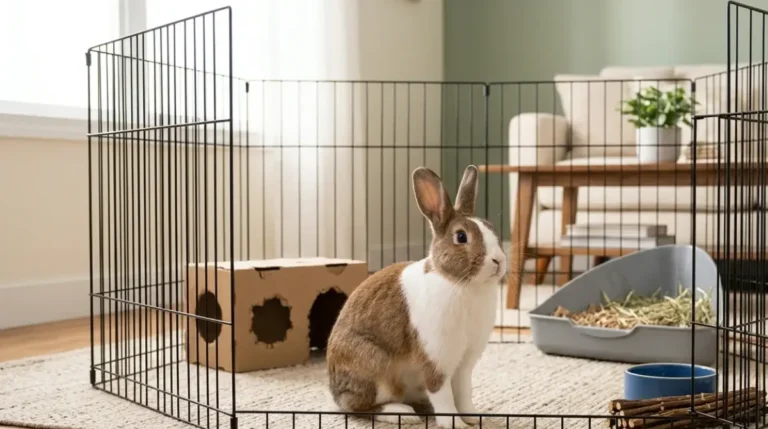
The four things inside every pen
- A hiding place
- A litter box with hay
- Water and food bowls
- Toys for chewing and digging
✅ Do This: Measure the floor area you can give your rabbit before you buy anything. That number decides how many panels you need.
If your rabbit lives outdoors
Outdoor rabbits need the same space as indoor rabbits, plus protection from heat, predators, and disease.
⚠️ Watch Out: The Merck Veterinary Manual’s rabbit housing guide warns that long exposure above 80°F (27°C) can make rabbits sick. Hot, humid conditions in an enclosed hutch can cause heat stress or death. If your rabbit seems overheated or unwell, contact a vet experienced with rabbits immediately.
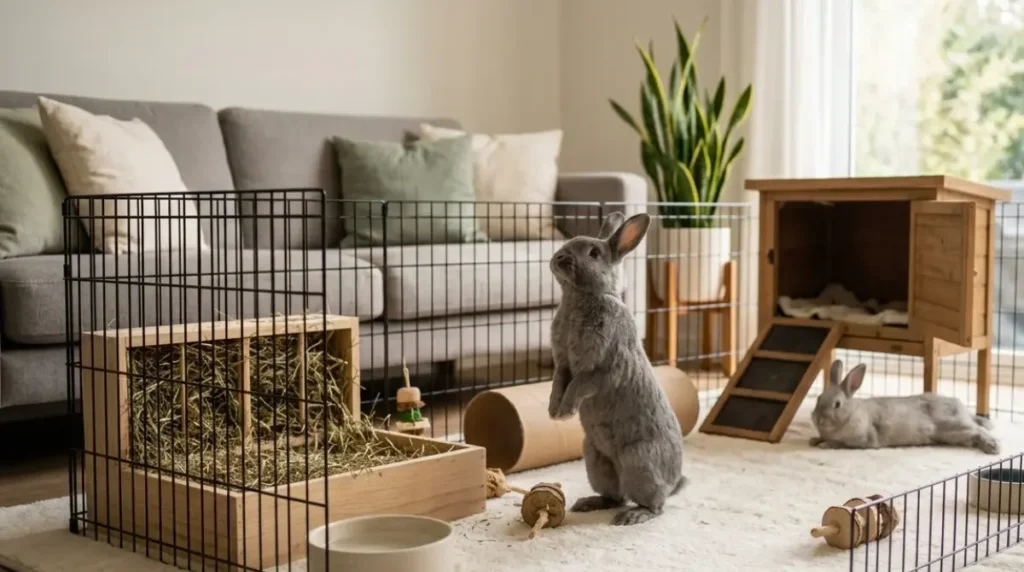
The hutch becomes the bedroom, attached to a run
RWAF’s 3 × 2 × 1 m minimum applies outdoors too, so the hutch must open onto a run your rabbit can reach at all times. Merck describes long-term outdoor enclosures as predator-proof, with small-gauge wire, a closed top, and protection against digging.
Heat, predators and RHDV2
Give outdoor rabbits shade and airflow, and bring them inside during temperature extremes. In the US, the USDA APHIS fact sheet on rabbit hemorrhagic disease describes RHDV2 as a fatal foreign animal disease and advises keeping wild and other rabbits away from yours. Ask your vet whether RHDV2 vaccination is recommended where you live.
Already bought a hutch? Here’s how to use it
If you already own a hutch, you haven’t wasted your money. You’ve bought the bedroom.
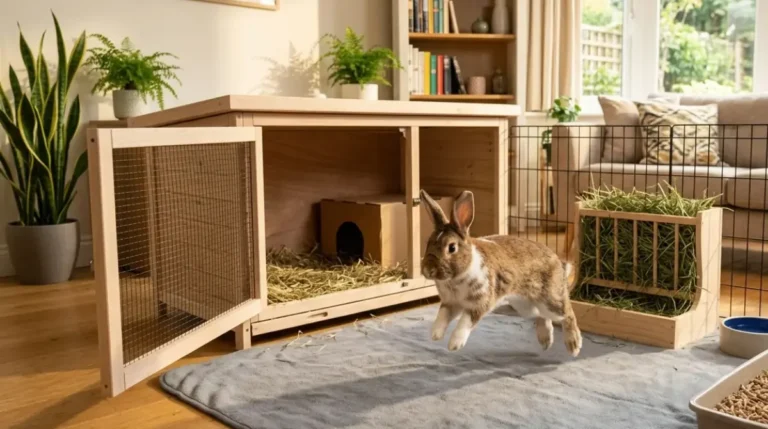
Open the door into a pen or run
RWAF describes small hutches as useful open-door retreats inside a larger space. Attach yours to a pen indoors or a secure run outdoors, and leave the door open around the clock. A small enclosure also helps when a vet advises restricted space, such as after surgery.
Cover any wire floor
Lay solid, cushioned flooring over any wire base to protect your rabbit’s hind feet.
Frequently asked questions
1. What is the best rabbit hutch?
The best rabbit hutch is used only as a bedroom that opens onto a larger enclosure. RWAF says a hutch should never be the main home.
2. What size rabbit hutch do I need?
RWAF’s minimum rabbit hutch size is 6 × 2 × 2 ft, used as sleeping quarters inside at least 3 × 2 m of space.
3. Is it cruel to keep a rabbit in a hutch?
A hutch as a rabbit’s only home falls short of welfare guidance. A Bristol study linked small hutches and limited run access to higher stress.
4. Do two-story rabbit hutches count as double space?
No. RWAF says the upper floor of a two-story rabbit hutch doesn’t count toward floor space; only the ground footprint does.
5. Is an exercise pen better than a rabbit hutch?
For most indoor rabbits, yes. An exercise pen expands with panels, takes a solid floor, and can meet HRS or RWAF guidance.
6. How tall should a rabbit pen be?
RWAF recommends rabbit living space at least 1 m (about 39 in) high. Jumpers may clear lower pens, so add height or a lid.
7. Can rabbits live outside in a hutch?
Outdoor rabbits can use a hutch as a bedroom attached to a predator-proof run, with shade, airflow, and shelter from extremes. If your rabbit seems overheated or unwell, contact a vet experienced with rabbits right away.
8. Does one rabbit need less space than two?
No. RWAF says one rabbit needs the same minimum space as a pair: a 3 × 2 m footprint, 1 m high.
9. What flooring goes in a rabbit pen?
Use cushioned flooring such as a blanket over a vinyl sheet in a rabbit pen. Avoid bare wire, which is linked to sore hocks.
10. How long should a rabbit be out of its enclosure?
The House Rabbit Society recommends at least four hours of active play daily for a rabbit living in a 4 × 4 ft pen.
The setup to buy first
Skip the hunt for a bigger box. Give your rabbit continuous space that meets RWAF guidance where you can, and never less than the House Rabbit Society’s pen-plus-play standard. Use any hutch only as the bedroom, and measure your floor before you buy.