Choosing the Right Gerbil Tank Setup for a Pair

A gerbil tank setup for Mongolian gerbils starts with a pair, then depth: why “20 gallons” can mean two very different tanks.
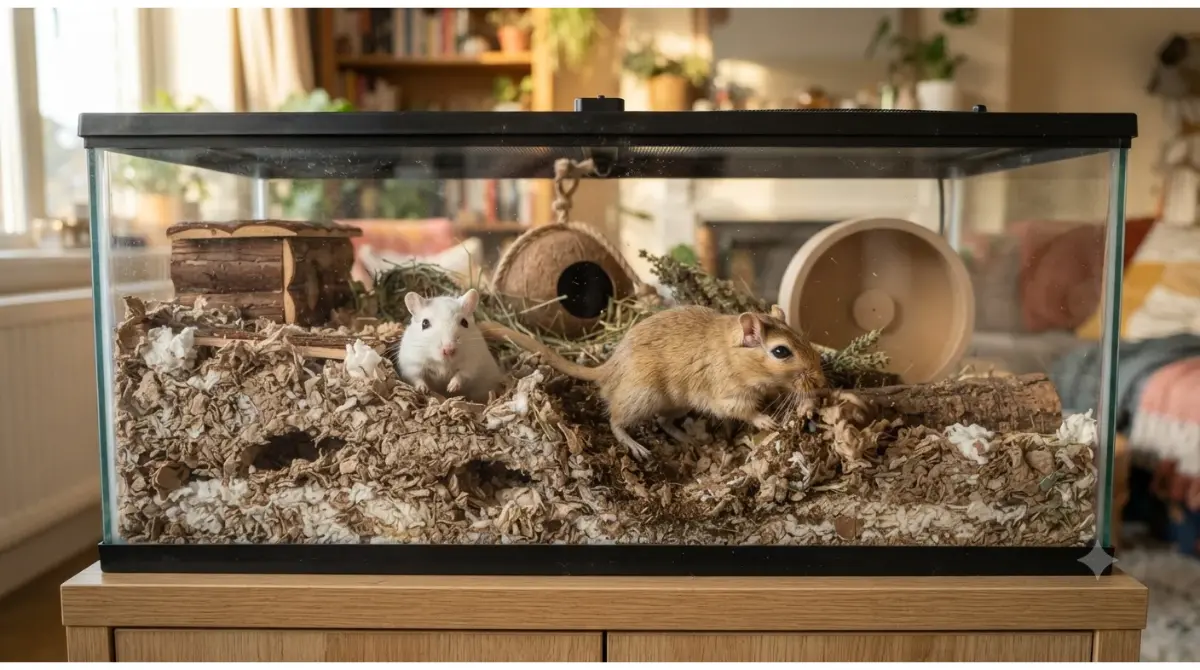
Table of Contents
🚨 Vet Now: If a gerbil’s tail skin has come off or is bleeding, a leg or foot is stuck or limp, there are bite wounds, or breathing looks hard, call a vet experienced with gerbils now instead of waiting to see if it settles. Tail skin that has pulled away can rot and may need surgery to remove.
Gerbils need a pair, deep bedding, and a glass tank
This guide covers Mongolian gerbils and the three choices that decide whether a setup works: company, depth and the enclosure.
The RSPCA’s guidance comes down to a same-sex pair, 20–30 cm (about 8–12 inches) of bedding, and a tank with solid glass walls and a secure mesh top. Where sources disagree, on floor space, bedding depth and temperature, you’ll see each figure with who said it instead of one number picked for you.
If something is wrong right now
Start with the red box above, then go to the injury section near the end.
If you’re still deciding
Gerbils are social, so you’d be taking on at least two. If you’re comparing them with hamsters, don’t assume the numbers carry over; the hamster cage size guide covers hamsters only.
If you brought gerbils home yesterday
A starter cage is fixable. Sections 3 to 5 show what to check and what to change.
If you’re upgrading a setup
Jump to the headroom table in the tank-size section. It shows why the same “20 gallons” can be very different homes.
🩺 Health Note: This is general information, not a substitute for an exam by a vet experienced with gerbils. Gerbils can lose the skin of the tail if it’s grabbed, and can be hurt by fights, wheels or mesh floors. Any injury, bleeding, limping or hard breathing needs a vet; if you don’t have an exotics vet yet, find one before you need one.
Why gerbils shouldn’t live alone — and who can pair up
The pair comes before the tank, because the RSPCA says gerbils need other gerbils.

Can gerbils live alone?
No. The RSPCA says gerbils should never be kept on their own, and notes that wild groups range from two to 15 animals.
Same-sex pairs and littermates
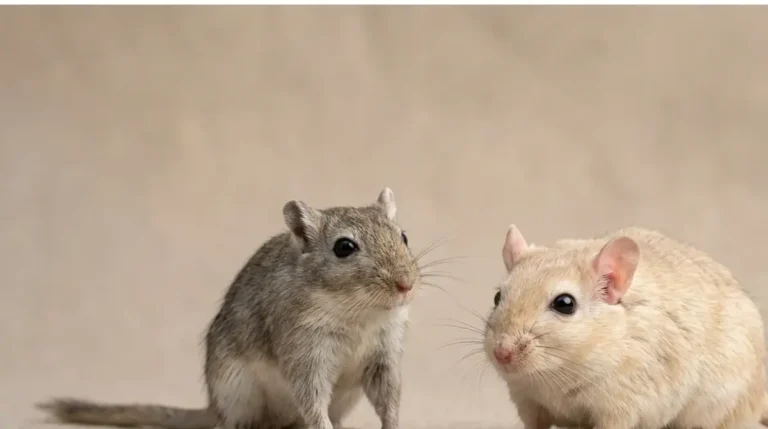
The RSPCA says same-sex pairs or groups work when they’re formed early in life and stay stable. Young littermates, or members of a harmonious group, lower the risk of aggression.
Check regularly for aggression, and be ready to separate gerbils that fight. Merck notes that fighting wounds can leave patches of missing hair around the tail and hindquarters.
Can male and female gerbils live together?
The RSPCA advises against it unless you can provide for the young and find good homes for the offspring. Breeding is outside this guide; a vet experienced with gerbils or an experienced rescue can advise.
If one gerbil is left alone
This is the hardest case. The RSPCA says unfamiliar adult gerbils housed next to each other can find it stressful, and it describes keeping young gerbils separate but adjacent for about a week before introducing them to a group.
For an adult left alone, ask an exotics vet or an experienced gerbil rescue to guide you before you try an introduction. A poor introduction can mean injuries.
How big a tank do two gerbils need? What sources say
No single figure is agreed. Merck’s rule of thumb is about 10 gallons for two, vet-media and retailer guides run 20 to 40 gallons, and rescue practice targets about 100 cm by 50 cm. The RSPCA gives no floor number on its housing page; it asks for a gerbilarium large enough to shelter, dig and exercise, ideally about 50 cm high.
The numbers, source by source
| Source | Type | Figure for a pair | Key detail |
|---|---|---|---|
| Merck Veterinary Manual | Veterinary reference | About 10 gallons (5 per gerbil) | Rule of thumb; fish tank with mesh lid |
| PetMD | Vet-media care sheet | At least 20 gallons | Avoids plastic habitats |
| Chewy | Retailer guide | 40 gallons “often” the minimum | No source given |
| NC3Rs | Research-lab standard | 1,200 cm² enclosure; 150–250 cm² per gerbil | Lab minimum, not a pet standard |
| Greatfield rescue; gerbilcare.co.uk | Rescue and keeper practice | About 100 × 40–50 cm | Practice, not regulation |
| RSPCA | Welfare charity | No floor figure on housing page | Tank about 50 cm high |
📊 Tested / Spec: 100 × 50 cm is 5,000 cm², about 775 square inches. A 40-gallon breeder floor of 36 × 18 inches is 648 square inches, about 84% of that.
We treat the lower figures as floors for a pair, not targets. Merck’s number is a rule of thumb, and the laboratory figure is a research minimum, not a pet standard.
Why “20 gallons” isn’t one size
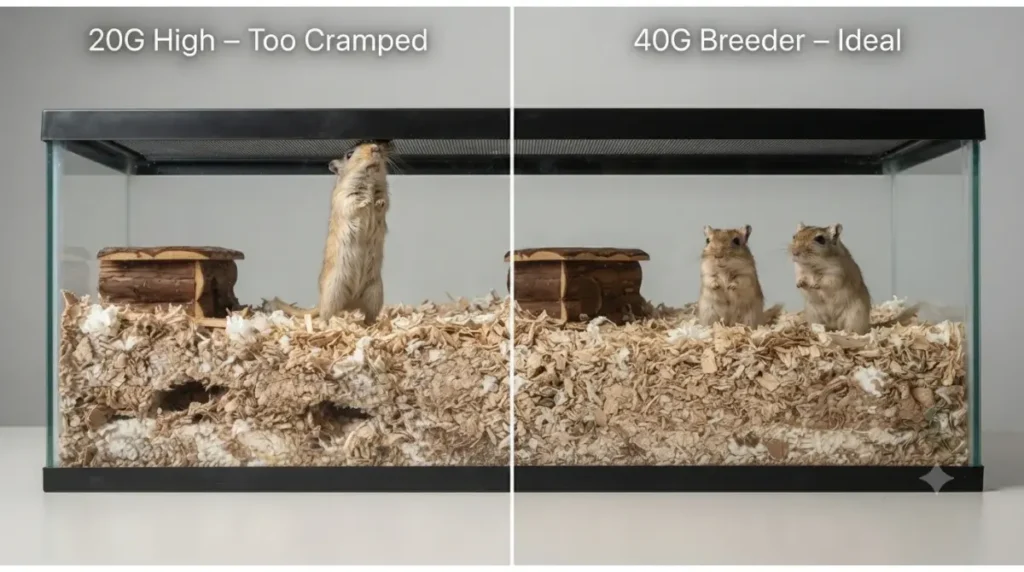
A gallon rating measures volume, not floor or height. A 20-gallon long is 30 × 12 × 12 inches, while a 20-gallon high is 24 × 12 × 16 inches, so the long has more floor and the high has more height.
The headroom table: floor plus height
| Tank (nominal) | Size (in) | Floor | Height | Most bedding that leaves 12 cm headroom |
|---|---|---|---|---|
| 20-gallon long | 30 × 12 × 12 | 360 sq in (≈2,320 cm²) | ≈30 cm | ≈18 cm |
| 20-gallon high | 24 × 12 × 16 | 288 sq in (≈1,860 cm²) | ≈41 cm | ≈28 cm |
| 40-gallon breeder | 36 × 18 × 16 | 648 sq in (≈4,180 cm²) | ≈41 cm | ≈28 cm |
| Any tank 50 cm tall | — | — | 50 cm | ≈38 cm |
📊 Tested / Spec: These are nominal aquarium sizes. Headroom is height minus bedding, compared with the RSPCA’s figure of roughly 12 cm for an adult gerbil standing. Measure your own tank’s internal height, because frames and rims change it.
If your space is limited
Pick the largest floor you can fit, then check height. Height solves depth; it doesn’t add floor space.
If a tank in the 100 × 50 cm range won’t fit, you can still be within other published figures, such as the 40-gallon breeder. You’d be below rescue practice, so make that choice knowingly.
How deep should gerbil bedding be? 20–30 cm, in practice
📊 Tested / Spec: The RSPCA recommends 20–30 cm (about 8–12 inches) of bedding, in a gerbilarium ideally about 50 cm high so gerbils can dig and still stand upright. It puts an adult gerbil at roughly 12 cm tall.
🔍 Why It Works: Wild gerbils live in large, deep burrows that protect them from weather extremes and predators, according to the RSPCA. In laboratories, gerbils without anywhere to dig develop repetitive digging, the NC3Rs reports, which is why depth is a welfare need rather than an extra.
What 20–30 cm looks like in a real tank
A standard 12-inch ruler is about 30 cm. Stand one in a corner to check your depth, and mark the glass at 20, 25 and 30 cm.
The headroom math
Measure the internal height from the floor to the underside of the lid frame. Subtract your bedding depth and compare what’s left with about 12 cm.
For example, a 41 cm tank with 25 cm of bedding leaves about 16 cm. With 30 cm of bedding it leaves about 11 cm, less than an adult gerbil’s standing height. This is arithmetic from nominal sizes, so use your own measurements.
Why gerbils dig in one corner
The RSPCA says gerbils that spend a lot of time digging repetitively in one corner need more enrichment and hiding places. It suggests moving them to a gerbilarium with added depth so they can build their own shelters.
When sources say less
🔄 Outdated Advice: Merck puts bedding at about one-third of the cage’s depth, and some older extension and retailer guides still say 4–8 inches. Wood Green and several US guides give 8–10 inches (20–25 cm), which overlaps the lower end of the RSPCA’s range. If your tank can take it, the RSPCA’s 20–30 cm is the figure to aim for.
Glass tank, wire cage or plastic habitat: what works
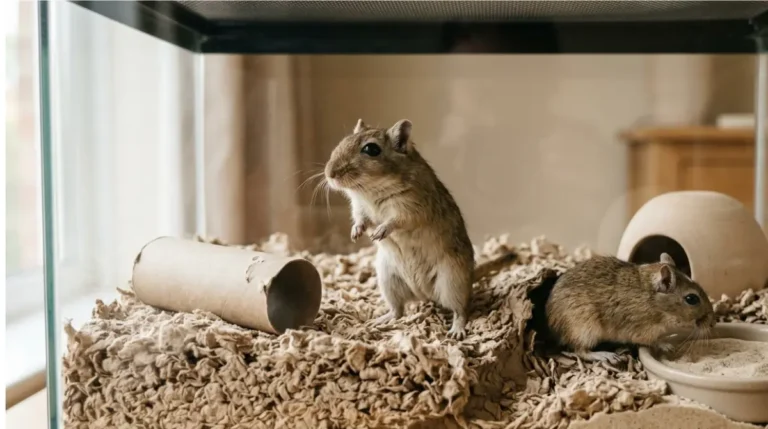
Yes, a glass tank works for gerbils. Merck calls an ordinary fish tank with a mesh lid an excellent home, and the RSPCA recommends solid glass walls, a secure wire-mesh top and a solid floor.
Why glass with a mesh lid
Gerbils dig, stand on their hind legs and chew. Merck says they need a solid, non-mesh bottom because they often stand up, and the RSPCA’s solid floor holds the bedding that digging needs.
Wire cages and shallow trays
🔄 Outdated Advice: Some US care guides still call a wire cage with a deep pan fine. The RSPCA doesn’t recommend metal-bar cages: gerbils can slip and injure their legs or feet, and gnawing the bars can damage their teeth. A shallow tray also can’t hold 20–30 cm of bedding.
Can gerbils live in a hamster cage?
A cage sold for hamsters hasn’t been checked against these gerbil needs, so test the cage, not the label. Use the hamster cage size minimums guide for hamsters only, not as a gerbil standard.
- Solid floor and solid walls deep enough for 20–30 cm of bedding plus standing room.
- A secure mesh lid.
- Nothing a foot or tail can get trapped in.
- No metal bars to gnaw, which the RSPCA advises against.
Sources differ on plastic. PetMD advises avoiding plastic habitats because gerbils chew through them, while Merck describes solid plastic containers with connecting tunnels as an interesting environment.
Lids and escapes
The RSPCA calls for a secure mesh top, and Merck says the cage should be secure against escape. The specialist keeper site gerbilcare.co.uk is blunt that gerbils need lids.
What goes in the tank: bedding, nest box, hides
The bedding mix
The RSPCA suggests rough-grained woodchips and hay, which give burrows structure and something to gnaw. Rescue and keeper sources such as Greatfield favor paper-based bedding with hay for bedding that holds its shape when dug.
Sources differ on wood. Wood Green warns that wood shavings can harm gerbils’ skin and airways, while the RSPCA lists rough-grained woodchips. The RSPCA says non-toxic peat may suit but isn’t environmentally friendly, and garden soil may carry harmful bacteria or parasites.
Is sawdust safe for gerbils?
No. The RSPCA warns that sawdust may cause respiratory problems, and Wood Green and Burgess also advise against it. Trouble breathing needs a vet experienced with gerbils.
Nesting material, and what to skip
⚠️ Watch Out: The RSPCA warns against cotton wool and other fluffy nesting that separates into thin strands, calling it a serious welfare risk. Merck says commercial nesting strands can tangle small feet.
Safe options named by the RSPCA are ink-free cardboard or paper, hay, empty toilet rolls and egg containers. Merck lists plain shredded facial tissue.
Nest box and hides
The RSPCA wants a dark nest box big enough to store food, sleep and move around in, ideally with several entrances so a dominant gerbil can’t trap another inside. An angled tube entrance keeps light out.
✅ Do This: Besides the nest box, the RSPCA says to provide one more hiding place than you have gerbils. For a pair, that’s three.
Where to put the tank: temperature, sun, and noise
Placement matters as much as the tank. The RSPCA lists drafts, damp, direct sun and radiators among the things to avoid, and Humane World notes that gerbils can overheat.
What temperature do gerbils need?
Sources differ. The RSPCA says 20–24°C; Merck says 60–70°F (about 16–21°C) with humidity below 50%; PetMD says 65–75°F (about 18–24°C) with humidity around 50%.
📊 Tested / Spec: All three ranges overlap at roughly 20–21°C (68–70°F). That overlap is our arithmetic, not a published figure.
We found no sourced upper danger temperature, so we aren’t giving one. If the room is hot and your gerbil seems unwell, move the tank somewhere cooler and call a vet experienced with gerbils.
Summer heat and winter drafts
The RSPCA wants the tank indoors, dry and draught-free, away from direct sun and radiators. Merck calls for relatively dry quarters and a breathable mesh lid.
Noise and ultrasound
Gerbils communicate in ultrasound, so the RSPCA says to keep the tank away from TVs, computer screens, vacuum cleaners and sources of running water.
How often to clean
The RSPCA says to remove faeces and uneaten food every few days and deep-clean every two to three weeks. Take the gerbils out while you clean, and keep a little used but unsoiled bedding, because removing all familiar smells can trigger fighting.
🔄 Outdated Advice: One older US pet-care guide says cleaning every one to two months is enough. PetMD says spot-clean daily and disinfect weekly, which is more often than the RSPCA’s schedule. If you clean fully, keep some familiar bedding.
Wheels, sand baths and gnaw sticks: the rest of the kit
Do gerbils need a wheel?
The RSPCA lists an axle-free wheel as a way to give daily exercise, not a requirement. Digging is the main exercise in a deep tank.
What makes a wheel safe
The RSPCA says a wheel needs a large diameter and a solid structure so feet and legs can’t be trapped. Merck reports broken bones when a leg or foot gets stuck in a wire wheel or mesh floor, and says tails can be injured the same way.
🔍 Why It Works: A solid surface and no axle leave nothing for a foot or tail to catch. Humane World lists 8 inches or larger, but that guide is older, so check current guidance before buying.
Gnaw sticks and rough surfaces
The RSPCA lists gnaw sticks, cardboard tubes and boxes, and wooden bridges, tunnels and logs. It also recommends a rough-surfaced object such as a stone, because claws that aren’t worn down can grow too long.
⚠️ Watch Out: Wood Green warns against mesh shelves, which can damage feet, and solid shelves, which a weaker gerbil can get stuck under.
Sand baths
Some gerbil care guides list a sand bath. We haven’t verified a specific product, so ask your exotics vet before adding one.
Gerbil injured or acting off? When to call an exotics vet
🚨 Vet Now: Missing or bleeding tail skin, a stuck or limp limb, bite wounds, or hard breathing: call a vet experienced with gerbils promptly. Don’t wait or try to treat it at home.
Never pick a gerbil up by its tail
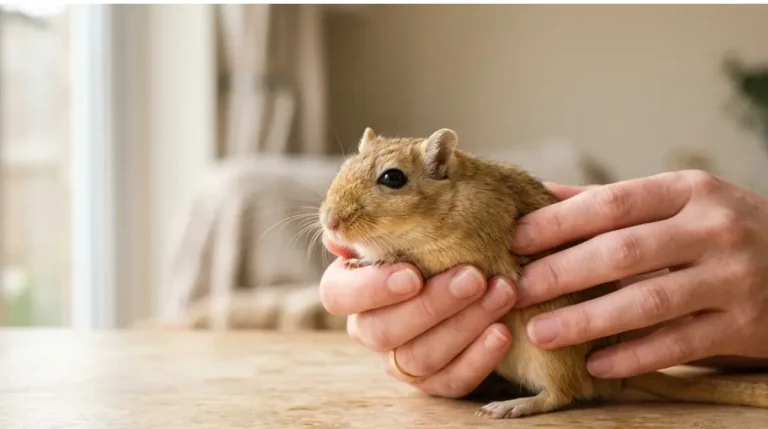
Merck says lifting a gerbil by the tail can cause fur loss or make the skin slip off, a condition called tail slip. The exposed tail often rots and must be amputated, so prevention is simply never lifting by the tail.
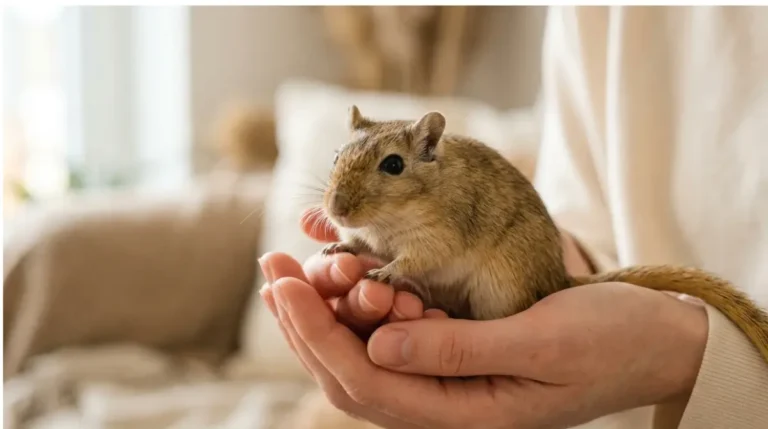
PetMD’s advice is to scoop the gerbil in your hands. The RSPCA says to let gerbils get used to your voice and presence before any touching.
🔄 Outdated Advice: Some guides allow gripping the base of the tail as a last resort. Merck says never pick a gerbil up by the tail.
What tail slip looks like
PetMD says the first sign can be subtle, a bald patch on the tail. Tail loss itself isn’t fatal, but PetMD warns that the resulting infection can reach the bloodstream.
Tell the vet what happened, when, and whether skin is missing or bleeding. There are no safe home-treatment steps to follow instead.
Fighting wounds and trapped limbs
Merck says wounds at the tail and hindquarters can come from fighting or overcrowding, and that separating gerbils that fight helps prevent them. The RSPCA says to check regularly for aggression.
A stuck or limping leg, or bite wounds, need a vet’s exam.
Finding an exotics vet
The AEMV directory helps you search for vets with an interest in exotic mammal health. Ask any clinic whether it sees gerbils before you need it.
PetMD recommends an annual vet visit for gerbils. It advises consulting a vet if teeth look too long, if there’s drooling, or if food is dropped while eating. Check Merck’s gerbil disorders page for the background on tail slip, trapped limbs and fighting.
What a proper gerbil setup really costs
We haven’t listed prices, because figures should come from receipts we can show.
One-time setup costs
- A tank, bought or converted from an aquarium
- A mesh lid
- Bedding and hay
- A nest box and hides
- A solid axle-free wheel, if you add one
- Gnaw sticks and a rough stone
Monthly running costs
Bedding, hay, food and replacement chews recur. PetMD recommends one vet visit a year, so budget for that too.
Where you can save safely
Don’t cut corners on the tank’s floor and height. Cardboard tubes, boxes, egg containers and toilet rolls are RSPCA-named enrichment and nesting items.
Quick answers about gerbil tanks and bedding
1. How big should a gerbil tank be?
Sources differ, from Merck’s 5 gallons per gerbil to rescue guidance near 100 × 50 cm for a pair. Height matters too.
2. How deep should gerbil bedding be?
RSPCA recommends 20–30 cm (about 8–12 inches) of bedding, in a gerbilarium ideally around 50 cm high so gerbils can still stand upright.
3. Can gerbils live in glass tanks?
Yes. Merck calls a fish tank with a mesh lid an excellent home, and RSPCA recommends solid glass walls with a secure mesh top.
4. Can gerbils live alone?
No. RSPCA says gerbils need other gerbils and should never be kept alone; same-sex pairs formed early are the usual choice.
5. Can gerbils live in a hamster cage?
Not if it’s a metal-bar cage or plastic habitat: RSPCA advises against metal bars, and PetMD says gerbils chew through plastic.
6. What temperature do gerbils need?
Sources differ: RSPCA says 20–24°C, Merck 60–70°F, PetMD 65–75°F. All three overlap at roughly 20–21°C (68–70°F).
7. Can you pick up a gerbil by its tail?
Never. Picking a gerbil up by the tail can make the tail skin slip off; scoop with both hands. If skin has slipped, call a vet experienced with gerbils promptly.
8. Is sawdust safe for gerbils?
No. RSPCA warns sawdust may cause respiratory problems, and Wood Green and Burgess also advise against it. Trouble breathing needs a vet experienced with gerbils.
Your next step: set up the tank before the gerbils come home
The one thing to do this week
You don’t need a perfect setup tonight. Check your tank’s internal height, work out your headroom, and make sure the gerbils come as a same-sex pair.
Where to go next
Browse the Hamsters, Gerbils & Mice category for new gerbil guides as they’re added.
If you take one health point from this guide, make it this: never lift a gerbil by its tail, and find a vet experienced with exotic mammals before you need one, since they aren’t available everywhere.