Getting a Gerbil Sand Bath Right for Your Mongolian Gerbils

Gerbil sand bath set-up starts with a shallow dish, sand made for pet rodents and a plan to sieve it clean. The part sources disagree on is how often.

Table of Contents
🚨 Vet Now: If something toxic or sticky is on your gerbil’s fur, or its breathing looks labored, call a vet experienced with gerbils now. Don’t wait, and don’t try a home fix.
Gerbils need a sand bath, and sources split on how often
Mongolian gerbils need to sand-bathe: the Merck Veterinary Manual says they require it to keep their coats from becoming oily. How often to offer one is where sources disagree, from daily to once or twice a week.
If something toxic or sticky is on your gerbil right now
Use the box above and call a vet now; this article can wait.
If you’re setting up a first bath
Next come frequency, sand, the dish and cleaning.
If you’ve seen conflicting numbers
The frequency section lines each source up side by side.
🩺 Health Note: This is general information, not a substitute for an exam by a vet experienced with gerbils. A sore nose, hair loss, a coat that stays rough or labored breathing needs a vet; find an exotics vet before you need one.
Why gerbils sand-bathe, and what happens without it
These facts apply to Mongolian gerbils, the species kept as pets.
What sand bathing does for the coat
The Merck Veterinary Manual’s gerbil page lists two sources of coat oil: Harderian gland secretions spread by grooming, and the skin. Sand removes the oil, and what’s left in the sand also works as a scent signal. A bath is usually finished within 5 minutes.

What a sand roll looks like
A sand roll is a roll onto the side or back, returning to the feet within a second, according to Merck.
What gerbils do when they can’t sand-bathe
Merck reports matted fur, less grooming, more sand rolling and more scent-marking, especially in males.
How often should gerbils have a sand bath? Sources split
For Mongolian gerbils, sources range from daily to once or twice a week.
What each source says
| Source | Type | How often | Key Detail |
|---|---|---|---|
| RSPCA gerbil health page | UK welfare charity | Each day | Shallow tray; remove and sieve after use |
| Merck Veterinary Manual (pet-owner page) | Vet reference | “Regular” | No number given |
| PetSmart Canada | Retailer | 2–3 times a week | No sources cited |
| PangoVet | Vet-media | Once or twice a week | Warns a permanent bath may dry skin (unsourced) |
How long a bath lasts
Merck says gerbils usually finish within 5 minutes; a vet-media guide suggests leaving the dish out 10–15 minutes.
A way to decide
Our reading, not a sourced rule: a matted coat is what Merck documents without sand baths; dry skin is one vet-media warning. If either appears, ask a vet experienced with gerbils before changing anything.
Which sand is safe for a gerbil sand bath?
For Mongolian gerbils, Merck’s home-for-a-gerbil page says sand is sold for pet rodents for this purpose.

Sand or chinchilla dust: where sources differ
The RSPCA names clean, fine sand or chinchilla dust. Omlet and PangoVet advise sand, not dust; Omlet cites respiratory problems, and we found no veterinary source behind either. Merck points to its chinchilla advice, but chinchilla figures aren’t gerbil figures, so we don’t borrow them.
If your gerbil breathes with effort after a bath, call a vet experienced with gerbils.
Sands we couldn’t verify
We found no reliable source that clears or rules out play, beach, builder’s or reptile sand for gerbils, so we don’t recommend one.
What to check on the label
Treat a species list on a sand label as the maker’s claim, not a vet’s check.
Dish, depth and where to put the sand bath
For Mongolian gerbils, a first set-up takes three steps:
- Pick a shallow, stable dish with a flat base.
- Add a shallow layer of pet bathing sand.
- Let your gerbils explore it; don’t pour sand over them, as Omlet and PangoVet advise.
A shallow, stable dish
The RSPCA calls for a shallow tray; Omlet adds a flat base filled no more than halfway. We found no source on dish material.
How much sand
The figures we found come from retailers and vet-media: about 1 inch (PangoVet), 2–3 inches (Small Pet Select). The RSPCA gives no figure, so we say “shallow.”
Where it goes in a deep-bedding tank
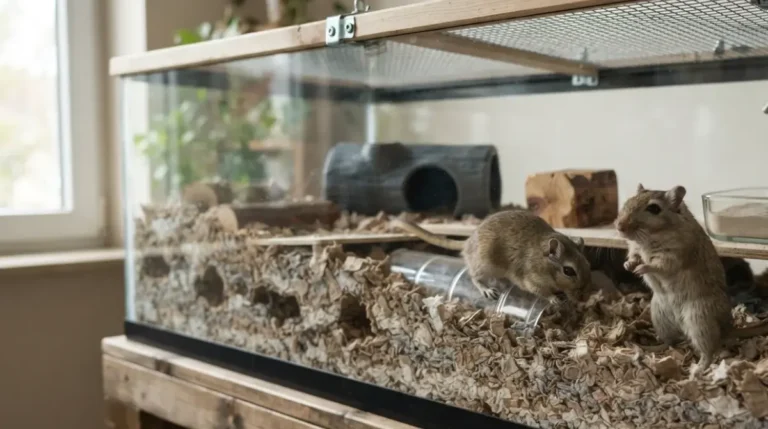
Set the dish on a flat spot; our gerbil tank setup guide for a pair covers bedding depth, and best gerbil bedding for pairs that dig covers the bedding.
Keeping the sand clean without stressing your gerbils
This covers the dish for Mongolian gerbils, not the whole tank.
Remove and sieve after each bath
The RSPCA says to remove the dish and sieve it clean after use.
How often to replace the sand
A multi-species sand label says to change it completely at least weekly. A UK keeper site sieves twice a day and replaces it fully once or twice a week.
When the bath turns into a toilet
PangoVet says some gerbils use the sand as a toilet. The RSPCA advises removing the dish after use; Omlet notes some owners leave one in, which PangoVet warns may dry skin.
When a sand bath isn’t the answer: coat, nose, breathing
A gerbil with something toxic on its fur, labored breathing, or a sore, bald or bleeding nose needs a vet experienced with gerbils.
Toxic or sticky substance on the fur
Call now and say what it was and when. The Royal Veterinary College’s gerbil factsheet says never give a water bath; Omlet allows one in emergencies, so let the vet decide.
Rough coat, red nose or hair loss
Merck’s gerbil disorders page ties sore noses to humidity above 50%, overcrowding or incompatible cage mates, and rough, matted coats to high humidity. Merck’s veterinary page lists limiting sand baths among treatments, so ask your vet before changing anything. For the room, see our gerbil temperature guidance.
Labored breathing after a bath
Labored breathing is a sign of illness in Merck’s veterinary reference; call a vet experienced with gerbils now.
Quick answers about gerbil sand baths
1. Do gerbils need a sand bath?
Yes. Merck says Mongolian gerbils require sand bathing to keep their coats from becoming oily; the RSPCA advises offering one daily.
2. How often should gerbils have a sand bath?
Gerbil sand bath advice splits: the RSPCA says daily, PetSmart Canada 2–3 times a week, and one vet-media guide once or twice weekly.
3. How long should a gerbil sand bath last?
A gerbil sand bath is usually over within 5 minutes, per Merck; one guide suggests leaving the dish out 10–15 minutes.
4. What sand is safe for gerbils?
Merck cites sand sold for pet rodents and the RSPCA says clean, fine sand; we found no source clearing other sands.
5. Can gerbils use chinchilla dust?
The RSPCA names chinchilla dust, while Omlet and PangoVet advise sand instead; Omlet cites respiratory problems but no veterinary source. If your gerbil breathes with effort, call a vet experienced with gerbils now.
6. Can I use play sand or beach sand?
We found no reliable source clearing play or beach sand for gerbils, so we don’t recommend either; ask a vet.
7. How deep should the sand be?
Gerbil sand bath depth has no authority figure: the RSPCA says a shallow tray, PangoVet about 1 inch, Small Pet Select 2–3 inches.
8. Should I leave the sand bath in the tank?
The RSPCA says remove a gerbil sand bath and sieve it after use; Omlet says some owners leave one in; PangoVet warns of dry skin.
9. Can I give my gerbil a water bath?
A gerbil water bath is something the Royal Veterinary College says never to give; Omlet allows one only in emergencies, so ask a vet first. For anything toxic or sticky on the fur, call a vet experienced with gerbils now.
10. Why does my gerbil have a sore nose?
Merck links a gerbil sore nose to humidity above 50%, overcrowding or incompatible cage mates. Ask a vet experienced with gerbils before changing the sand bath routine.
Your next step: a shallow dish, then watch the coat
Offer a shallow dish of sand made for pet rodents, sieve it after use, and watch coats and noses. Frequency is the open question: use the source table above and ask your vet. Call a vet experienced with gerbils for anything in the boxes above.