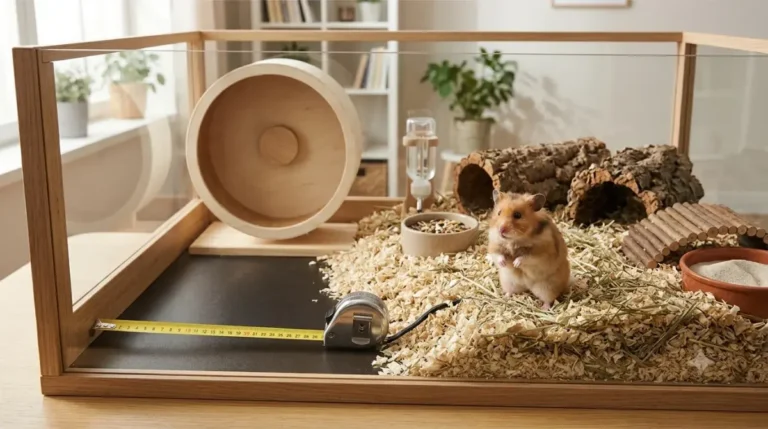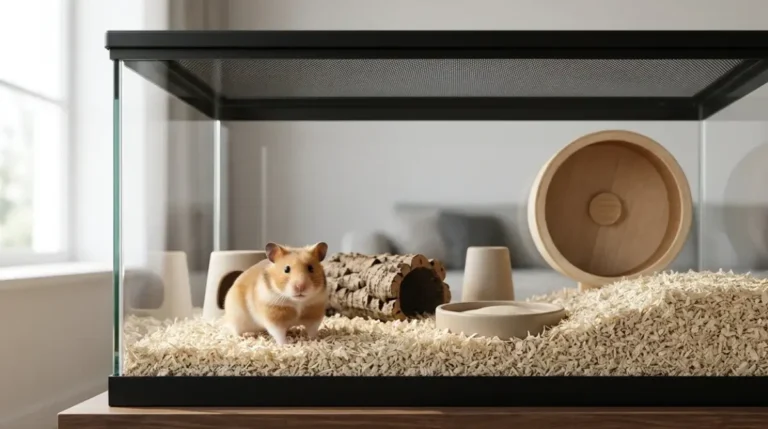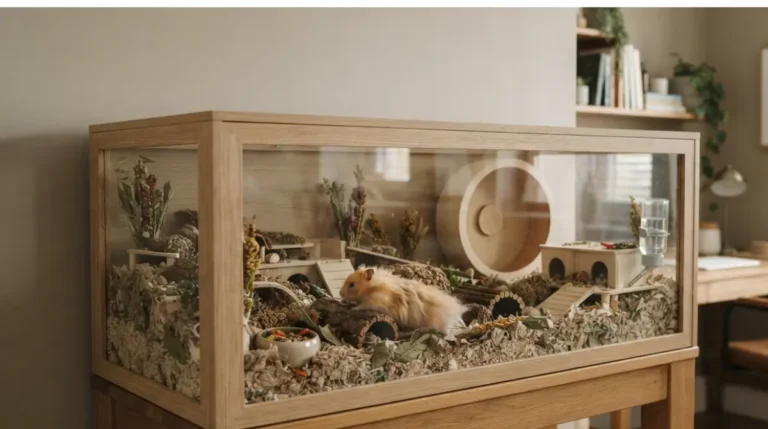
Is an IKEA Detolf hamster cage the right size?

The IKEA Detolf hamster cage gives more unbroken floor than almost any hamster cage sold — and IKEA stopped selling it in 2024. Here’s what that means.
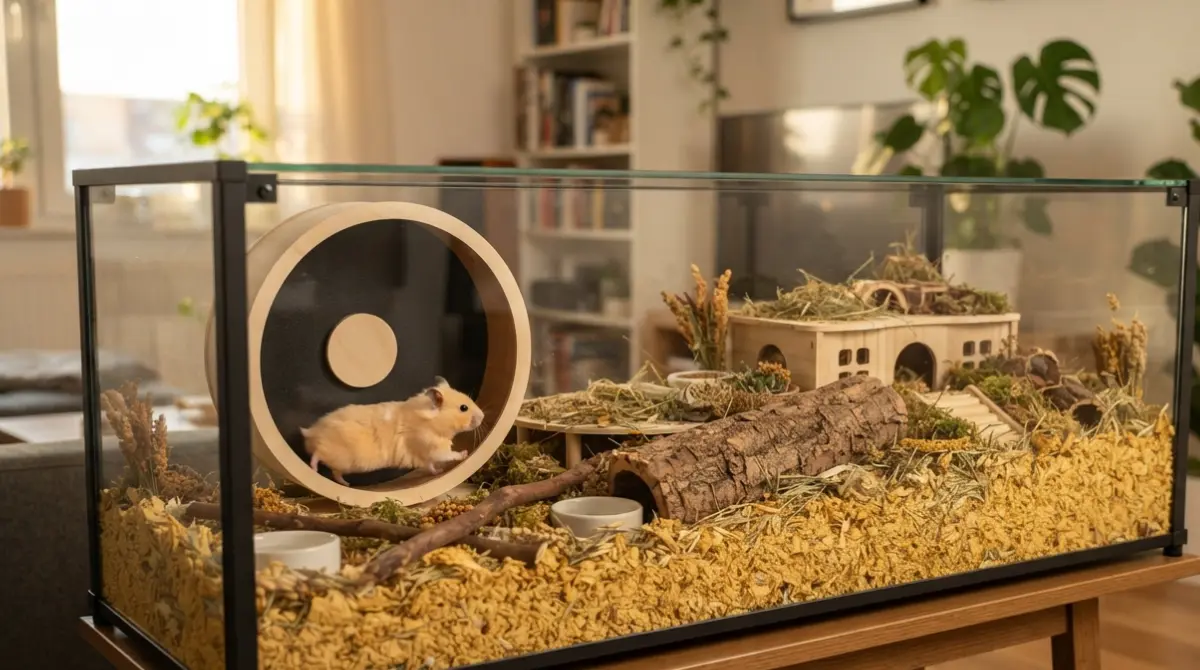
Table of Contents
Lay an IKEA Detolf on its back and the outer footprint works out to about 1,086 square inches. That is more unbroken floor than almost any cage sold for hamsters. Whether that number survives contact with a real setup is what the rest of this covers.
Three situations bring people here. If you already own one, start with the interior height — that single measurement decides whether your wheel fits. If you are deciding whether it is big enough, the standards comparison below answers it directly. If you are trying to buy one, skip ahead to availability, because that answer changed in 2024.
Every figure here is either IKEA’s published spec or a named welfare source, and it says which.
🩺 Health Note: This is a housing article, not health advice. A glass enclosure carries real heat and injury risks, covered in the safety section. If your hamster seems limp, unusually still, or unresponsive in a warm room, contact a vet experienced with small mammals rather than waiting to see if it passes.
What the numbers actually are
IKEA lists the Detolf glass-door cabinet at 43 cm wide, 37 cm deep and 163 cm tall — 16¾ × 14⅜ × 64⅛ inches. Those are the only figures anyone can verify, so everything below is built from them.
Turn it onto its back and the back panel becomes the floor. The floor space is then 163 × 43 cm, which is 7,009 cm² or 1,086 square inches, edge to edge.
| Measurement | Figure | Key detail |
|---|---|---|
| Cabinet as sold | 43 × 37 × 163 cm | IKEA published spec |
| Footprint laid on its back | 7,009 cm² / 1,086 in² | Outer edge to outer edge |
| Usable floor inside | Less than that | End panels and corner shelf supports eat into it |
| Interior wall height | Under 37 cm / 14⅜ in | Caps bedding depth and wheel diameter |
Published hamster figures for this cabinet range from roughly 896 to 1,004 square inches. None of them shows a method, which is why they disagree — and why the honest answer is the spec plus the subtraction, not a confident single number.
🔄 Outdated Advice: Treat any Detolf floor figure quoted without a method as an estimate. If you want the real usable number for your unit, measure the unbroken floor space yourself — it takes two minutes and beats every figure online.
How that compares to the 775-square-inch minimum
Yes, a Detolf clears the widely cited minimum comfortably — even at the low end of the reported range, with room to spare.
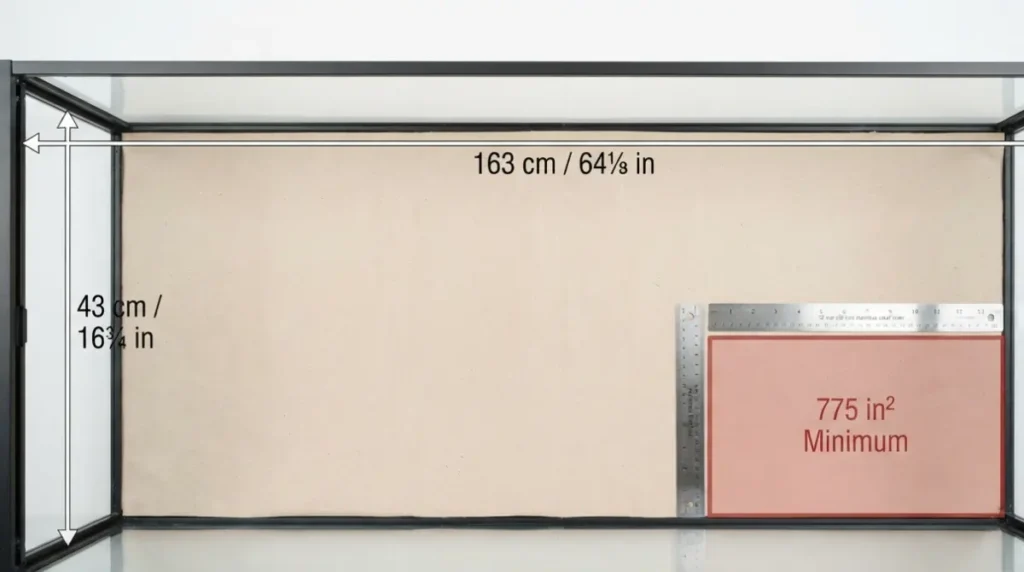
The minimum cage size most UK welfare bodies publish is 100 × 50 cm, which is 5,000 cm² or 775 square inches of unbroken floor. That figure appears in PDSA’s hamster housing guidance and in Blue Cross’s hamster care advice. It originates with the German Veterinary Association for Animal Welfare.
It applies to dwarf hamsters too. The same minimum covers every species — there is no reduced figure for a smaller animal, a point our guide on dwarf versus Syrian cage size goes into properly.
⚠️ Watch Out: The standards genuinely differ. PDSA and Blue Cross set 5,000 cm²; the RSPCA’s hamster environment advice publishes no number at all and asks for the largest cage possible; and a 2007 cage-size study in Animal Welfare found stereotypic wire-gnawing was worse in small cages and that welfare appeared better at 10,000 cm². That is a single laboratory study, not a standard — but it means a Detolf sits above the minimum and below the figure that research favoured. For the standard itself, see what 775 square inches actually looks like.
The measurement nobody mentions: interior height
Lying on its back, the cabinet’s 37 cm depth becomes its wall height — under 14½ inches before you account for the panels. Every other Detolf article gives you the length and stops there.
That height has to hold two things that compete. The Merck Veterinary Manual’s guidance on providing a home for a hamster puts the floor at 6 inches of height and notes that 8 inches or more allows deeper bedding depth. Deep burrowable bedding and a full-size exercise wheel are both good; in a shallow cabinet they fight for the same inches.
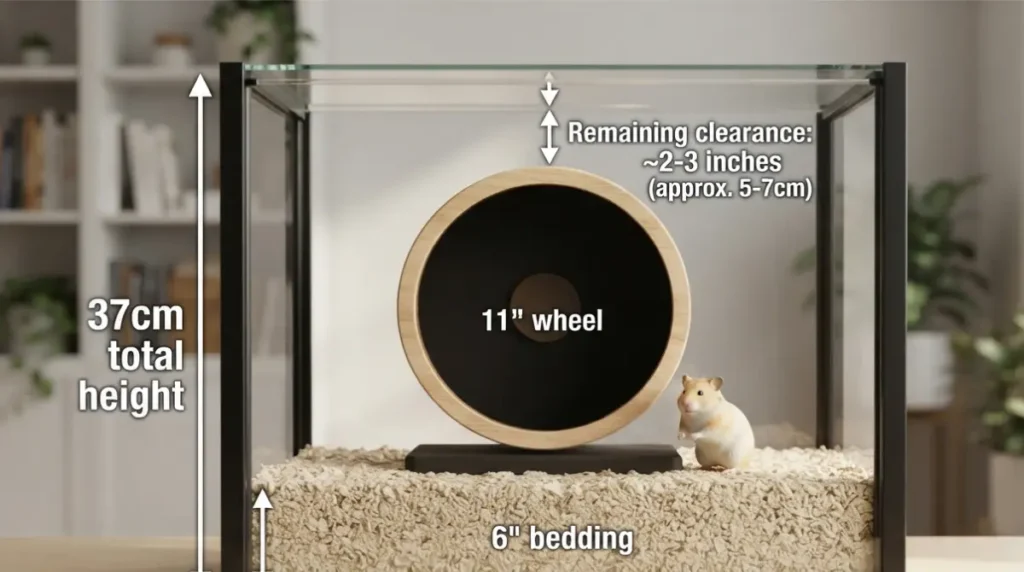
For a Syrian hamster, run the subtraction before you buy anything: wall height, minus your intended bedding depth, minus the wheel’s diameter. If it comes out negative, bedding goes shallower under the wheel or the wheel gets mounted on a raised flat area — those are the options.
🔄 Outdated Advice: Several guides still tell you to add shelves or reuse the Detolf’s own glass panels as platforms. Current welfare guidance favours unbroken floor space, and a glass shelf is a fall risk for an animal with poor eyesight. Levels do not count toward the 775 minimum.
Can you still buy a Detolf?
No, not new in the US, UK or Europe. IKEA withdrew the Detolf at the end of January 2024 and replaced it in the range with the smaller, wood-framed BLÅLIDEN; a handful of regional IKEA sites outside those markets still list it.
This matters because nearly every page recommending a Detolf still quotes a shop price of around $60–70 and links you to a dead product page. Secondhand is now the only realistic route in most countries.
They surface regularly on local resale marketplaces, and supply tends to rise in January and around university move-out. Prices are set entirely by your local market, so treat any fixed figure you read — including a resale listing from last year — as out of date.
✅ Do This: Before paying for a used one, check three things in person: the glass edges for chips, the panels for deep scratches, and that the metal corner shelf supports and base panels are all present. A chipped edge is the one flaw worth walking away from, for the reason in the next section.
What you still have to buy after the cabinet
The cabinet is not the whole cost. Four things are genuinely required before a hamster can live in one, and none come with it.
- A lid. The cabinet’s own glass door cannot serve as one. Merck’s housing guidance is blunt that hamsters are outstanding escape artists, and a Syrian or Chinese hamster will leave an open-topped enclosure. A timber frame with hardware cloth stapled underneath is the standard build; dwarf owners need a finer mesh aperture.
- A fully flat support surface. Covered in the next section, and not optional.
- A species-correct wheel, sized against the interior height above.
- Bedding by volume, not by bag. Work out length × width × intended depth and buy to that number. Most people underbuy by half.
Merck notes that smooth glass is a good wall material precisely because hamsters chew wire, so the cabinet itself is sound. It is the finishing that people underestimate. If the total stops making sense, bin cages and other enclosures over 775 square inches reach the same floor area for less work.
Glass, heat, and the two ways this goes wrong
Two failure modes are specific to a glass enclosure, and both are avoidable.
IKEA’s own product warning states that a damaged edge or scratched surface can cause the glass to crack suddenly, and that side impacts are where it is most vulnerable. A cabinet resting on an uneven surface, or with bedding compacted against an unsupported panel, is loading tempered glass the way it was never meant to be loaded. Support the full footprint on something flat and rigid.
The second is heat. Merck’s housing guidance puts a hamster’s ideal environment at 64–79°F (17–26°C) and calls for good ventilation; glass amplifies direct sun and traps ammonia without airflow. Keep it out of sunlight and away from radiators, and make the lid mesh, not solid.
🚨 Vet Now: A hamster that is limp, unresponsive, or lying stretched out and unmoving in a warm room needs a vet experienced with small mammals today. Move the enclosure out of the heat source first, then call.
Detolf hamster cage questions, answered
1. Is the IKEA Detolf discontinued?
Yes. IKEA withdrew it at the end of January 2024 in the US, UK and Europe, replacing it with the smaller BLÅLIDEN cabinet.
2. How many square inches is an IKEA Detolf?
Laid on its back, the footprint is about 1,086 square inches from IKEA’s published dimensions. Usable interior floor is somewhat less.
3. Why do different sites give different Detolf floor figures?
Reported figures range from about 896 to 1,004 square inches because none of them states how the measurement was taken.
4. Is an IKEA Detolf hamster cage big enough for a Syrian?
Yes. It clears the 775-square-inch minimum published by PDSA and Blue Cross comfortably, even at the low end of reported figures.
5. Do dwarf hamsters need less floor space?
No. PDSA and Blue Cross apply the same 100 × 50 cm minimum to every hamster species, including all dwarfs.
6. How tall is the inside of a Detolf on its back?
Under 14½ inches, since the cabinet’s 37 cm depth becomes the wall height once it is laid down.
7. How deep can bedding go in a Detolf?
Deep bedding competes with wheel clearance in under 14½ inches of height. Subtract your wheel diameter before deciding.
8. Can a Detolf shatter?
Yes. IKEA warns that a damaged edge or scratch can cause sudden cracking, and side impacts are the most vulnerable point.
9. Can you use the Detolf glass shelves as platforms?
No. Current welfare guidance favours unbroken floor space, and glass shelving is a fall risk for hamsters.
10. Does a Detolf need a lid?
Yes. The cabinet’s glass door cannot serve as one, and hamsters are capable escape artists from open-topped enclosures.
Where that leaves you
A Detolf clears the floor-space minimum that matters and falls short on height, which is the trade you are actually making. Nothing about that changed when IKEA stopped selling it — only the sourcing did.
If you own one, measure the interior height tonight and check your wheel against it. If you are still looking, start with the floor space you need and work backwards.