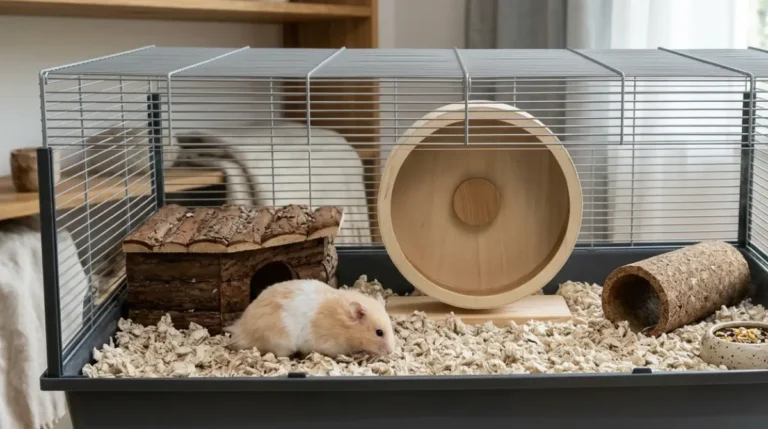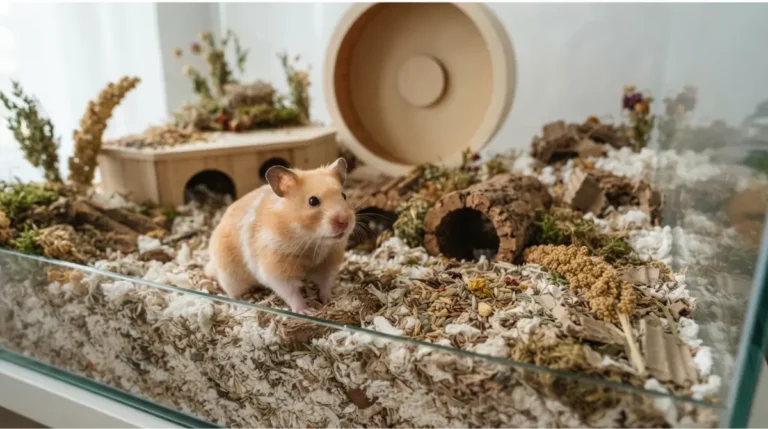
Dwarf hamster cage size and the safe floor space by species

Dwarf hamster cages need the same floor as a Syrian’s. In a 2023 survey, 65 of 90 co-housed dwarf hamsters were later separated for aggression.
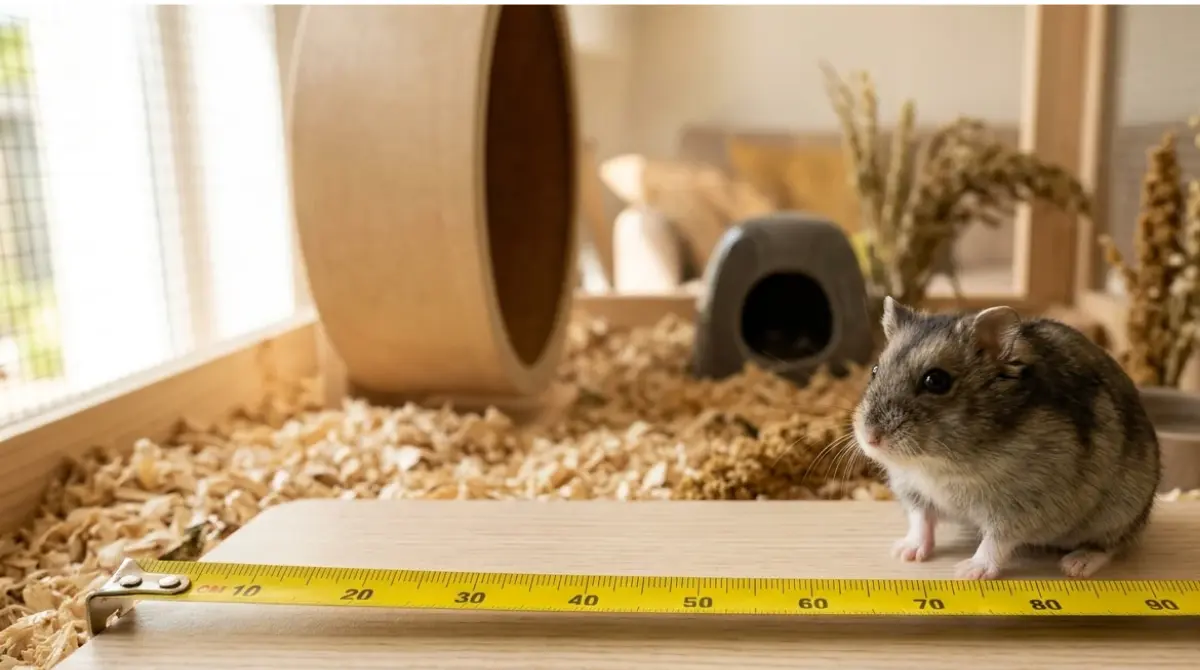
Table of Contents
Care guidance checked on October 29, 2026.
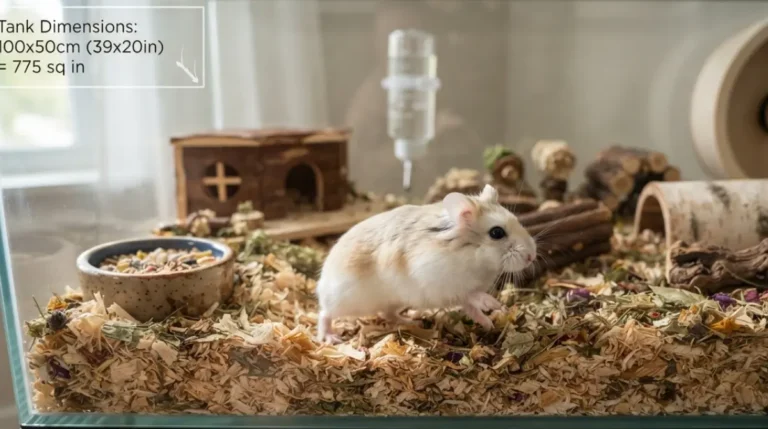
Campbell’s, winter white, Roborovski and Chinese hamsters get no smaller floor than a Syrian: PDSA’s minimum for every hamster is 100 × 50 cm, about 39.4 × 19.7 inches or 775 square inches, a figure it takes from Germany’s Veterinary Association for Animal Welfare. The species changes the wheel, and it decides whether a second hamster can share the space at all.
Every dwarf species gets the same 100 × 50 cm floor
Owners of pet dwarf hamsters are told to buy the largest enclosure they can, without any specific guidelines for different species behind that advice. That gap was the starting point for a 2023 Veterinary Record study from the Royal Veterinary College.
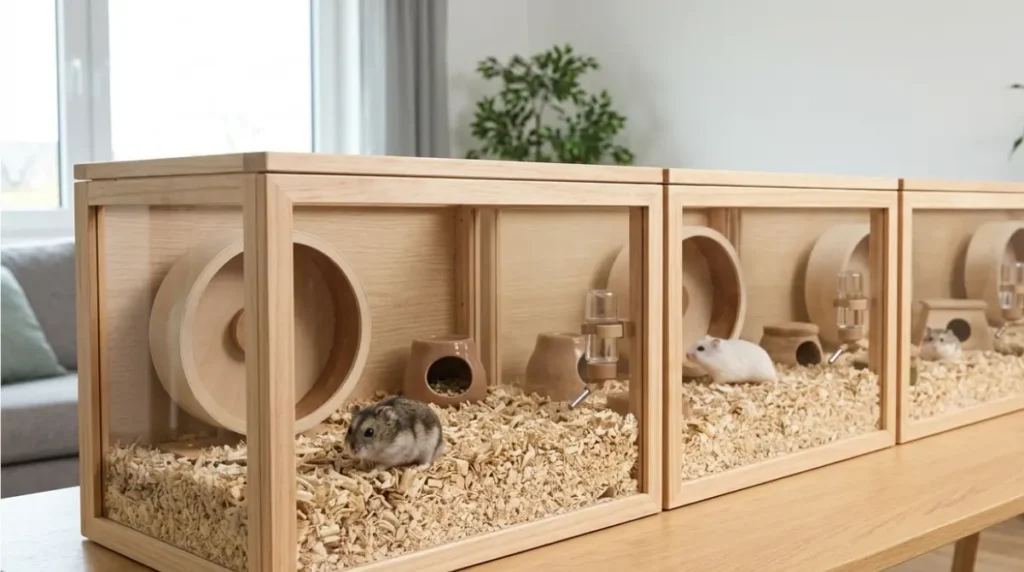
Evidence on exactly how big a hamster cage should be is limited (PDSA), so the 775-square-inch figure works as a floor, and a bigger cage is better. It describes the base. A larger single-level cage tends to suit a hamster better than a tall one with several levels, because hamsters see poorly and can fall from height. How that minimum compares with other charities and national laws is laid out in hamster cage size when welfare standards disagree.
Smaller bodies don’t earn a smaller floor in any of it.
Campbell’s, winter white, Robo and Chinese compared
Down the table, only two rows change from one species to the next.
| Measure | Campbell’s | Winter white | Roborovski | Chinese |
|---|---|---|---|---|
| Scientific name | Phodopus campbelli | Phodopus sungorus | Phodopus roborovskii | Cricetulus griseus |
| Minimum floor | 775 sq in (5,000 cm²) | Same | Same | Same |
| Bedding depth | 10 in (25 cm) | Same | Same | Same |
| Minimum wheel | 8 in (20 cm) | Same | Same | No figure published |
| Sharing with another hamster | Pairs or trios sometimes (RSPCA); not housed together (PDSA) | Same as Campbell’s | As Campbell’s under RSPCA advice; no PDSA line | Alone (RSPCA and PDSA) |
Sources: floor, bedding and wheel from PDSA, whose wheel figure covers “dwarf hamsters” without naming species; company from the RSPCA and PDSA; scientific names from Hedley and colleagues’ 2023 study.
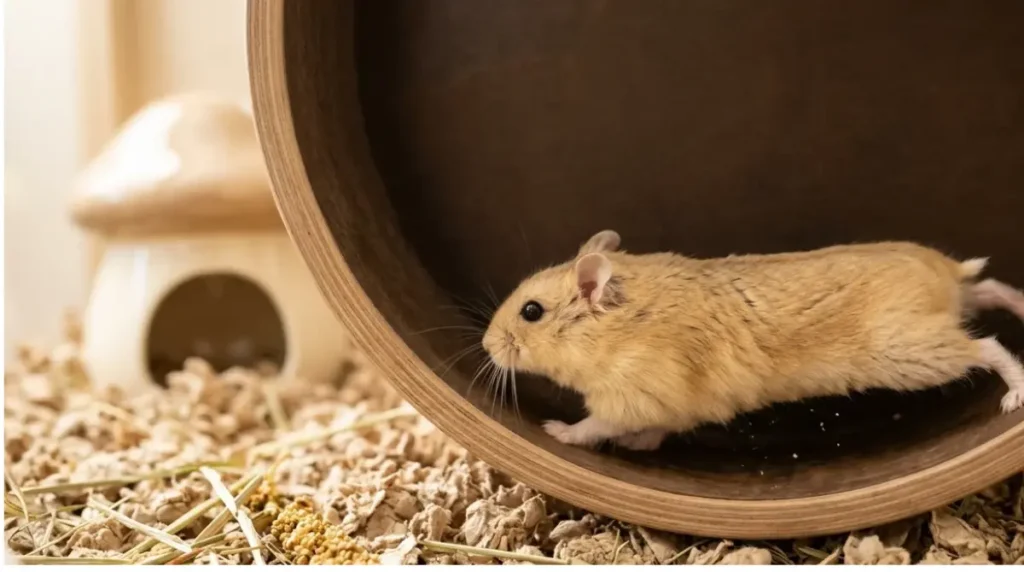
PDSA puts the Syrian wheel at 12 inches (30 cm), so the dwarf figure is two-thirds of it. A wheel that is too small forces the hamster to run with a curve in its back, which can cause long-term pain, and the running surface should be solid, with no slats or bars to catch a leg. Wheel sizes for Syrian and dwarf hamsters explains how to check one against your own animal.
Bar spacing is the other fitting to check against your hamster, at the door and lid too. Bar gaps for Roborovski hamsters covers how to measure them.
Is a Chinese hamster a dwarf hamster?
Not in the scientific sense. Cricetulus griseus belongs to a different genus from the three Phodopus species that the 2023 study treats as the dwarf hamsters, and it should live on its own. Its floor and bedding match the others. No wheel diameter is published for the species, so judge the wheel by the hamster: its back should stay straight while it runs.
A dwarf pair means a second enclosure on standby
Of the 90 co-housed dwarf hamsters compared in the 2023 Veterinary Record survey, 65 had been separated after fighting, biting, scratching or screaming, and 25 were still living together. Hamsters older than 6 months were 4.75 times as likely as younger ones to have been split up, and the authors advise separating dwarf hamsters by 6 months of age. Owners were recruited through online hamster and veterinary groups, a selection bias the paper acknowledges, so the sample likely leans toward better-informed keepers.
The charities split on whether to try. The RSPCA says Roborovski, Campbell’s and winter white hamsters can sometimes share a cage, provided the group forms early in life, ideally from young litter mates, and that even these species don’t need company to be happy. PDSA says domesticated Russian dwarf hamsters should not be housed together, because dominance disputes and fights often occur.
Neither page gives a floor figure for a pair. A pair needs lots of space, several shelters and equal access to resources, since fights are more likely when space or enrichment is short (RSPCA). Many of the survey’s pairs and groups fell short of that: 60 percent had fewer wheels than hamsters, and 60 percent had fewer water sources.
Fights tend to happen at night, so check both hamsters each morning. After a fight, the RSPCA’s advice is permanent separation into different cages, with no reintroduction. That is why a second enclosure of the same minimum size belongs in the plan before a pair comes home.
See a vet today if: either hamster has a bite wound or a sudden hot, red, painful swelling. Fighting between cage mates is a common cause of both (PDSA); separate the two before you go.
Austria’s 60 × 30 cm legal floor
Austria sets a hamster cage minimum in law: 60 × 30 × 40 cm, or 23.7 × 11.9 inches of floor and 15.8 inches of height, with at least 2 inches (5 cm) of diggable bedding (Austrian government guidance). The same rules let the smaller dwarf species be kept in pairs and require Syrians to live alone.
That legal floor works out to 279 square inches, 36 percent of PDSA’s minimum, and the legal bedding depth is a fifth of PDSA’s.
Before you buy: measure the inside of the base and compare it with 39.4 × 19.7 inches. A cage that clears Austria’s legal floor can give a dwarf hamster just over a third of the welfare minimum.
Small enclosures were common even among owners the survey’s authors thought better informed than most: 30 of 248 dwarf hamster enclosures (12.1 percent) were shorter than 75 cm (29.6 inches), a finding the paper flags as a key welfare concern.
Measure the base before you choose a wheel
Start with the empty enclosure, or the listed inside dimensions of the one you plan to buy.
- Measure the inside length and width of the base in inches and multiply them. A result of 775 square inches or more meets PDSA’s minimum, and the method for measuring hamster cage floor space shows where curved corners cut into it.
- Check that the base is deep enough to hold 10 inches (25 cm) of bedding.
- Fit a solid wheel of at least 8 inches (20 cm) for a Campbell’s, winter white or Roborovski hamster, and watch a Chinese hamster run to see that its back stays straight.
For a pair of Russian dwarfs, buy both enclosures at once.