Why Does My Hamster Bite the Cage Bars? Real Causes and Fixes

Bar biting in hamsters is a signal, not a quirk. Syrian hamsters on 10 cm of bedding gnawed bars more than those on deeper bedding. Here’s the fix.
Table of Contents
Bar biting is usually a sign that your hamster’s setup isn’t meeting its needs. The usual gaps are too little floor space, bedding too shallow to burrow in, or not enough to do. In controlled studies of Syrian hamsters, smaller cages and shallower bedding both led to more wire-gnawing.
If you bought the cage a pet store recommended, you haven’t failed your hamster. PDSA notes that most shop-sold cages aren’t big enough to meet a hamster’s basic needs.
Start where you are:
- Want it to stop? Jump to the fix, in order.
- Worried about teeth? Go straight to the tooth check.
- Keep a dwarf hamster? The setup check breaks out Syrian and dwarf differences.
🩺 Health Note: This is general information, not a substitute for an exam by a vet experienced with hamsters. If your hamster has a chipped, broken, or overgrown front tooth, or is eating less, book a vet visit promptly rather than waiting to see if it settles.
Is it normal chewing or a stress behavior?
All hamsters gnaw, but repetitive bar biting is different from everyday chewing.
Why hamsters need to gnaw at all
🔍 Why It Works: A hamster’s front incisors grow continuously for life, while its back teeth don’t. Gnawing on wood, cardboard, and hard food keeps those incisors at a working length.
Signs it’s a stress behavior
Researchers call the repetitive version stereotypic wire-gnawing. Watch for:
- Biting in the same spot, often a cage corner
- Going back to the bars again and again
- Carrying on even when chews are within reach
Some keepers call extreme cases “cage rage.” That’s a community term, not a veterinary diagnosis.
Why you mostly hear it at night
Hamsters sleep through most of the day and wake in the evening. That’s why bar biting tends to happen while you’re trying to sleep.
What the studies found about cage size and bedding
Two controlled studies of Syrian (golden) hamsters tested floor space and bedding depth directly.
| Study | Hamsters | What changed | Wire-gnawing result |
|---|---|---|---|
| Cage size (Fischer et al., 2007) | 60 females | Floor area from 1,800 to 10,000 cm² | More often and for longer in smaller cages; seen at every size |
| Bedding depth (Hauzenberger et al., 2006) | 45 males | 10, 40, or 80 cm of bedding | Significantly more at 10 cm; never observed at 80 cm |
Both studies used Syrian hamsters only; sources are linked below.

Cage size: less gnawing in bigger cages, but not zero
One of the four cage sizes in a controlled study of golden hamsters in four cage sizes was 5,000 cm². That equals 100 × 50 cm, the 775 sq in minimum explained in what 775 square inches actually looks like. Gnawing still happened at that size, and the authors concluded welfare looked better at 10,000 cm².
Bedding depth: deeper meant less gnawing
In research on bedding depth and wire-gnawing, about half the hamsters on 10 cm of bedding gnawed the wire, mostly at the corners. We found no comparable studies of dwarf hamsters, so treat these as Syrian findings.
Check your setup: the 6 likely causes
Check each cause against your current setup. The figures come from PDSA’s hamster housing guidance and apply to Syrian and dwarf hamsters except where noted.
| Cause | What to check | Current guidance |
|---|---|---|
| Floor space | Unbroken floor area | At least 100 × 50 cm (775 sq in), the TVT minimum cited by PDSA |
| Bedding depth | Depth at the deepest point | About 25 cm (10 in), in a solid base |
| Wheel | Diameter and surface | Solid surface; 30 cm+ Syrian, 20 cm+ dwarf |
| Hides | Places to sleep unseen | Several nest boxes or hides |
| Location | Noise, drafts, sun | Quiet spot, steady 18–21°C |
| Chews | Safe gnawing items | Untreated wood branches, gnawing blocks, cardboard |
Source: PDSA, checked September 2026.
Floor space and bedding depth
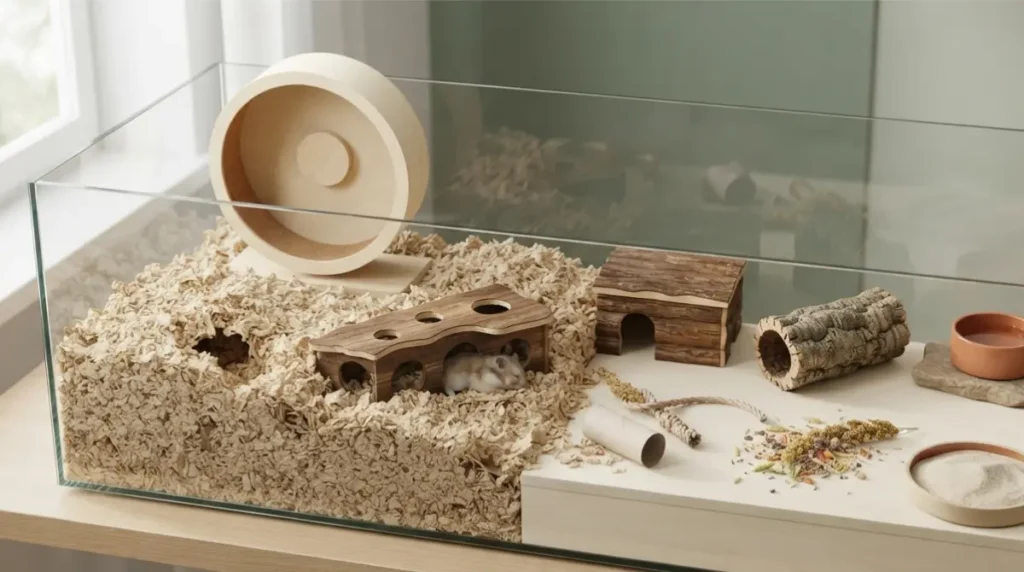
✅ Do This: Measure your cage’s unbroken floor space before buying anything new. Shelves and levels don’t count toward the minimum.
Wheel size (Syrian vs dwarf)
PDSA warns that a small wheel forces a curved-back running posture. Compare how cage needs differ for dwarf and Syrian hamsters, and dwarf keepers should check bar spacing for Roborovski hamsters.
Noise, location and temperature
PDSA lists noise and vibration, from a TV or washing machine, as stressful for hamsters.
Nothing better to chew
Chews won’t fix a small cage, but without them the bars become the main gnawing option.
How to stop bar biting, in the order that matters
Start with space and bedding, the two changes the research actually tested in Syrian hamsters.
1. Give more space, or go barless
Aim for at least 100 × 50 cm of unbroken floor. A barless tank or bin cage removes the bars entirely, and a DIY bin cage that ends bar biting on a budget is the cheapest route.
2. Deepen the bedding
Build toward about 25 cm in at least one area. PDSA recommends adding paper-based bedding, because aspen, spruce, and hemp alone don’t hold burrows well.
3. Right-size the wheel
Choose a solid running surface: 30 cm (12 in) or larger for Syrians, 20 cm (8 in) or larger for dwarfs.
4. Add chews and scatter-feed
Offer untreated wood and cardboard, and scatter daily food instead of using a bowl, as PDSA suggests. Once the new setup is in, keep the layout the same, because hamsters find sudden changes stressful.
Fixes that don’t work (or make it worse)
Some popular fixes for Syrian and dwarf hamsters skip the cause or add new stress.
Chew toys on their own
🔄 Outdated Advice: “Just add chew toys.” In the cage-size study, hamsters kept gnawing even with standardised enrichment. Chews help, but fix space and bedding first.
Hamster balls
Exercise balls can cause disorientation, overheating, and injury because your hamster can’t stop when it wants to. A properly sized wheel is the safer choice.
Sprays, tapping the cage, or feeding through the bars
- Bite-deterrent sprays: we found no welfare guidance supporting them, and they don’t change the setup causing the biting.
- Tapping or scolding: adds the noise and vibration PDSA lists as stressful.
- Treats through the bars: a vet-authored guide advises against it, as it may worsen the habit.
Has bar biting hurt your hamster’s teeth?
If your Syrian or dwarf hamster has a chipped, broken, or overgrown front tooth, or is eating less, book a vet experienced with hamsters promptly.
Signs to watch
- Front teeth that are chipped, broken, or no longer line up
- Teeth that look unusually long or curve outward
- Dropping food, eating less, or losing weight
Because incisors keep growing, a damaged tooth that no longer meets its partner can overgrow. Overgrown incisors made up about 4% of disorders in a UK study of pet hamsters under veterinary care. Vets check for overgrown teeth during an exam, per the Merck Veterinary Manual’s hamster guidance, so ask them to record your hamster’s weight too.
Why you should never trim teeth at home
Clippers and scissors can split a tooth, causing pain and infection. Trimming is a job for a vet with proper dental tools.
FAQ
1. Is it normal for a hamster to bite the cage bars?
Occasional gnawing is normal. Repetitive bar biting in the same spot usually points to a space, bedding, or enrichment problem.
2. Is bar biting bad for hamsters?
Yes. Bar biting signals stress and can chip or break front teeth. See a vet experienced with hamsters for any damaged tooth or eating trouble.
3. Will a bigger cage stop bar biting?
It usually reduces it. In a Syrian hamster study, bar biting was more frequent in smaller cages but still occurred at every size.
4. Does bedding depth affect bar biting?
Yes. Syrian hamsters on 10 cm of bedding gnawed significantly more, and no bar biting was observed at 80 cm.
5. Why does my hamster bite the cage bars at night?
Hamsters wake in the evening and stay active overnight, so bar biting happens while they’re awake and you’re asleep.
6. Do chew toys stop bar biting?
Chews help, but alone they rarely stop bar biting. Fix unbroken floor space and bedding depth first.
7. Is a tank or bin cage better for a hamster that bites bars?
Yes. A barless tank or bin cage removes the bars entirely and holds deeper bedding, if it meets 100 × 50 cm.
8. Do dwarf hamsters bite the cage bars too?
The bar-biting research we found studied Syrians only. Dwarf hamsters still need 100 × 50 cm and a 20 cm+ solid wheel.
9. Can bar biting break a hamster’s teeth?
It can chip or break incisors, and a damaged tooth can overgrow. See a vet experienced with hamsters promptly.
10. Should I use a deterrent spray to stop bar biting?
We don’t recommend it. No welfare guidance we found supports sprays, and they don’t fix the space or bedding problem.
Your next step
Bar biting is your hamster telling you something in its setup is missing. Check floor space and bedding depth first, fix the wheel and chews next, then keep the layout steady. Watch the front teeth while you make changes, and grab the setup checklist above to work through it tonight.