Why Hamster Cage Levels Don’t Count as Floor Space

Stacked levels don’t add floor space for hamsters, and Blue Cross notes their poor depth perception makes ledge falls a real risk. Here’s what counts.
Table of Contents
No — only the floor your hamster can run across counts
No. For hamsters of every species, only the continuous base of the cage counts toward floor space. Levels, shelves, and tubes are extras on top.
If you added up the tiers on your cage to reach a minimum, you’re far from alone. Checking your real number takes two minutes.
- You already own a multi-level cage: measure the base in Section 3, then see the fixes in Section 7.
- You’re shopping: check the standards in Section 4 and see what 775 square inches actually looks like.
- You have a dwarf hamster: Section 5 explains why smaller doesn’t mean less floor.
Why height doesn’t give a hamster more room
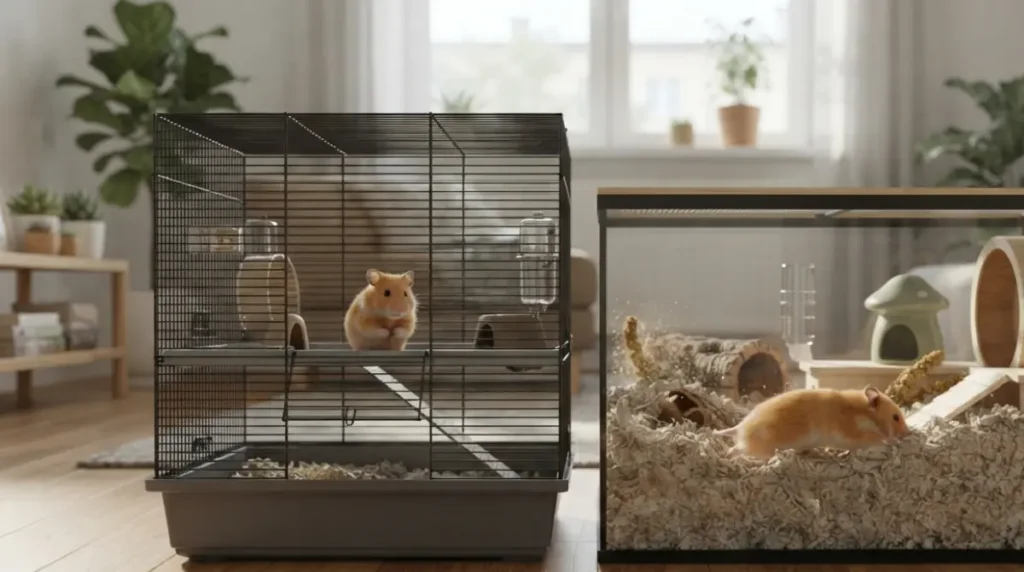
Hamsters live, dig, and forage at ground level, so the base is where their night happens.
Hamsters are ground-dwelling burrowers
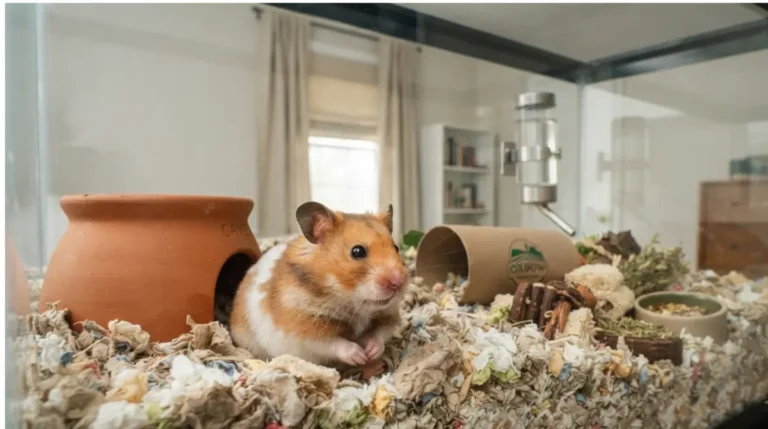
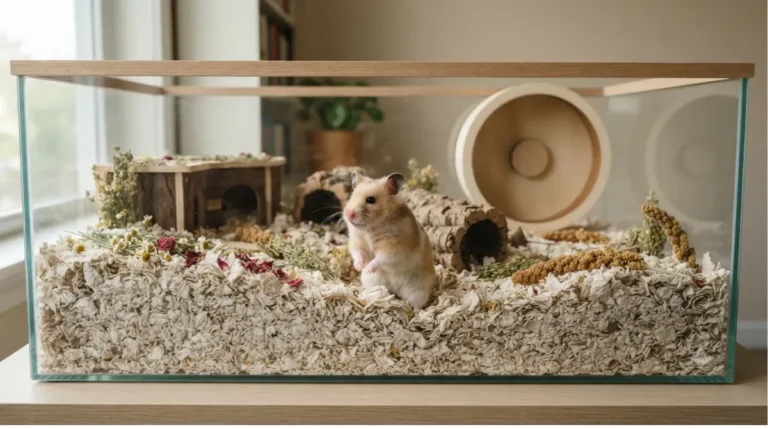
PDSA advises a base deep enough for about 25 cm (10 inches) of bedding, so hamsters can burrow, sleep, and store food. A tall cage with a shallow tray offers height they can’t dig into.
Levels break up running space
Blue Cross’s hamster care guidance notes that hamsters have poor depth perception and can be injured falling from ledges. Each platform is a small island, not an extension of the floor below.
🔍 Why It Works: A hamster uses space in long runs and tunnels. Three small floors stacked up give it three short runs and two drops, not one long stretch.
How to find your cage’s real floor space in 2 minutes
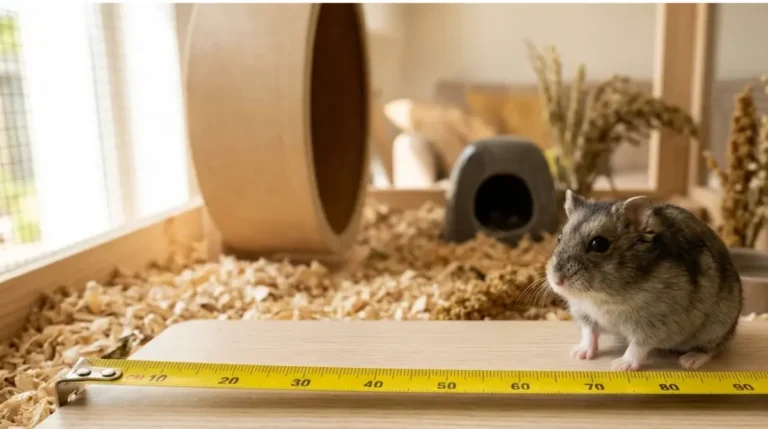
To find unbroken floor space, multiply the inside length of the base by its inside width. Ignore every level, ramp, and tube.

Measure the inside base, not the label
- Measure the inside length of the base tray, wall to wall.
- Measure the inside width the same way.
- Multiply the two. Centimeters give cm², and inches give square inches.
- Compare your result with 5,000 cm² (100 × 50 cm), which is about 775 square inches.
Use the tray’s inside measurements, not the outer dimensions printed on the box. Our step-by-step guide to measuring your cage covers corner and odd-shaped bases.
Worked example: advertised vs usable
| Measurement | Example 3-tier cage | Key Detail |
|---|---|---|
| Inside base | 60 × 40 cm | The only part that counts |
| Floor space | 2,400 cm² (~372 sq in) | This is the cage’s real number |
| Two platforms, 30 × 15 cm each | 900 cm² | Doesn’t count |
| Base + platforms combined | 3,300 cm² (~512 sq in) | Still short of 5,000 cm² |
Illustrative example with round numbers, calculated by our editors. It is not a measured product.
📊 Tested / Spec: 100 × 50 cm = 5,000 cm², about 775 square inches. This is the minimum Blue Cross and PDSA use (conversion calculated by our editors).
How big the floor should be — and who says so
Respected organizations don’t all publish the same number, so here’s who says what.
The 100 × 50 cm standard (UK and German guidance)
Blue Cross recommends a hamster cage with no less than 100 × 50 cm of floor space and 50 cm of height. PDSA’s guide to a hamster’s ideal home cites the same minimum from the German Veterinary Association for Animal Welfare (TVT). PDSA also notes there is limited evidence on an exact size.
Where RSPCA and US guidance differ
The RSPCA doesn’t currently publish a fixed minimum and advises owners to go as large as possible. In the US, the Merck Veterinary Manual’s page on housing a pet hamster gives no figure. It stresses a solid floor, deep bedding, and room to nest, eat, and exercise.
🔄 Outdated Advice: Older minimums of 360 or 450 square inches still circulate online. They fall well short of the 775 square inches Blue Cross and PDSA now use, which is the standard we follow.
Do dwarf hamsters need less floor — or fewer levels?
Neither Blue Cross nor PDSA sets a smaller floor minimum for dwarf species.
Dwarf hamsters: same floor minimum, weaker climbers
Blue Cross notes that dwarf hamsters aren’t very agile, struggle to climb, and often struggle with steeply inclined tunnels. The dwarf species include Campbell’s, winter white, Roborovski, and Chinese hamsters. A tall, tiered cage is a poorer fit for them, not a space-saver.
Syrian hamsters: narrow tubes are the problem
For Syrian hamsters, Blue Cross warns that tube systems are often too narrow to travel through comfortably. Levels reached by tubes add risk without adding floor. See how cage needs differ between dwarf and Syrian hamsters.
Platforms as enrichment, not square footage
Platforms aren’t off-limits: PDSA lists branches, ladders, and shelves as places for hamsters to climb. They just don’t count toward the minimum.
What makes a platform safe
- Keep each platform low, with deep bedding below to land on.
- Choose a solid surface and a gentle ramp, in line with the solid flooring Merck recommends.
- Add platforms only once the base already meets the minimum on its own.
⚠️ Watch Out: Blue Cross notes that poor depth perception makes falls from ledges a real injury risk for hamsters. If your hamster limps or seems sore after a fall, book a vet experienced with small mammals.
Tubes, ledges and multi-chamber hides
Blue Cross advises against elaborate tube systems for all hamsters. It recommends a multi-chamber hide instead, which offers exploring without a drop.
My cage is mostly levels — what now?
If your cage came tiered from a store, you followed what the packaging suggested, and the fix is straightforward.
Upgrade options at different budgets
- A DIY bin cage is often the lowest-cost route. Our bin cage size and build guide walks through it.
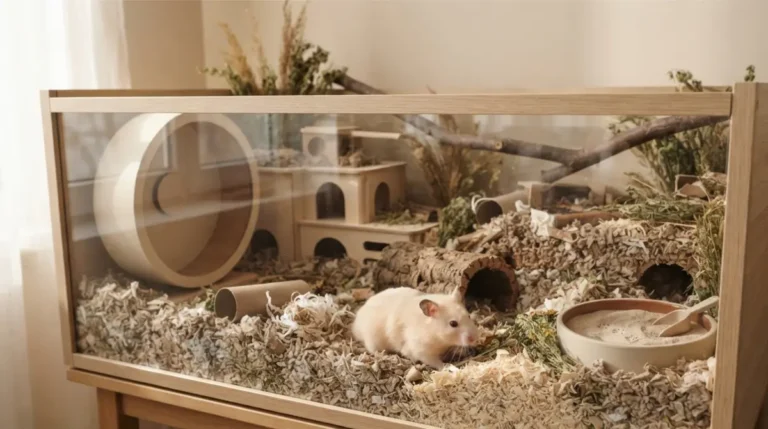
- A ready-made cage or tank with a base of at least 100 × 50 cm is the other route. Compare large hamster cages that meet 775 square inches.
Why joining small cages isn’t the same
Linking two small cages gives you two small floors joined by a tube system, which Blue Cross advises against. It is not one continuous floor.
✅ Do This: Measure your base tonight. If it’s under 775 square inches, plan an upgrade and reuse the levels as extras in the new setup.
Hamster floor space and levels: quick answers
1. Do levels count as floor space for hamsters?
No. Only the continuous base floor counts toward a hamster’s floor space; levels, shelves, and tubes are extras added on top.
2. Is a tall multi-level cage okay for a hamster?
Only if its base alone meets the floor space minimum. Height and levels don’t add usable floor for a hamster.
3. How big should a hamster cage floor be?
Blue Cross and PDSA use 100 × 50 cm of floor space, about 775 square inches, as the hamster cage minimum.
4. Do dwarf hamsters need less floor space?
No. Blue Cross and PDSA don’t set a smaller floor space minimum for dwarf hamsters than for Syrian hamsters.
5. Can hamsters get hurt falling from levels?
Yes. Blue Cross notes hamsters have poor depth perception and can be injured falling from ledges, so keep platforms low.
6. Is 775 square inches enough floor space?
It’s the minimum Blue Cross and PDSA use, not a target. More unbroken floor space gives more room to burrow and explore.
7. Do tubes count as floor space?
No. Tubes add no floor space, and Blue Cross advises against elaborate tube systems for all hamsters.
8. Can I connect two small cages to reach the minimum floor space?
No. Two small cages joined by tubes give two small floors, not the continuous floor space a hamster needs.
9. How deep should hamster bedding be?
Blue Cross says at least 20 cm of bedding and PDSA suggests about 25 cm, which needs a deep base, not extra levels.
10. How do I measure hamster cage floor space?
Multiply the inside length by the inside width of the base tray, then compare with 5,000 cm², about 775 square inches.
Measure the floor, then add the extras
Your hamster’s real floor space is the base alone: length times width, with nothing stacked above it counted. Aim for at least 100 × 50 cm (about 775 square inches) and give your hamster deep bedding. Add platforms only as low, solid extras once the floor is right.