How Deep Hamster Bedding Should Be for Healthy Burrowing

Hamster bedding depth changes behavior: Syrians on 4 inches chewed wire more, and every one on 16 inches built a burrow. See each standard.
Table of Contents
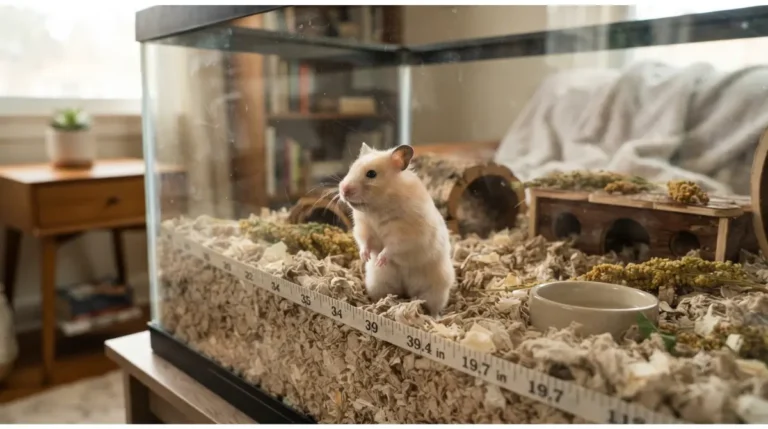
Hamster bedding should be at least 20–25 cm (8–10 inches) deep. That’s the minimum set by the UK welfare charities Blue Cross and PDSA. Research on Syrian hamsters found that at 40 cm (about 16 inches) or more, every hamster built and lived in its own burrow.
If your cage base holds 2 inches, you’re far from alone. Many cages are sold that way, and the fix is simpler than it looks.
- Seeing bar chewing? Skip to the signs your hamster needs deeper bedding.
- Keep a dwarf hamster? See the Syrian vs dwarf section.
- Base too shallow? Go straight to building one deep zone.
Depth is half the setup. The other half is covered in our guide to how much floor space a hamster cage needs.
What the bedding-depth study actually found
One controlled experiment sits behind almost every “deep bedding” recommendation you’ll read.
The setup: 10, 40 and 80 cm
In a 2006 study in Applied Animal Behaviour Science, researchers at the Vetsuisse Faculty in Bern housed 45 male Syrian (golden) hamsters. Each lived alone on 10, 40 or 80 cm of wood shavings.
What changed at 10 cm
Hamsters on 10 cm showed significantly more wire-gnawing and ran on their wheels more than the deeper groups. No hamster on 80 cm gnawed the wire. Every hamster on 40 or 80 cm dug a burrow and lived in it.
📊 Tested / Spec: The researchers concluded that at least 40 cm of bedding appeared to improve Syrian hamster welfare. The Merck Veterinary Manual’s hamster chapter gives the same 40–80 cm welfare figure for Syrians.
What the study didn’t test
It used only males, only Syrians and only wood shavings, in a laboratory. The 80 cm group also carried more body fat, so deeper isn’t endlessly better.
Why the recommended depths don’t match
Published figures range from 15 cm to 80 cm because each one answers a different question.
Legal minimum vs welfare minimum vs research benchmark
| Source | Recommended depth | Key Detail |
|---|---|---|
| Swiss Animal Welfare Ordinance | 15 cm (6 in) | Legal floor for golden hamsters |
| Blue Cross’s hamster wellbeing advice | 20 cm (8 in) | Minimum digging bedding for tunnels and nests |
| PDSA’s hamster care guidance | 25 cm (10 in) | Minimum so hamsters can burrow |
| RSPCA’s hamster environment advice | No number given | Deep enough to dig, plus a burrowing area where possible |
| Merck Veterinary Manual | 40–80 cm (16–31 in) | Welfare benchmark for Syrians |
Figures checked against each organization’s published guidance, September 2026.
A legal minimum is what the law allows. A charity minimum is what lets a hamster burrow. The research figure is the depth at which every Syrian in the study built a burrow.
The advice that’s now outdated
🔄 Outdated Advice: Some retailer care guides still suggest as little as 2 inches of bedding. Every current figure above is at least three times that, so treat 20–25 cm as your starting point.
Do dwarf hamsters need bedding this deep?
Yes, based on current guidance, though the evidence behind that answer is weaker than for Syrians.
Syrians: direct experimental evidence
The 40 cm research finding applies to Syrian hamsters, the only species tested.
Dwarfs: charity guidance, no controlled study found
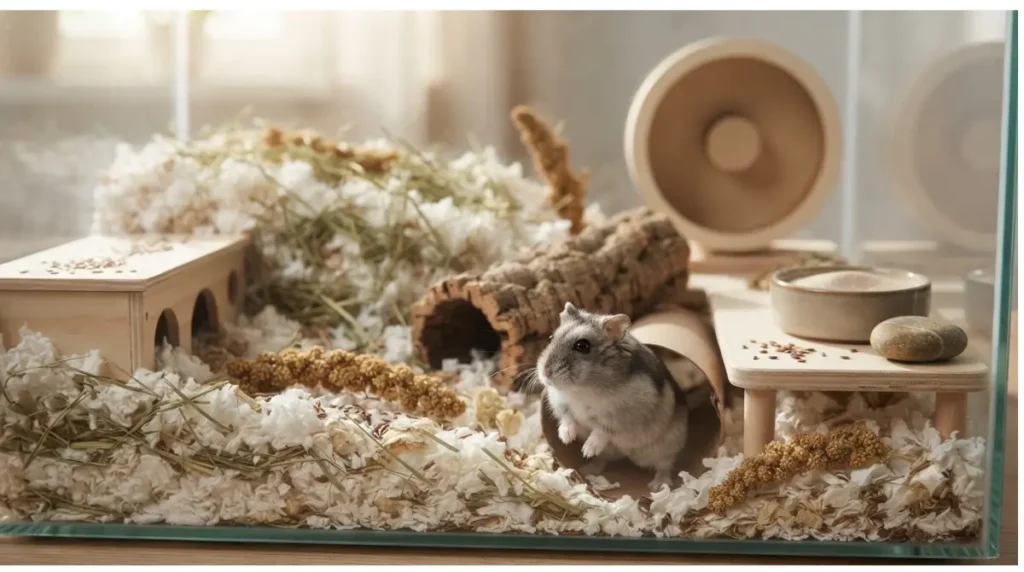
We found no controlled bedding-depth trial on dwarf hamsters (Roborovski, Campbell’s or Winter White). Blue Cross and PDSA apply their 20 cm and 25 cm figures to hamsters in general. Neither sets a lower figure for dwarfs.
Missing research isn’t evidence that dwarfs need less. Give them the same 20–25 cm starting depth. For the floor-space side, see how dwarf and Syrian housing needs differ.
How to get deep bedding in a normal cage
A shallow base doesn’t automatically mean buying a new enclosure.
Check your base height
Measure from the floor of the cage base to its top edge. That’s the most bedding it can hold without spilling. The Merck Veterinary Manual’s owner guide says enclosures should be at least 6 inches (15 cm) high, and 8 inches (20 cm) or more is better because it allows deeper bedding.
Build one deep zone
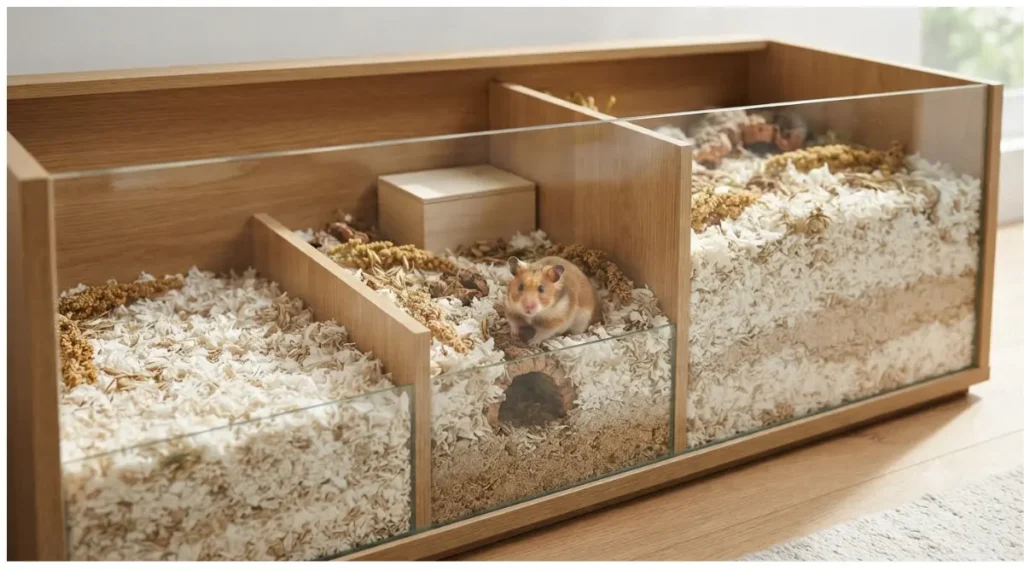
If the whole floor can’t reach 20–25 cm, pile bedding deep in one section and hold it in with a solid panel inside the bars. The Bern team found hamsters on 40 or 80 cm used an artificial shelter only occasionally. Expect your hamster’s burrows to take over part of the hide’s job. A tall-sided DIY bin cage that holds deep bedding makes this far easier.
How many litres you’ll need
| Depth | Litres for a 100 × 50 cm floor (≈775 sq in) | Key Detail |
|---|---|---|
| 20 cm (8 in) | ~100 L | Blue Cross minimum |
| 25 cm (10 in) | ~125 L | PDSA minimum |
| 40 cm (16 in) | ~200 L | Research figure for Syrians |
These figures are calculated (floor area × depth), not measured in a real fill. Packing bedding down so tunnels hold will use more. Start by learning to measure your enclosure’s usable floor space.
Why the bedding type matters as much as depth
Depth only counts if a tunnel dug into it stays standing.
Mix for structure
PDSA advises that aspen, spruce and hemp don’t support burrows well on their own, so mix in paper-based bedding for stability. Soft hay adds more structure.
✅ Do This: Push a finger-width tunnel into one corner of the bedding. If it collapses straight away, mix in more paper bedding or hay before adding depth.
What to avoid
⚠️ Watch Out: PetMD’s hamster care sheet warns that fluffy bedding can cause gut blockages if swallowed and can wrap around a hamster’s paws. It also lists cedar shavings as toxic to hamsters. Skip both, however deep you’re filling.
Signs your hamster needs deeper bedding
These signs apply to all hamsters, though the research link between depth and behavior comes from Syrians.
Bar chewing
In the Bern study, Syrians on 10 cm of bedding gnawed the wire far more than those on deeper bedding. A cage that’s too small can also cause bar chewing, so read why hamsters bite their cage bars before changing only one thing. If chewing continues after you’ve upgraded both depth and space, book a check with a hamster-experienced vet.
No burrow, only surface nests
Every Syrian given 40 cm or more in the study built a burrow. A hamster that only ever sleeps on the surface may lack depth, or bedding that holds a tunnel.
Hamster bedding depth: quick answers
1. Is 6 inches of hamster bedding enough?
Six inches (15 cm) matches the Swiss legal minimum. Blue Cross and PDSA recommend at least 8–10 inches (20–25 cm) of hamster bedding.
2. How deep should bedding be for a dwarf hamster?
No dwarf-specific study exists, so follow the Blue Cross and PDSA figures for all hamsters: 20–25 cm (8–10 inches) of bedding.
3. Can hamster bedding be too deep?
In the 2006 study, Syrian hamsters on 80 cm of bedding carried more body fat. The researchers named at least 40 cm as the welfare benefit point.
4. Why does my hamster chew the cage bars?
Shallow bedding was linked to more wire-gnawing in Syrian hamsters, but a too-small cage can also cause bar chewing, so check both.
5. Which hamster bedding holds burrows best?
PDSA says paper-based bedding supports burrows. Aspen, spruce and hemp need paper mixed in, and soft hay adds extra structure.
6. How do I get deep hamster bedding in a wire cage?
Build one deep zone behind a solid panel inside the bars, or move to a tall-sided bin cage that holds 20–25 cm.
7. How much hamster bedding do I need to buy?
For a 100 × 50 cm floor, 20 cm of hamster bedding is about 100 litres by calculation. Packing it down for burrows uses more.
8. Does the RSPCA give a hamster bedding depth?
No. The RSPCA gives no number, saying only that hamster bedding should allow digging, with a deeper burrowing area where possible.
9. Is fluffy hamster bedding safe?
No. PetMD warns that fluffy hamster bedding can cause gut blockages if swallowed and can wrap around a hamster’s paws.
10. Does deep bedding replace a hamster hide?
Syrian hamsters on 40–80 cm of bedding used an artificial shelter only occasionally, so expect burrows to take over part of the hide’s job.
Your next step: check the depth you have
Aim for at least 20–25 cm (8–10 inches) of hamster bedding for every hamster. That’s the Blue Cross and PDSA minimum. Treat 40 cm (16 inches) as the research benchmark for Syrians. Tonight, hold a ruler against your enclosure’s base. If it falls short, build one deep zone first.