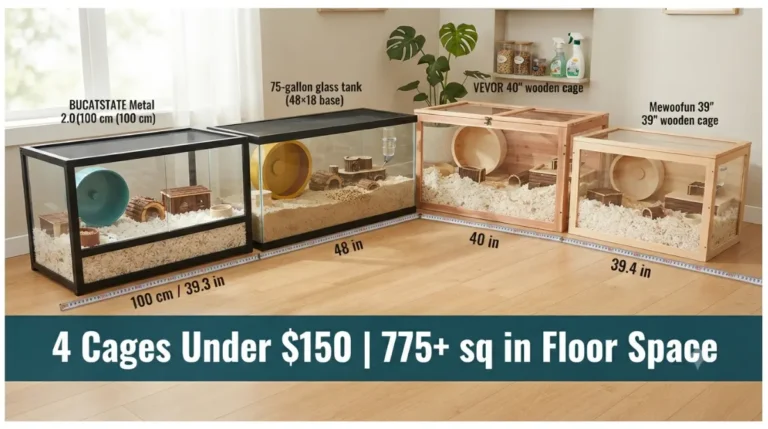
How to measure hamster cage floor space without guesswork

Hamster cage floor space comes from the inside of the base. The Skyline Hoppelgarden 100 lists 39.4 × 28 in outside and 38.6 × 20.5 in inside, 789 sq in.
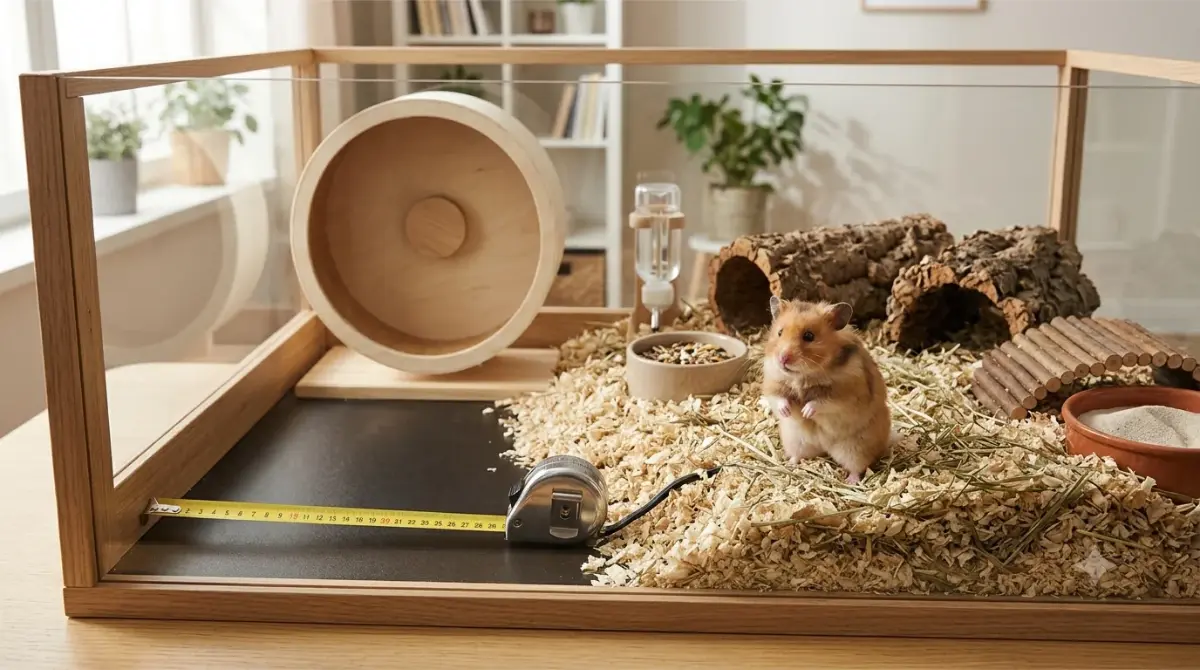
Table of Contents
Care guidance checked on October 28, 2026.
Hamster cage floor space is the inside length of the base multiplied by its inside width, and the figure to compare it with is 775 square inches (5,000 cm²). That is the 100 × 50 cm minimum that PDSA cites from Germany’s Veterinary Association for Animal Welfare, and the size Blue Cross also uses. The size on the box can mislead by a wide margin: a Sterilite 180-quart tote lists 758 square inches across its outside and 521 across its inside bottom.
The method doesn’t change between a Syrian, a Campbell’s, a winter white, a Roborovski or a Chinese hamster, because neither charity sets a smaller floor for dwarf species.
Measure the inside of the base, wall to wall
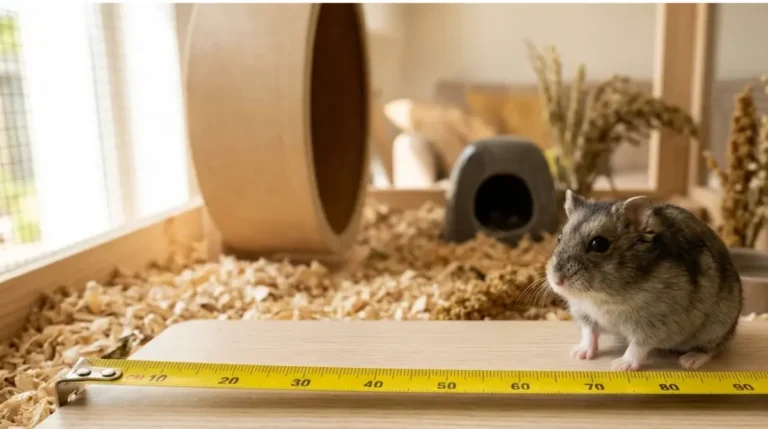
Start with the enclosure empty, or do it during a full clean, so bedding doesn’t hide the line where floor meets wall. A rigid tape lies flatter than a sewing tape and won’t ride up a curved corner.
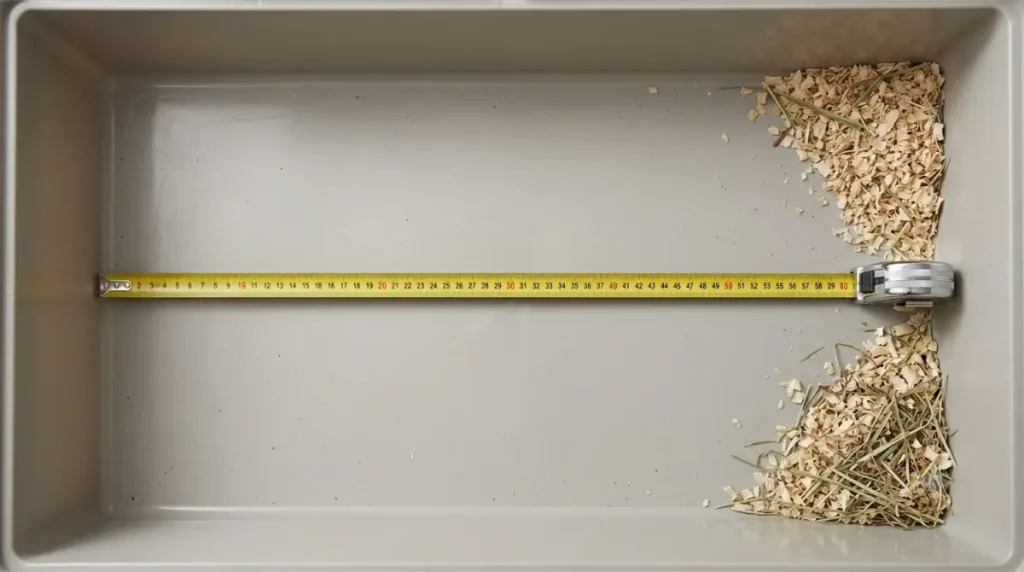
- Lay the tape flat on the floor of the base, not along the top rim.
- Read the inside length at floor level, from one wall to the other.
- Read the inside width the same way.
- Round each reading down to the nearest ¼ inch (0.5 cm).
- Multiply length by width.
- Compare the result with 775.
Near the line, rounding decides the answer. A base that reads 39⅜ by 19⅝ inches is 100 cm long and a little under 50 cm wide, and it multiplies out to 772.7 square inches (4,985 cm²). That is 2.3 short of 775, a gap that vanishes if the total gets rounded up, so keep the product as it comes out.
What the listed size leaves out
The Skyline Hoppelgarden 100 is listed at 39.4 by 28 inches (100 by 71 cm) on the outside, which would suggest about 1,100 square inches. Its listed inside is 38.6 by 20.5 inches (98 by 52 cm), or 789 square inches, which passes 775 by just 14.
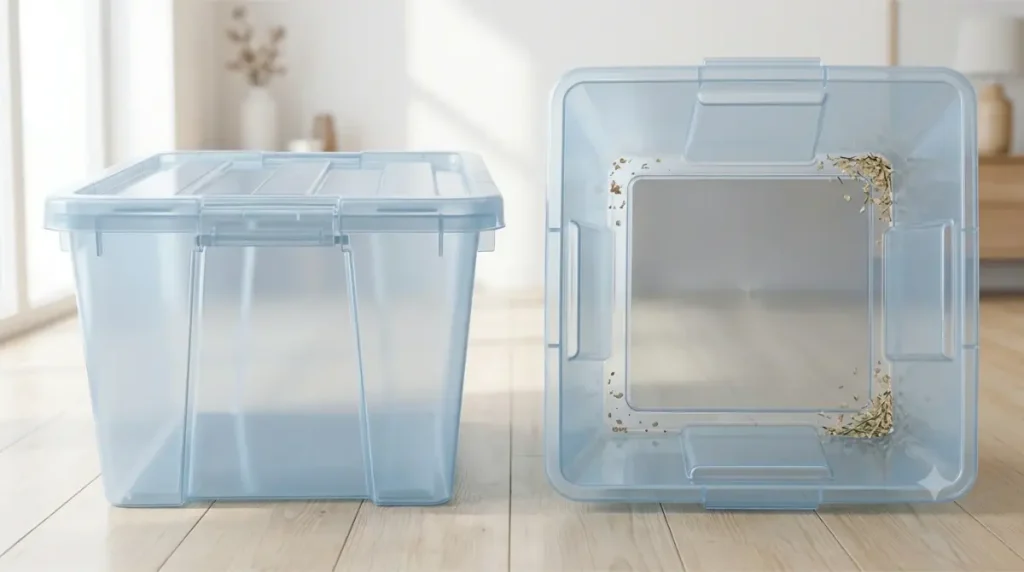
Frames, lids, rims and wall thickness are all counted in the outside figure, and how much they take depends on the design. Each listing below states both sets of numbers, so the gap can be read straight off the page.
| Listing (retailer, country, checked Oct 28, 2026) | Outside | Inside base | Inside as share of outside |
|---|---|---|---|
| Skyline Hoppelgarden 100 (zooplus.com, Europe) | 39.4 × 28 in (100 × 71 cm) = 1,100 sq in | 38.6 × 20.5 in (98 × 52 cm) = 789 sq in | 72% |
| Skyline Lima 80 (zooplus.com, Europe) | 31.5 × 23.6 in (80 × 60 cm) = 744 sq in | 30.7 × 22.8 in (78 × 58 cm) = 701 sq in | 94% |
| Sterilite 180 qt Wheeled Latching Tote (Staples, US) | 36⅛ × 21 in (91.8 × 53.3 cm) = 758 sq in | 30¼ × 17¼ in (76.8 × 43.8 cm) = 521 sq in | 69% |
| Sterilite 45 gal Wheeled Latch Tote (Walmart, US) | 36⅝ × 21 in (93.0 × 53.3 cm) = 769 sq in | 30⅝ × 16 in (77.8 × 40.6 cm) = 490 sq in | 64% |
| Member’s Mark 60 qt Clear Tote (Sam’s Club, US) | 25.7 × 17.2 in (65.3 × 43.7 cm) = 442 sq in | 21.3 × 12.9 in (54.1 × 32.8 cm) = 274 sq in | 62% |
Listed dimensions: Skyline Hoppelgarden 100, Skyline Lima, Sterilite 180 qt, Sterilite 45 gal, Member’s Mark 60 qt. Square inches are converted from each listing and rounded down.
The Sterilite 45-gallon tote is the one to remember. Its outside comes within 6 square inches of 775, while its inside bottom falls 285 short. It holds the same 180 quarts as the other Sterilite tote, yet its bottom is about 31 square inches smaller, which shows how little a quart or gallon rating says about floor. A thin-framed wire cage like the Lima 80 gives up far less, about 6 percent. Enclosures whose listed inside base passes the minimum are compared in large hamster cages with enough unbroken floor.
Before you buy: if a listing gives only outside dimensions, ask the seller for the inside base or check it with a tape in the store.
Tapered bins lose more floor than rounded corners
A rounded corner costs very little floor. The area lost at each corner is about 0.215 times the corner radius squared. Four corners with a 2-inch (5 cm) radius take about 3.4 square inches (22 cm²), and four 3-inch (7.6 cm) corners take about 7.7 (50 cm²).
Sloping walls are a different matter. Storage totes are molded narrower at the bottom than at the top, and the Member’s Mark 60-quart listing gives both inside figures: 14.4 by 22.7 inches at the top (326 square inches) and 12.9 by 21.3 inches at the base (274 square inches). That taper alone takes 52 square inches, roughly fifteen times what the corners cost.
In a bin, then, the bottom is the measurement to compare. The surface of deep bedding sits higher up, where the walls are wider, but no welfare standard defines floor area at bedding height. Comparing the bottom keeps a bin from passing on a number its floor doesn’t have. Which totes reach the minimum at the bottom, and how to fit a ventilated lid, is covered in how to size and build a hamster bin cage.
Glass tanks and wire-top cages
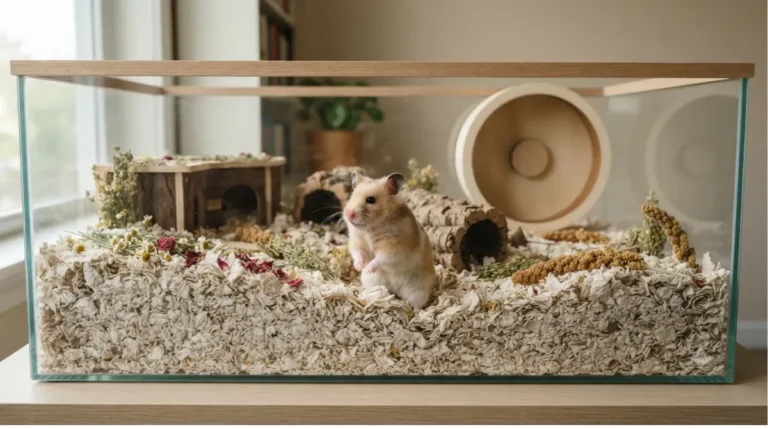
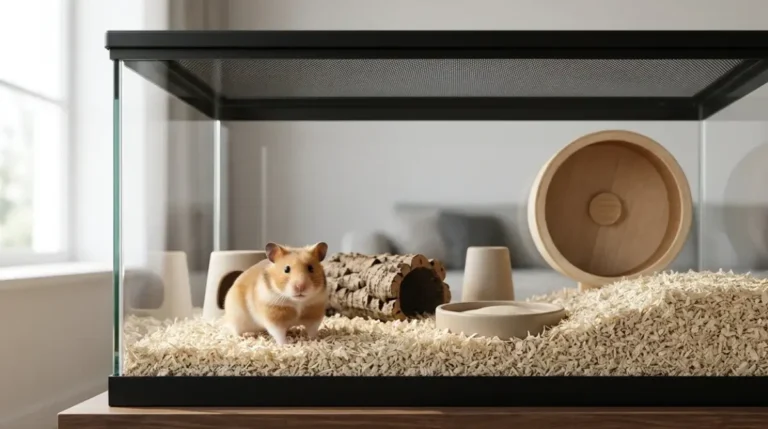
Aquariums are sold by gallons, a measure of water, and their listed length and width are outside figures that include the glass and the plastic trim around the rim. Measure inside the glass at floor level, below that trim. A 40-gallon breeder tank is sold as 36 by 18 inches (91 by 46 cm), which is 648 square inches (4,181 cm²) before the glass is taken off, so no amount of careful measuring brings it up to 775.
On a wire-top cage, only the plastic base tray counts. Measure the tray rather than the wire section that clips onto it, since the tray floor is what the hamster walks and digs on.
Does an L-shaped or joined enclosure count?
If the floor is one open area with no wall or tube between the parts, split it into rectangles, measure each one inside, and add them. An L-shaped enclosure with a 40 by 20 inch main run (102 by 51 cm) and a 20 by 15 inch arm (51 by 38 cm) adds up to 800 plus 300, or 1,100 square inches (7,096 cm²).
Enclosures joined by a tube are another case. Compare only the largest single floor with 775 and treat the rest as extra room. Shelves and second levels never add to the total, for the reasons set out in why cage levels don’t count as floor space.
The evidence behind the continuous-floor rule is thinner than its popularity suggests. Vet Help Direct notes that it appears to be mostly anecdotal rather than based on research. It is still the safer way to compare, because it stops a row of small connected boxes from reading as one large home.
Converting centimeters to square inches
Square centimeters divided by 6.4516 gives square inches. That turns 5,000 cm² into 775 square inches, and a 98 by 52 cm base (5,096 cm²) into 789.
Working in inches from the start gives the same result. Divide each side by 2.54 first: 100 cm is 39.37 inches and 50 cm is 19.69 inches, so the target base is about 39.4 by 19.7 inches. Older targets of 360 or 450 square inches still turn up in online calculators, and the comparison of published hamster cage minimums shows where each figure comes from and why the charities moved on from them.
If the floor comes up short, size the upgrade
A 490-square-inch floor is 285 short of 775, and writing that gap down before shopping keeps the next enclosure from repeating the same miss. Most cages sold in shops are too small for a hamster’s basic needs, according to PDSA, so a cage that fails this check is common and fixable. Take the gap to the next listing or store, and check each candidate’s inside base the same way before you pay.
Wheels, hides and dwarf hamsters
Should I subtract the wheel and hides?
No. Measure the empty base and compare that total. No deduction for a wheel, hides or a sand bath appears in the PDSA guidance, which gives 100 × 50 cm as a minimum cage size. The wheel still needs room inside it: at least 12 inches (30 cm) across for a Syrian and 8 inches (20 cm) for a dwarf hamster (PDSA, citing the German veterinary association).
Is the method different for dwarf hamsters?
No. The tape goes in the same places for a Roborovski as for a Syrian, and Blue Cross and PDSA give dwarf species the same floor minimum. Dwarfs differ on bar gaps and wheel size, which are set out in dwarf hamster cage size compared with a Syrian’s.