Hamster Escaped From Cage? A Calm Plan for Tonight and Beyond

A hamster escaped from its cage is usually more active at night. Here’s a calm catch plan, then the lid, mesh and corner checks that come after.

Table of Contents
Hamster loose right now? Start here
🚨 Vet Now: Hamsters hide injury well, so contact a vet experienced with small mammals right away if yours seems hurt or unwell after an escape.
Everything here applies to Syrian and dwarf hamsters unless a section says otherwise. If yours is loose right now, read the next section first; if it’s back in its enclosure and you want to stop a repeat, jump to the lid section.
The RSPCA notes that hamsters dig quickly and can escape easily from poorly constructed cages, so an escape often points to the enclosure, not to a failure on your part.
🩺 Health Note: This is general information, not a substitute for an exam by a vet experienced with hamsters. Hamsters hide pain and can decline quickly, so if yours seems unwell after an escape, don’t wait to see if it improves. If you don’t have a small-mammal vet yet, find one before you need one.
How to catch an escaped hamster tonight
A hamster is usually more active at night, so tonight is a good chance to catch an escaped hamster. These steps apply to all hamster species.

Close the room and keep other pets out
Shut the room’s doors and keep cats and dogs out. Search dark, enclosed spaces first and listen for scratching.
Set a bucket trap and go to bed
The Hamster Forum, a keeper community, recommends a bucket trap: a bucket, a pile of books, a ruler or stiff card, a small towel and food such as cucumber or cheese. Set it in the middle of the closed room, turn the lights off and leave it overnight.
If it’s behind a wall or under a floor
If you hear scratching in a wall or under floorboards, the same guide suggests placing the enclosure near the hole.
Why hamsters keep trying to get out
Repeated escape attempts in any hamster species often point to the enclosure, not the hamster.
Too small or too bare
The Hamster Forum, a keeper community, says hamsters rarely try to escape unless the enclosure is too small, too bare or over-cleaned. Blue Cross advises at least 100 cm x 50 cm of floor space (about 775 square inches), as our hamster cage size minimums guide explains.
Stress and repeated behavior
The RSPCA says repetitive behavior can signal stress. If yours chews its bars, our guide to hamsters biting cage bars covers what to change.
A build with weak points
Size isn’t the only cause: a lid that doesn’t fit, weak mesh or a chewed corner gives a hamster a way out, and the RSPCA says a cage should be secure.
Lids a hamster can’t push, chew or squeeze past

A tank or bin cage only works if its lid stays shut, for every hamster species.
Tank and bin lids: fit and fastening
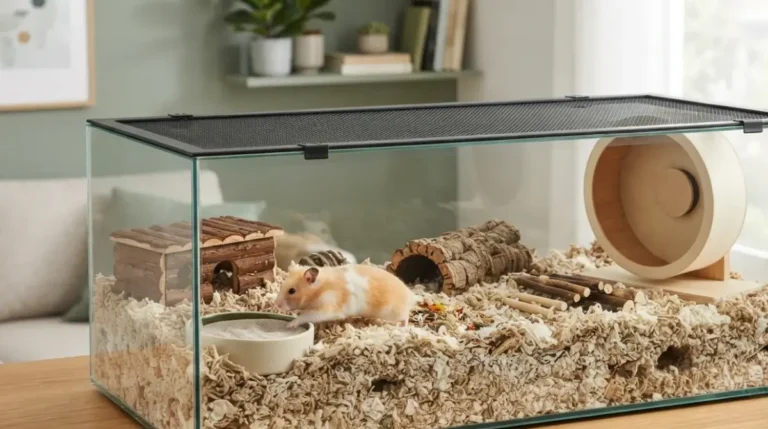
Blue Cross says a tank still needs a mesh lid, with gaps under 1 cm. The Hamster Forum reports hamsters pushing up loose lids, so fasten yours with a clip or latch. Keepers also warn that flimsy window-screen mesh gets chewed.
Detolf lids: mesh, frame and supports
A Detolf turned on its side has no lid of its own, so you’ll need to build one; our IKEA Detolf hamster cage guide covers floor space. The RSPCA advises against wooden cages, so put mesh on the underside of any wooden frame (our editorial suggestion).
Ventilation without gaps
Never close a gap with a solid lid; Blue Cross says a tank needs a mesh lid for ventilation.
Chew points, gaps and other escape routes
Every hamster species can exploit the weak points below, drawn from keeper reports and welfare guidance.
Bedding depth and climb-out height
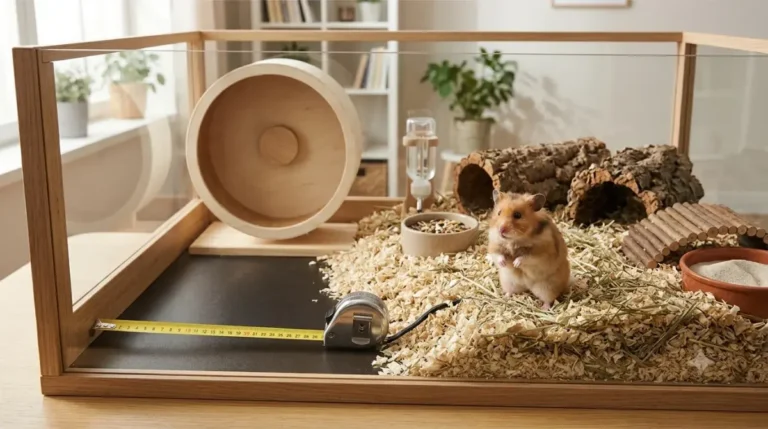
Blue Cross recommends at least 20 cm of digging bedding. Measure from the highest point a hamster can climb (bedding, wheel or hide) to the rim.
Bin cage corners and mesh
The Hamster Forum reports hamsters chewing out of bin cages at bottom corners, even with a secure lid; our hamster bin cage guide covers the build.
Wood parts, doors and seams
The RSPCA advises against wooden cages; run a hand along every seam, door and joint.
| Escape route | Check | Source |
|---|---|---|
| Lid | Snug, fastened | Hamster Forum |
| Mesh | Gaps under 1 cm | Blue Cross |
| Bin corners | No chew marks | Hamster Forum |
| Wood parts | Replace or cover | RSPCA |
| Seams, doors | No cracks | Editorial |
Syrian vs dwarf hamsters: how big a gap is too big
Blue Cross says hamster enclosure gaps should be under 1 cm; other sources split by species.
| Source | Syrian | Dwarf | Roborovski |
|---|---|---|---|
| Blue Cross (UK) | under 1 cm | under 1 cm | under 1 cm |
| The Hamingway | 1 cm | 0.8 cm | 0.6 cm |
| PetMD (mesh top) | 1/2 in | not given | not given |
| Keeper forums | 1/2 in | 1/4 in | not given |
Syrian hamsters
Sources run from under 1 cm to 1/2 inch.
Campbell’s and Winter White dwarfs
Sources run from under 1 cm to 1/4 inch.
Roborovski hamsters
Of the sources we reviewed, only The Hamingway gives a Roborovski-specific limit (0.6 cm); our Roborovski cage size and bar spacing guide goes deeper.
Note that 1/2 inch is 1.27 cm, wider than Blue Cross’s limit. We lean to the tighter figure for dwarfs and Roborovskis, which is our editorial judgment, not a published standard.
After you catch it: what to check and when to call a vet
🚨 Vet Now: Hamsters hide injury well, so contact a vet experienced with small mammals right away if yours seems hurt or unwell after an escape.
The RSPCA says hamsters don’t show outward signs of pain and can lose condition quickly when unwell.
Signs to call a vet
Call for any of these:
- A limp, a dragged leg or swelling
- Wobbling, weakness or slow responses
- Refusing food or water
- Feeling cold or not responding
Keeping it safe until then
Put your hamster back in a secure enclosure and call your vet. Give no medicine unless a vet prescribes it; the RSPCA warns that human and other animal medicines are dangerous to hamsters.
FAQ
1. How do you catch an escaped hamster?
For an escaped hamster: shut the room’s doors, set a bucket trap with food in the middle, then leave it overnight in the dark.
2. Where do escaped hamsters hide?
An escaped hamster is usually easiest to find in dark, enclosed spaces, so search those first and listen for scratching.
3. Is it easier to find an escaped hamster at night?
Yes, an escaped hamster is usually more active at night, so a night-time search and a trap left overnight give the best chance.
4. What gap size is too big for a hamster enclosure?
Blue Cross says gaps in a hamster enclosure’s bars or mesh should be under 1 cm; some keeper sources set tighter limits for dwarfs.
5. Can a hamster escape from a tank with a lid?
Yes. A hamster can push up a loose lid or chew weak mesh, so fit tank lids snugly, fasten them and use sturdy mesh.
6. What mesh size should a DIY hamster lid use?
For a DIY hamster lid, use mesh gaps under 1 cm (Blue Cross) and lean tighter for dwarf and Roborovski hamsters.
7. Can hamsters chew out of a bin cage?
Yes. Keepers report hamsters chewing out of bin cages, usually at bottom corners, even with a secure lid, so inspect corners regularly.
8. Are wooden hamster cages escape-proof?
No. The RSPCA advises against wooden hamster cages, and hamsters chew, so wood is a weak point to replace or cover.
9. Why does my hamster keep trying to escape?
Keepers say a hamster tends to try escaping when its enclosure is too small or bare, or after too much cleaning.
10. Should I call a vet if my hamster escaped and fell?
Yes. Hamsters hide pain after an escape or fall, so contact a vet experienced with small mammals rather than waiting.
Next steps
Finding a loose hamster takes a quiet, closed room and an overnight trap. Keeping it in takes a snug, fastened lid, mesh gaps under 1 cm, and a regular check of every corner and seam.
Run the audit table against your own enclosure this weekend and fix the weakest point first. If your hamster ever seems hurt after an escape, see a vet experienced with small mammals.