A Calm Gerbil vs Hamster Guide to Space, Company and Cost

Gerbil vs hamster comes down to company: gerbils live in same-sex pairs, Syrian and Chinese hamsters live alone, and the details differ by type.
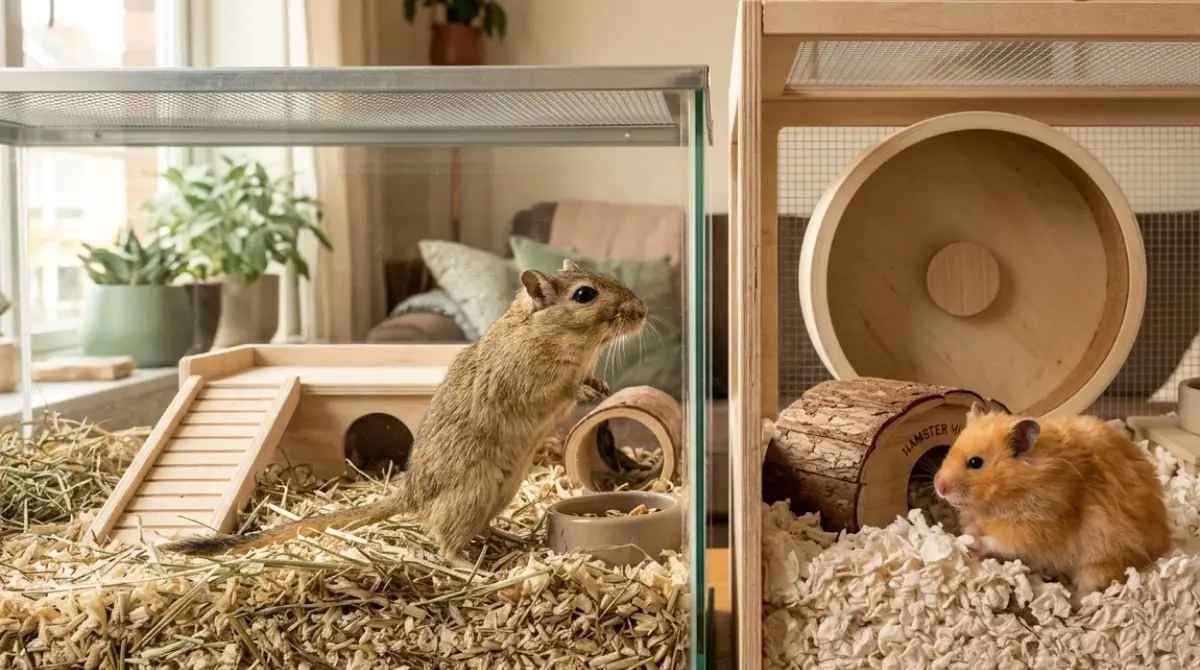
Table of Contents
Gerbil or hamster? Check your state, then your floor space
A Mongolian gerbil suits a home that can keep a pair; a hamster suits a home that wants one pet.
Which one fits your home?
- Choosing for a child? See the handling section.
- Short on space? Read the housing section first.
- Already own one gerbil or a starter cage? There is a fix below, and no blame.
Check your state first

California’s wildlife agency lists gerbils among animals prohibited as pets. Its Title 14 Section 671 exempts only golden (Syrian) and Phodopus dwarf hamsters, so Chinese hamsters are not clearly allowed. Check your state or city wildlife agency before you buy.
🩺 Health Note: This is a legal question, not a medical one. Laws vary and change, so confirm with your wildlife agency. For health concerns, see a vet experienced with small mammals.
Next, how the two compare.
Gerbil vs hamster at a glance, by type
Choose gerbils if you can house a same-sex pair, and a hamster if you want a single pet.

The quick answer by situation
| Type | Company | Active | Key Detail |
|---|---|---|---|
| Mongolian gerbil | Same-sex pair | Day | Digs; needs deep bedding |
| Syrian hamster | Alone | Night | Needs the largest wheel |
| Chinese hamster | Alone | Night | Not in California’s exemption |
| Dwarf hamsters | Alone is safest | Night | Some pairs possible (RSPCA) |
Sources: PetMD, RSPCA, Blue Cross, Woodgreen.
Lifespan and daily rhythm by type
Lifespan differs by source: gerbils 2-3 years per the Merck Veterinary Manual’s gerbil entry but 3-5 per PetMD and Woodgreen; hamsters 1-2 years per PetMD, up to 3 per Woodgreen. None splits hamsters by type. How dwarf and Syrian hamsters differ covers cage and wheel changes.
The biggest gap is space.
How much space each one needs
Hamsters need at least 100 x 50 cm of floor space; sources split on a gerbil pair.
| Type | Floor space | Source | Key Detail |
|---|---|---|---|
| Hamsters, all types | At least 100 x 50 cm, 50 cm tall | PDSA, Blue Cross | About 775 square inches |
| Gerbil pair | About 10 gallons | Merck | 5 per gerbil |
| Gerbil pair | At least 20 gallons | PetMD | Pair minimum |
| Gerbil pair | At least 100 x 50 x 50 cm | Woodgreen | Pair minimum |
Hamsters: the 100 x 50 cm range
PDSA’s hamster housing advice gives a minimum cage size of 100 x 50 cm, citing the Veterinary Association for Animal Welfare. Blue Cross says no smaller than 100 x 50 cm floor space by 50 cm tall. See what 775 square inches looks like.
A gerbil pair: why sources disagree
No single figure is neutral. How to set up a gerbil tank for a pair compares them.
Bedding depth and wheel size change the math
The RSPCA recommends 20-30 cm of gerbil bedding and Woodgreen 20-25 cm; PetMD suggests only 1-2 inches. For hamster wheels, Woodgreen says 12 inches for Syrian and Chinese, 8 for the rest; Blue Cross gives Syrian 27-32 cm, dwarf types 20-25 cm.
Space settled, who lives with whom?
Pairs or solo: what each one needs socially
Yes. Gerbils should not be kept alone.
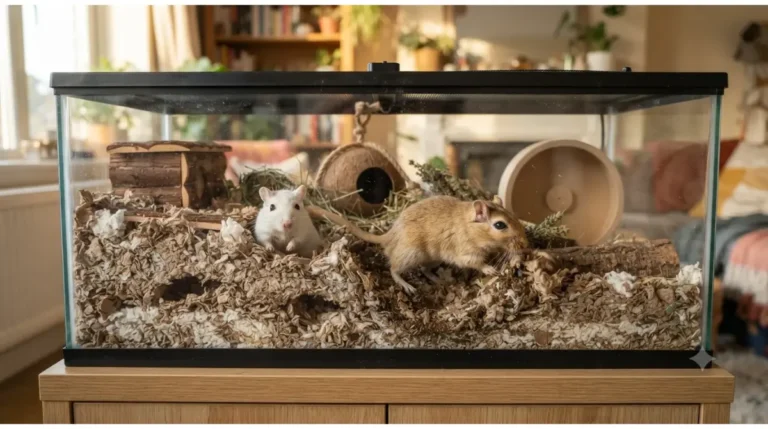
Gerbils: a same-sex pair, never one
The RSPCA’s gerbil companionship advice says gerbils live in same-sex pairs or groups formed early and kept stable, and established groups seldom accept newcomers. Already own one? Can gerbils live alone explains the next step, with no blame.
Hamsters: alone, with dwarf exceptions
The RSPCA’s hamster companionship advice says Syrian and Chinese hamsters always live alone, while some dwarf hamsters (Roborovski, Campbell’s Russian, winter white) can sometimes pair if grouped early. Woodgreen says every hamster must live alone. Solo is the safe default.
Now, what it costs.
What each one really costs
Costs follow setup: two animals and a large, deep bedding tank for gerbils; one animal, a 100 x 50 cm enclosure and a large wheel for a hamster.
First-year setup
We have not bought and priced either setup, so there are no dollar totals here. Merck suggests a tank with a mesh lid, bedding about one-third of its depth. A cheaper enclosure below the figures above does not meet welfare guidance.
Monthly upkeep
Ongoing costs are bedding, food and cleaning supplies. Merck recommends pellets formulated for gerbils and a full clean at least every 2-3 weeks.
Last, daily life.
Handling, noise, and which suits a child
PetMD says gerbils are active during the day, while hamsters are nocturnal, so a hamster’s busiest hours fall while the household sleeps.
Daily rhythm and noise
PetMD adds that gerbils may produce slightly less smell; the RSPCA notes small quantities of urine.
Handling and children
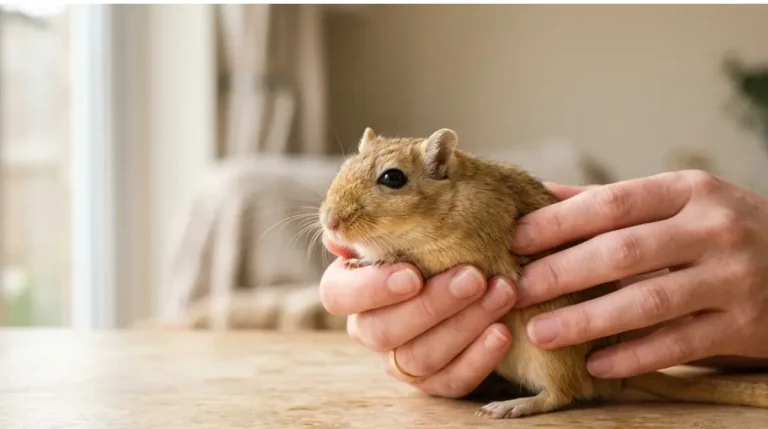
PetMD calls gerbils easier, more docile and less likely to bite, but Woodgreen says gerbils rarely enjoy handling and suit families happy to watch them. PetMD says hamsters are not great pets for children but suit adults and older children. Never hold either by the tail.
🔄 Outdated Advice: A hamster is often assumed to be the default child’s pet. PetMD, written by a veterinarian and reviewed by another, says otherwise.
Advice that still ranks but no longer holds up
These claims are common and easy to believe.
Cage sizes that are far too small
A 1-gallon tank or 2-square-foot cage is sometimes called enough for a hamster. PDSA and Blue Cross both give 100 x 50 cm as the minimum floor space.
Gerbil housing and diet myths
| Claim | Current answer | Source |
|---|---|---|
| Wire cages suit gerbils | Solid glass walls, wire-mesh top, solid floor; metal-bar cages not recommended | RSPCA |
| Seed mixes are fine | Pellets formulated for gerbils; avoid seed-and-pellet mixes | Merck |
| One gerbil is fine | Pairs or groups, never alone | RSPCA |
Already have one gerbil? You can introduce a second gerbil with a split cage, though the RSPCA notes established groups seldom accept newcomers.
Gerbil vs hamster: quick answers
1. Are gerbils or hamsters better for beginners?
PetMD calls gerbils easier and less likely to bite; Woodgreen says gerbils rarely enjoy handling. Hamsters suit older children or adults.
2. Can gerbils live alone?
No. The RSPCA says gerbils should never be kept on their own; same-sex pairs formed early are the usual arrangement.
3. Can two hamsters live together?
Not Syrian or Chinese hamsters, says the RSPCA. Some dwarf hamsters sometimes pair, but Woodgreen says every hamster lives alone.
4. Which is cheaper, a gerbil or a hamster?
It depends on setup: a gerbil pair needs a deep-bedded tank, one hamster a 100 x 50 cm enclosure and large wheel.
5. How big a cage does a hamster need compared with a pair of gerbils?
PDSA and Blue Cross say hamsters need at least 100 x 50 cm; gerbil pairs range from 10 gallons to 100 x 50 cm.
6. Do gerbils smell less than hamsters?
PetMD says gerbils may produce slightly less smell than hamsters, and the RSPCA notes small quantities of gerbil urine.
7. Are gerbils active in the day?
Yes. PetMD says gerbils are active during the day, while hamsters are nocturnal and most active at night.
8. Are gerbils legal in my state?
Not everywhere: California’s wildlife agency lists gerbils among prohibited pets. Check your state or city wildlife agency before buying gerbils.
9. How long do gerbils and hamsters live?
Gerbils live 2-3 years per Merck and 3-5 per PetMD and Woodgreen; hamsters 1-2 years per PetMD and up to 3 per Woodgreen.
10. Which is better for a child, a gerbil or a hamster?
PetMD says hamsters are not great pets for children but suit adults or older children; it calls gerbils easier. Never hold either by the tail.
Which one should you choose?
Gerbils suit a household that can keep a same-sex pair and enjoys watching a day-active pet; a hamster suits one that wants a single, night-active animal. Both need the floor space the welfare sources set out above, so measure before you buy. For either, the setup is where welfare is won.