Are Your Gerbils Fighting? Tell the Signs and Split Them Safely

Gerbils fighting can look like play until blood or a ball fight shows up. Here is how the sources tell the difference, and where they disagree.

Table of Contents
Gerbils fighting: separate now or keep watching?
Do this first if there is blood or a ball fight
If you see blood, two Mongolian gerbils rolling together in a ball fight, or one gerbil chased without a break, separate them now. Use a solid object or thick gloves, never bare hands, and give each gerbil its own container with a water bottle.
Any wound needs a vet experienced with gerbils or exotic pets. The American Gerbil Society (AGS) warns that warring gerbils must be split before a fight turns deadly.
Not sure yet? Here is how to tell
Some chasing and boxing is normal, and fights happen in well-kept pairs too. The next sections cover how to read the signs, separate safely, find the cause, and decide what comes next. Everything here applies to Mongolian gerbils.
🩺 Health Note: This is general information, not a substitute for an exam by a vet experienced with gerbils or exotic pets. Gerbils can be badly hurt in a fight, so any bite wound should be seen by a vet. If you don’t have an exotics vet yet, find one before you need one.
Playing or fighting? Three tiers to check
Dominance is normal between gerbils and becomes a problem only when one gets hurt, says the AGS.

| Tier | What you see | Action | Source |
|---|---|---|---|
| Normal | Brief chasing, boxing, no biting | Watch | Gerbilcare, PangoVet |
| Warning | Sleeping apart, cowering, blocked food, escalating mounting | Check causes | Omlet, Gerbilcare, AGS |
| Emergency | Ball fight, blood, non-stop chase | Separate now | AGS, Omlet, Gerbilcare |
Normal dominance and play
Boxing and wrestling without biting is usually play fighting, according to PangoVet’s gerbil guide.
Warning signs the pair is splitting
Gerbils that stop sleeping together or leave one cowering may be starting to declan, which means the bond is breaking, so check the causes below.
Emergency signs
A ball fight, blood, or a gerbil leaping to escape means separate now.
How to separate fighting gerbils safely
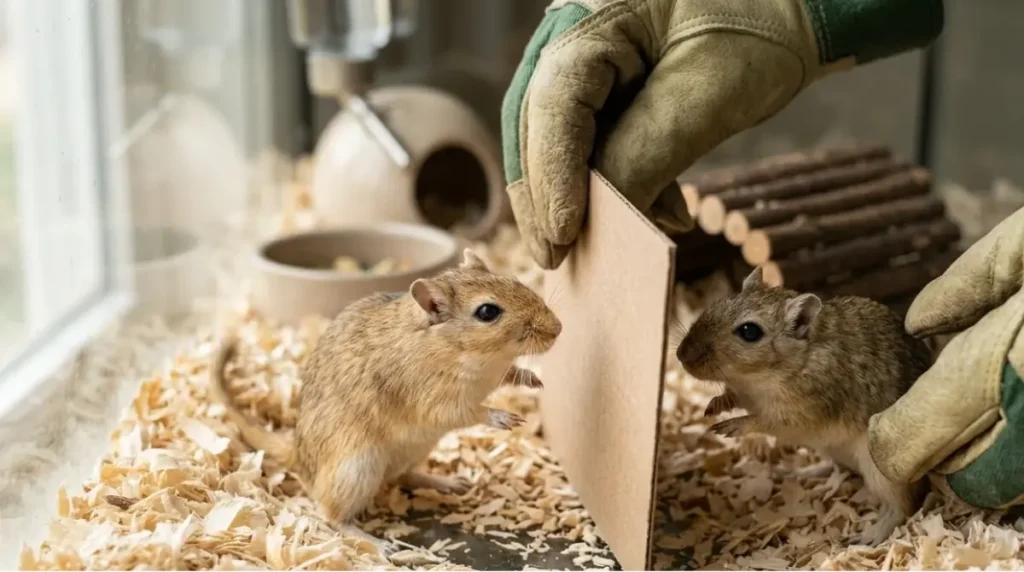
Safe separation needs three things: a barrier, thick gloves, and a spare container.
Break it up without bare hands
Slide a solid object between them or wear thick gloves; Chewy warns against touching fighting gerbils bare-handed, and the Merck Veterinary Manual’s gerbil housing guide notes stressed gerbils may bite.
Where they go next
The AGS advises keeping a spare container and water bottle ready. Its split cage divider lets gerbils see and smell, not touch, and Omlet suggests swapping sides a few times daily.
Separate now or wait? What sources say
Omlet, Chewy, and the AGS say separate once a fight or blood occurs. Gerbilcare says wait after a minor fight without blood, since a short split can leave two lone gerbils needing re-bonding. All four call a full ball fight dangerous.
Why gerbils suddenly start fighting
Sudden fights usually trace back to scent, rank, or setup.
Scent changes and illness
A full bedding change, handling one gerbil, or a strongly scented new toy can spark a fight between old partners, says the AGS. Omlet adds that illness can change a gerbil’s smell, so see a vet experienced with gerbils if one seems unwell.
Growing up and growing old
A maturing gerbil may challenge its partner, or an ageing partner may weaken, shifting dominance, says the AGS.
Space, hides and group size
Trios and larger groups are less stable than pairs, per the AGS. Check your gerbil tank setup for a pair and the tank size for a pair of gerbils.
🔄 Outdated Advice: Extra nest boxes can backfire; Omlet, Chewy, and Gerbilcare favor one shared nest box.
Fight wounds: when to call the vet
🚨 Vet Now: Any bite wound from a fight needs a vet experienced with gerbils or exotic pets as soon as possible, and a badly injured gerbil should go straight away.
See a vet if there is any wound
Wood Green, a UK animal charity, says fight wounds need a prompt vet visit for antibiotics, and Omlet says an abscess needs vet treatment.
Where to check
Wood Green advises checking the legs and face. Hair loss near the tail and rump can also come from fighting wounds, per the Merck Veterinary Manual’s gerbil disorders page.
What to ask the vet
Ask whether each wound needs treatment, whether the other gerbil should be checked, and how to keep the injured gerbil comfortable while it heals.
After the fight: reunite, or find a new partner?
A fighting pair can sometimes reunite, but a gerbil should never end up alone.
Can a fighting pair be reunited?
The AGS says a pair may reunite through the split cage method, though it is not guaranteed. Gerbilcare says to separate a fought pair permanently and re-bond each gerbil with a new partner.
If it was a trio
For a trio, the AGS advises keeping the aggressor with the gerbil he did not fight.
Never leave one gerbil alone
The RSPCA’s guidance on keeping gerbils together says they should never be alone, and the Merck Veterinary Manual recommends same-sex pairs. See whether a gerbil can live alone.
🔄 Outdated Advice: Putting separated gerbils straight back together can restart the fight; use a split cage first, as the AGS and Omlet advise.
Stopping the next fight
Prevention mostly means protecting the shared smell and keeping the nest simple.
Keep their scent shared
The AGS lists changed bedding, uneven handling, and strong smells as possible triggers, so leave some old nesting when cleaning, handle both gerbils alike, and avoid strong smells. A sand bath may help them share a scent.
Keep the setup simple
Keep one nest box, stay with a same-sex pair, and consider a motion-activated night camera, which Gerbilcare recommends for monitoring.
✅ Do This: After any fight, list anything that changed recently, from bedding to new toys to household smells.
Frequently asked questions
1. Are my gerbils playing or fighting?
Gerbils playing box and wrestle without biting; fighting means biting, blood, or a ball fight, according to PangoVet and the AGS.
2. When should I separate fighting gerbils?
Separate fighting gerbils at once for blood, a ball fight, or non-stop chasing, using a solid object or thick gloves. Any wound needs a vet experienced with gerbils.
3. Why are my gerbils fighting suddenly?
Gerbils fighting suddenly often follows a scent change, a rank shift as one matures or weakens, illness, or a group bigger than a pair. See a vet experienced with gerbils if one seems unwell.
4. Is it normal for gerbils to chase each other?
Brief chasing and boxing is normal dominance, but gerbil fighting that draws blood or becomes a ball fight is not.
5. Can fighting gerbils be put back together?
Fighting gerbils may reunite through the split cage method, says the AGS, but Gerbilcare advises permanent separation and new partners.
6. How can I stop gerbils fighting?
Stop gerbils fighting by keeping one nest box, leaving some old nesting when cleaning, handling both gerbils alike, and avoiding sudden strong smells.
7. Do gerbils fight to the death?
A ball fight between gerbils can turn deadly, so separate fighting gerbils before it escalates, the AGS warns. Wounds need a vet experienced with gerbils.
8. Should I take a gerbil with fight wounds to the vet?
Yes: gerbils fighting can leave bite wounds that may need antibiotics, so book a vet experienced with gerbils or exotic pets promptly.
9. Can one gerbil live alone after a fight?
No. The RSPCA says gerbils should never be kept alone, so a separated gerbil needs a new partner introduced through a split cage.
10. Can I touch fighting gerbils?
Never use bare hands on fighting gerbils; slide in a solid object or wear thick gloves, because stressed gerbils may bite.
What to do next
If your gerbils fought, separate them for blood, a ball fight, or non-stop chasing, and have any wound seen by a vet experienced with gerbils. Then choose between a careful reunion with the split cage method and a new partner, because a gerbil should not live alone.