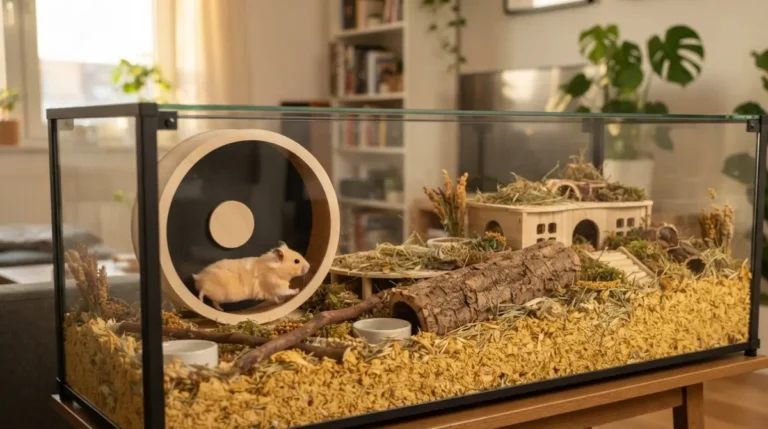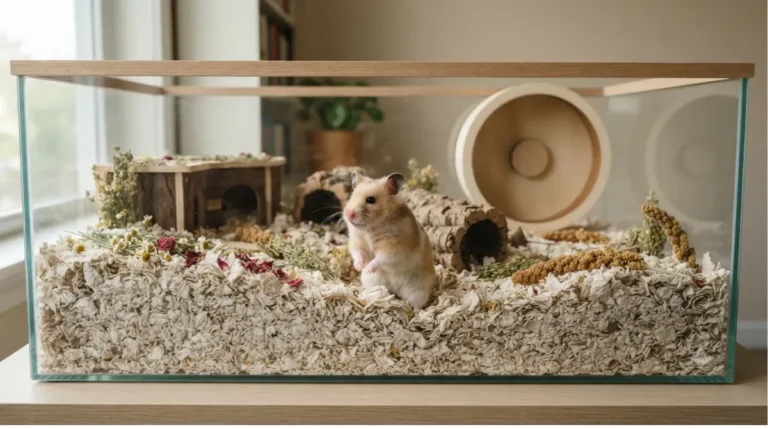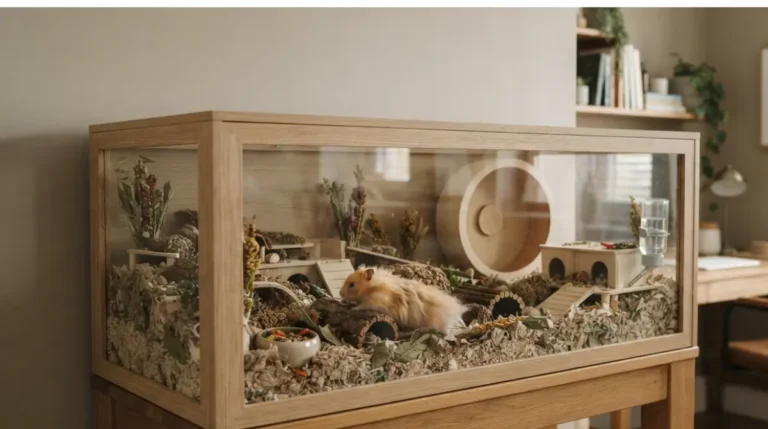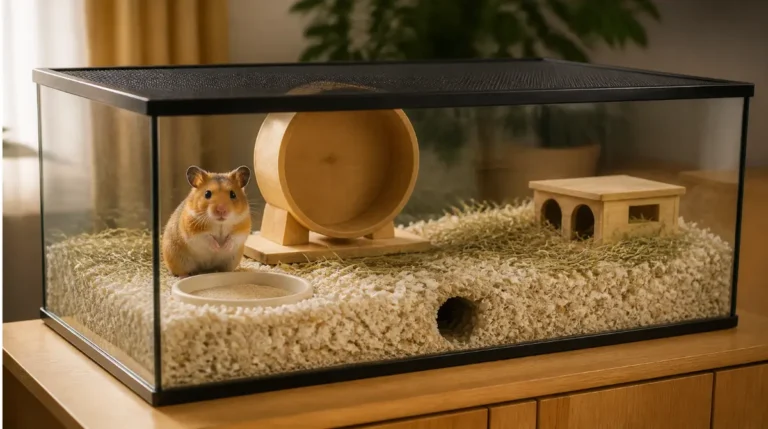
Smart Ways to Fit a Full-Size Hamster Cage in a Small Space

Small-space hamster cage plans often start with a 40-gallon breeder tank, but its 648 sq in falls short of 775. Here’s what actually fits.
Table of Contents
Yes, a big hamster cage can fit a small apartment
A small apartment shrinks your options, but it doesn’t shrink what your hamster needs. The good news is that the problem is footprint and placement, not square footage.
The number that doesn’t shrink
Every hamster, Syrian or dwarf, needs the same minimum floor space. The fix is choosing a shape that fits your walls and furniture.
Where to jump in
- Buying a cage: go to the three-number filter below.
- DIY or tight budget: the four enclosure types cover bins, tanks, and furniture builds.
- Already bought a small cage? You’re in good company, since most shop cages are undersized. Skip to the upgrade path.
🩺 Health Note: This article covers room temperature and placement as general guidance, not a substitute for an exam. If your hamster seems limp, unusually cold, or overheated, contact a vet experienced with hamsters promptly.
Why small homes still need 775 square inches
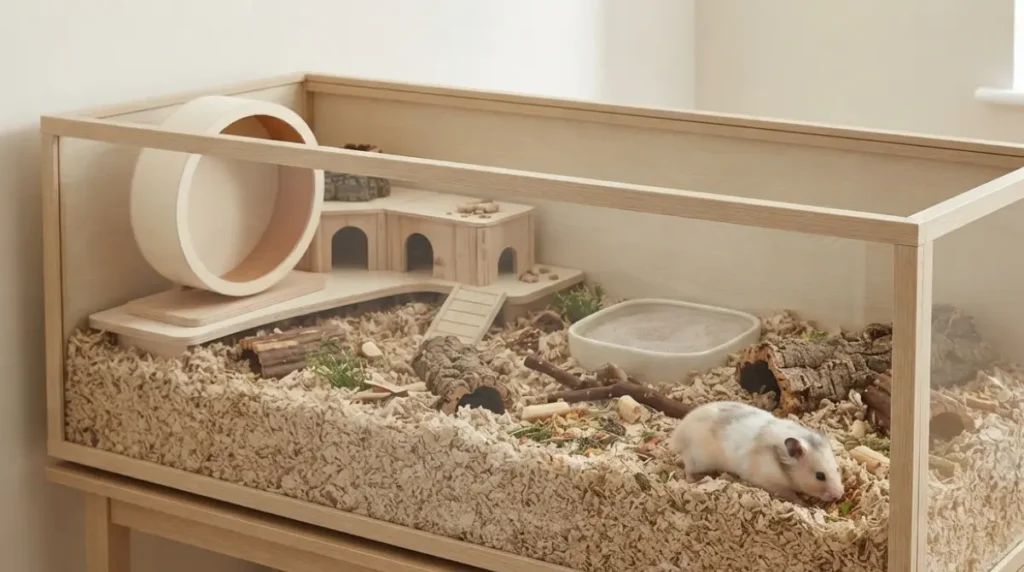
A hamster enclosure should give at least 100 × 50 cm, about 39 × 20 inches or 775 square inches, of unbroken floor space, whatever the size of your home.
What the major charities say
Blue Cross recommends housing no smaller than 100cm x 50cm of floor space and 50cm tall, noting that bigger is better. Blue Cross, PDSA and Woodgreen all updated their guides in 2023 to set that minimum for all hamster species.
Standards genuinely differ, though. The RSPCA has moved away from an official size, citing a lack of evidence, and says only that the cage should be as large as possible. Its older guidance of 80 × 50 cm works out to about 620 square inches.
Why dwarfs don’t get a smaller minimum
Dwarf hamsters are smaller, but the charity minimum is the same for them. For a feel of the space, see what 775 square inches actually looks like.
🔄 Outdated Advice: “Large” on the box isn’t a measurement. Some cages sold as large measure only around 36 × 26 cm. Check the listed floor dimensions, not the label.
Four enclosure types that fit where cages don’t
The right apartment enclosure is long, low, and placed on furniture you already need.
| Enclosure type | Where it fits | Floor space | Key detail |
|---|---|---|---|
| Detolf (on its side) | Sideboard, long wall | Varies by interior build | Long and narrow; confirm interior floor space |
| Bin cage | Sturdy bench or shelf | Varies by bin | Lightest and cheapest option |
| Glass tank | Desk or console top | 40-gal breeder = 648 sq in | Size up; a breeder is under 775 |
| Furniture conversion | Replaces a desk or wardrobe | Built to size | Most space per footprint |
Tank figure from published aquarium dimensions; other figures depend on your build.
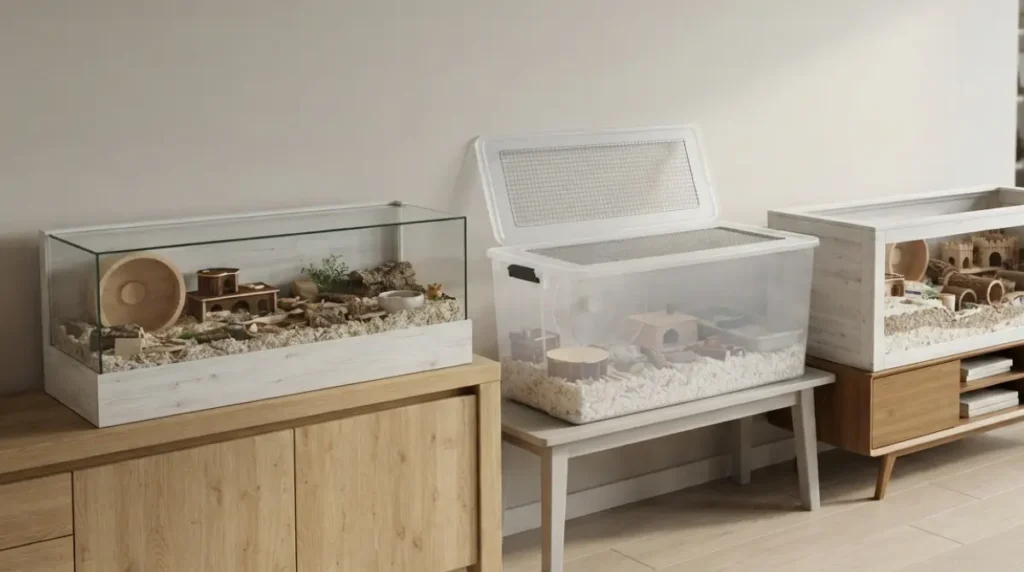
Long and narrow: the Detolf on a sideboard
A glass cabinet laid flat trades width for length. Our guide to Detolf floor space covers whether it meets the minimum.
Bin cage on a sturdy bench or shelf
A bin cage built to the minimum is light enough for most shelving.
Tank as a desk or console top
A 40-gallon breeder tank measures 36 × 18 × 16 inches. That’s 648 square inches, short of 775. See why the 40-gallon breeder falls short.
Furniture conversions
Keepers turn a desk on its side and add an acrylic front, creating an enclosure that doubles as furniture.
⚠️ Watch Out: Glass tanks are heavy before you add a single scoop of bedding. Place them only on furniture rated for the load, never a wobbly bookshelf.
Store-bought big cages that suit apartment life
A store-bought enclosure works in an apartment if it passes three checks before it passes your eye.
The three-number filter
✅ Do This: Before you buy, confirm three things:
- At least 775 square inches of unbroken floor space.
- A base deep enough for 20–25 cm of bedding.
- Room for a correctly sized wheel (see below).
Flat-pack vs glass for renters
One experienced keeper notes a flat-pack wooden enclosure packs down into its box for moving and weighs less than a glass tank. Glass holds bedding well, but tanks still need a mesh lid for good ventilation. Compare options in our guide to large hamster cages.
Where to put a hamster cage in a studio or one-bed
Placement matters as much as size, because a hamster can’t leave a spot that’s too loud, hot, or cold. PDSA’s guidance for hamsters covers three points:
- Quiet: keep the cage away from the TV or washing machine, since noise and vibration stress hamsters.
- Steady temperature: keep the room at 18–21°C (about 64–70°F).
- Sheltered: keep it out of draughts and direct sunlight.
Quiet, steady, out of the sun
In a studio, that rules out spots beside the stove, radiator, or a sunny window.
🔍 Why It Works: An overheated hamster can’t escape the enclosure and may develop heatstroke. Too cold, and it can slip into a dangerous hibernation-like state called torpor. If your hamster seems limp, unusually cold, or overheated, contact a vet experienced with hamsters promptly.
Sleeping in the same room as a nocturnal pet
Hamsters spend most of the day asleep and wake at night. Place the cage as far from your bed as the room allows and choose a quiet-running wheel. Don’t move it into a closet, where airflow and temperature are harder to control.
Use height for bedding, not for extra floors
In a small apartment, the cage’s height should go to bedding depth, not stacked levels.
Deep bedding is your vertical space
Recommended bedding depth ranges from a minimum of 20 cm per Blue Cross to at least 25 cm per PDSA, roughly 8–10 inches.
Platforms: add-on, never a substitute
🔄 Outdated Advice: “Multi-level cages maximize space.” Ledges and capsule-style compartments don’t provide continuous floor space. Blue Cross advises against elaborate tube systems, which lack ventilation, and notes that dwarf hamsters are poor climbers.
Wheel size by species
Undersized wheels can damage the spine over time. Published minimums vary:
- Syrian: 28 cm or larger, per one RSPCA branch.
- Dwarf: guidance ranges from 20 cm (HamsterWelfare) to 25 cm or larger (the same RSPCA branch).
The fuller reasoning is in Blue Cross’s hamster care guidance.
Bought a small cage already? Your upgrade path
A small cage is a common starting point, and it’s fixable without a bigger apartment.
The fastest affordable upgrade
A bin cage built to 775 square inches is usually the cheapest route. Keep the old cage as a carrier for cleaning days.
Renting and moving
Choose a bin or a flat-pack enclosure if you move often.
⚠️ Watch Out: Blue Cross says hamster exercise balls must not be used. Hamsters tire quickly, can’t escape, and lack ventilation inside. It recommends a secure playpen instead. Playpen time adds space but never replaces the minimum enclosure.
FAQ
1. Can you keep a hamster in a small apartment?
Yes. A small apartment works if the hamster cage fits a small space by footprint while still giving 775 square inches of floor space.
2. Do multi-level cages count as floor space?
No. Ledges and capsule compartments aren’t continuous floor space, so multi-level cages count only their largest unbroken floor.
3. Is a 40-gallon breeder tank big enough for a hamster?
No. A 40-gallon breeder tank measures 36 × 18 inches, giving 648 square inches, below the 775-square-inch minimum.
4. Is a bin cage OK for a Syrian hamster?
Yes, if the bin cage provides at least 775 square inches of floor space and holds 20–25 cm of bedding.
5. Where should a hamster cage go in a studio?
Put a studio hamster cage somewhere quiet and draught-free, away from direct sun, the TV, and appliances that vibrate.
6. What temperature should a hamster room be?
PDSA recommends keeping a hamster room at a steady 18–21°C, about 64–70°F. If your hamster seems limp, cold, or overheated, contact a vet experienced with hamsters promptly.
7. Do dwarf hamsters need a smaller cage?
No. Blue Cross and PDSA set the same 100 × 50 cm minimum for dwarf hamsters as for Syrians.
8. Will a hamster wheel keep me awake?
It might, because hamsters are active at night. Place the hamster wheel’s cage away from your bed and choose a quiet-running wheel.
9. Are tube cages good for small spaces?
No. Blue Cross advises against elaborate tube cages because they lack ventilation and are often too narrow for Syrians.
10. What if I already bought a small hamster cage?
Upgrade to a bin cage built to 775 square inches, and keep the small hamster cage as a cleaning-day carrier.
Small apartment, full-size hamster home
Your apartment sets the shape, not the size. Measure your longest free wall or surface first, pick the enclosure type that fits it, then place it somewhere quiet and steady. That order gets your hamster the full 775 square inches without giving up your living space.