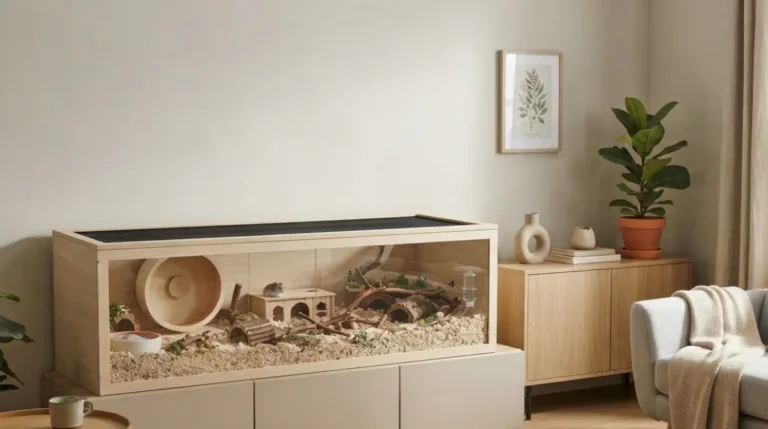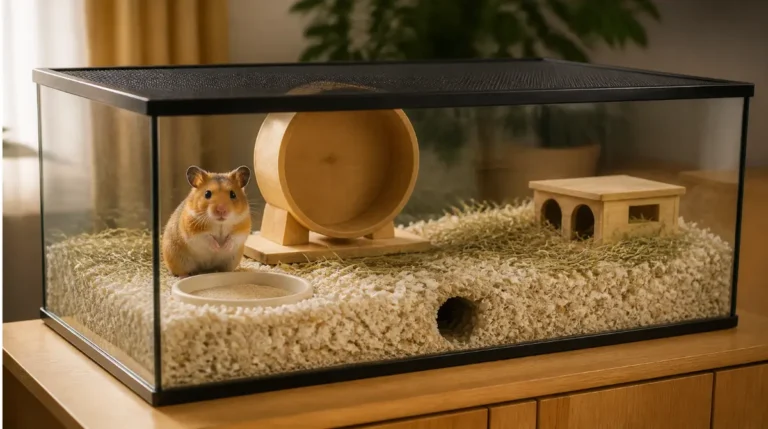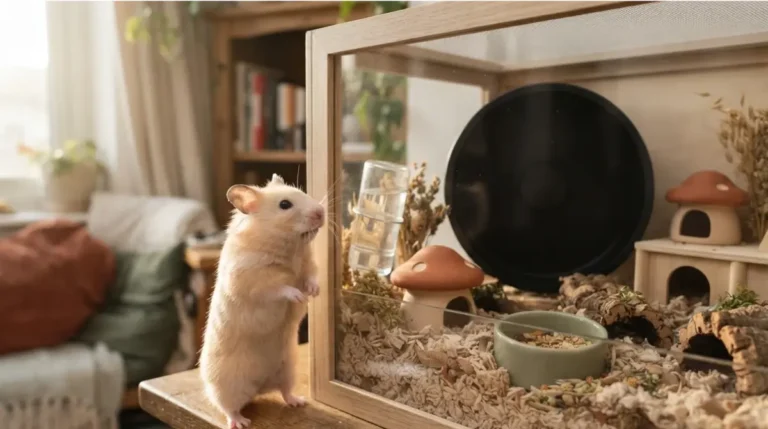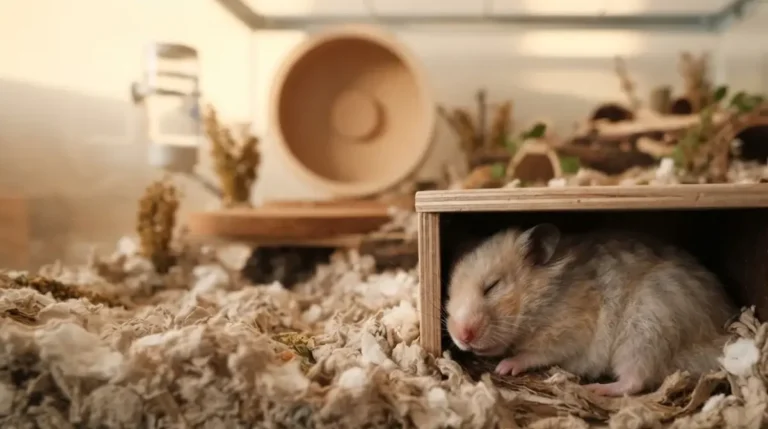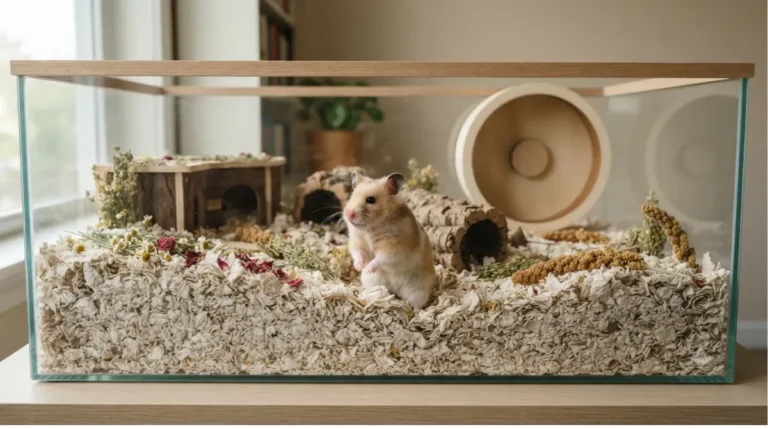
The Right Hamster Room Temperature for Cold Winter Nights

Hamster room temperature matters most overnight. Aim for a steady 64–70°F at the cage, not the thermostat, and see why Djungarians react to day length.
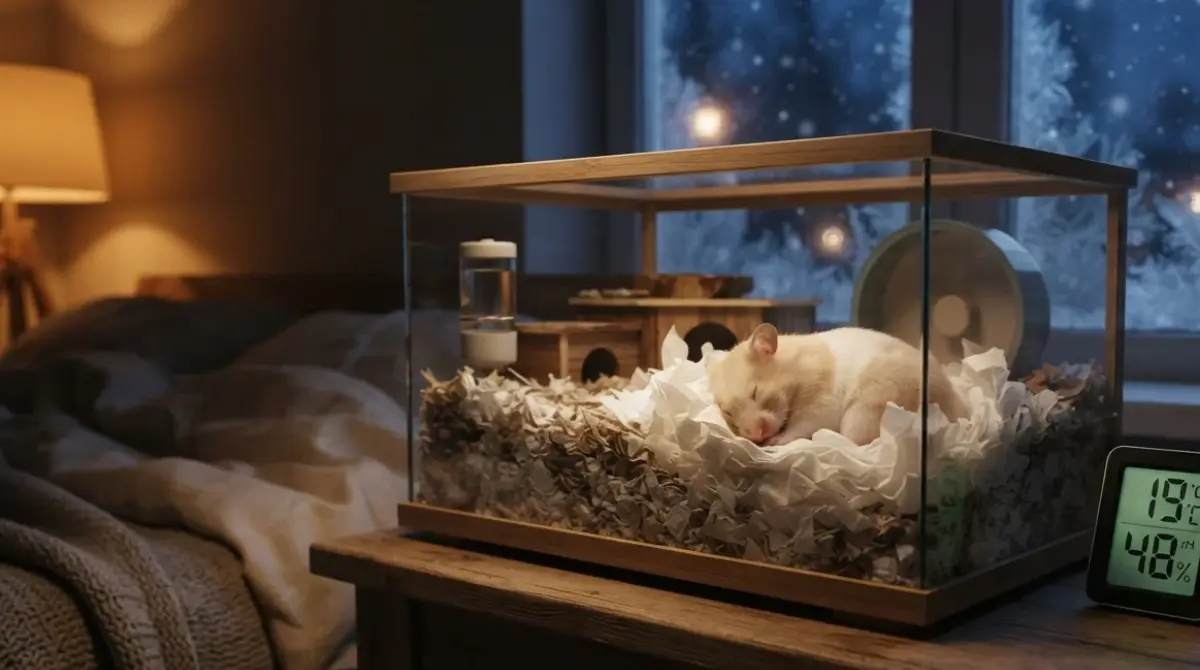
Table of Contents
Is your hamster’s room too cold right now?
🚨 Vet Now: If your hamster feels cold, is limp, or doesn’t react when you gently touch its whiskers, call a vet experienced with hamsters now. While you arrange care, warm the room gradually. Don’t put a heater or heat pad on or against your hamster.
If your hamster is cold and not responding
Follow the step above first. Everything else on this page can wait.
The short answer for everyone else
Keep your hamster room temperature steady at about 64–70°F (18–21°C), measured beside the cage rather than at the thermostat. That’s the range PDSA recommends, and it sits inside the Merck Veterinary Manual’s wider range.
New owner? Start with the range and the measuring method. Hamster seems sluggish? Go straight to the vet signs section near the end.
🩺 Health Note: This is general information, not a substitute for an exam by a vet experienced with hamsters. Hamsters hide illness, and a cold, unresponsive hamster needs care right away. If you don’t have an exotics vet yet, find one before winter sets in.
What temperature should a hamster’s room be?
Respected sources agree on the middle of the range and differ at the edges.
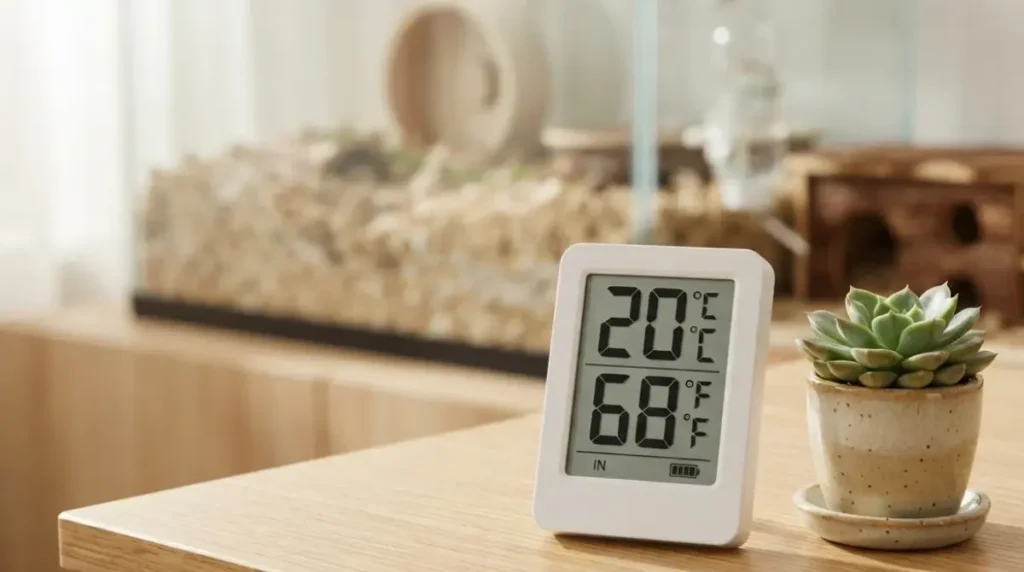
Keep a hamster’s room at a steady 64–70°F (18–21°C). Veterinary guidance tolerates up to about 79°F (26°C), but steadiness matters as much as the number.
What veterinary and welfare groups recommend
| Source | Range | Key Detail |
|---|---|---|
| PDSA (UK veterinary charity) | 18–21°C (64–70°F) | Steady; away from draughts and direct sun |
| Merck Veterinary Manual | 64–79°F (18–26°C) | Enclosure with good airflow |
| UK Home Office lab standard (via NC3Rs) | 20–24°C (68–75°F) | Laboratory hamster rooms, not homes |
Sourced: ranges as published by each organization; checked September 2026.
We use the overlap, 64–70°F, as our winter target because it satisfies both pet-care sources. See PDSA’s hamster care advice and the Merck Veterinary Manual’s hamster housing guidance.
Why a steady temperature matters more than the exact number
PDSA warns that a cage that gets too cold can push a hamster into torpor, a dangerous hibernation-like state. A cage that gets too hot risks heatstroke the hamster can’t escape. In winter the real danger is the overnight drop, so the lowest reading is the one that matters.
Why winter affects Syrian and dwarf hamsters differently
The safe range applies to every pet hamster, but what tips each species toward torpor differs.
Syrian hamsters: cold plus short days
Syrian hamsters are facultative hibernators. In laboratory studies, they entered hibernation after long exposure to both cold and short days, typically two to three months. PDSA notes that Syrians may slip into torpor when exposed to low temperatures.
Djungarian dwarfs: shorter days alone
Djungarian (Winter White) hamsters respond mainly to day length. In a 2021 lab study, they began using daily torpor as days shortened, even at 20°C (68°F), though individual hamsters varied widely. Research colonies aren’t pet homes, so treat this as a reason to watch your hamster, not a reason to panic.
Campbell’s, Roborovski, and Chinese hamsters
We found no species-specific research strong enough to say how these hamsters respond to winter. Use the same range and the same warning signs. For how the two main types differ in other ways, see how Syrian and dwarf hamster cage needs differ.
How to check the temperature where your hamster actually sleeps
Your thermostat measures the hallway, but your hamster lives at bedding level.
Put the thermometer at bedding level, not on the wall
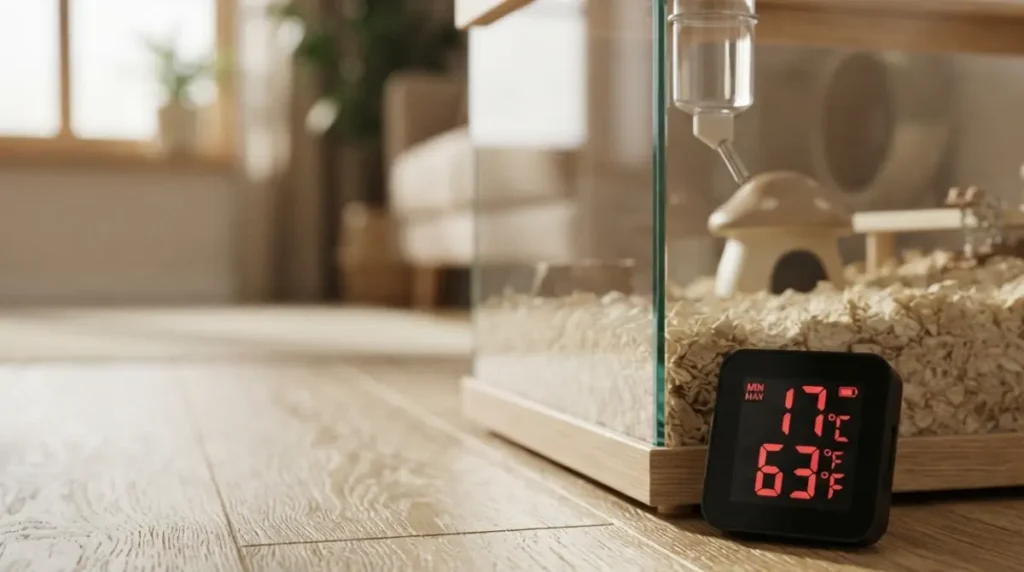
Place a digital thermometer beside the enclosure at nest height, away from windows and heaters. A room can feel comfortable at head height while the spot beside an outside wall runs colder.
Check the overnight low, not the daytime reading
A min/max thermometer records the lowest temperature while you sleep. Check it each morning for the first cold weeks, and again whenever you change your heating settings. If the low falls below 64°F (18°C), act before it becomes a pattern.
✅ Do This: Before tonight, set a min/max thermometer beside the cage at bedding height. Read the overnight low tomorrow morning.
How to keep a hamster warm in winter without overheating
Fix placement first, then room temperature, then bedding.
Move the cage before you add heat
The RSPCA’s hamster housing guidance says to keep hamsters indoors, away from draughts and damp. PDSA adds direct sunlight to that list. Moving the cage away from a draughty window or an outside wall often solves the problem, and our guide to where to put a hamster cage covers room-by-room choices.
Warm the room, not the hamster
If the room still runs cold, raise the room’s heating gradually. Keep heaters and radiators well away from the enclosure, because a hamster can’t move away from heat. We don’t recommend in-cage heat sources; ask your vet before using any.
Let bedding and a nest do their job
Hamsters keep warm by nesting. Laboratory care guidance treats nesting material as essential, because a hamster’s comfortable body-temperature zone sits well above normal room temperature. Merck suggests an enclosure base 8 inches or taller so it can hold deeper bedding. See how deep hamster bedding should be and how much floor space a hamster actually needs.
Winter hamster myths worth ignoring
Some advice still circulating makes a cold-weather emergency more likely. If you’ve followed any of it, you’re not alone, and each one is easy to fix.
Myth: hibernation is natural, so let them sleep
🔄 Outdated Advice: A pet hamster in torpor isn’t safely hibernating. The RSPCA explains that domestic hamsters lack the fat reserves to go without food for long periods. The goal is to prevent torpor, not wait it out.
Myth: dwarf hamsters never go into torpor
Djungarian hamsters can use daily torpor as days shorten, according to the research above. A dwarf hamster that seems unusually sluggish in winter gets the same checks as a Syrian.
Myth: a heater next to the cage is fine
A heater beside the enclosure swaps a cold risk for an overheating one. If your hamster lives in a glass tank, read our guide to glass tanks and overheating before adding any heat nearby.
Torpor, illness, or something worse: when to call a vet
🚨 Vet Now: Call a vet experienced with hamsters immediately if your hamster doesn’t react when its whiskers or cheeks are touched, won’t wake once the room is warm, or feels stiff.
Torpor and illness can look alike, so a vet should make the call.
Call a vet now if…
- Your hamster is cold, limp, or barely breathing.
- It doesn’t wake after the room has warmed.
- It has stopped eating or drinking.
During torpor, a Syrian hamster’s heart rate can drop from around 400 beats a minute to single digits, so an owner may not be able to tell torpor from something worse. That’s exactly why the next step is a phone call, not waiting. The Merck Veterinary Manual’s guidance on hamster health checks advises a vet visit for any change in appearance or behavior.
What to do while you arrange care
- Raise the room temperature gradually. PDSA advises checking that it hasn’t fallen below 20°C (68°F).
- Don’t apply direct heat to your hamster.
- Tell the vet the species, the hamster’s age, how long it has been still, and the bedding-level temperature.
Hamster room temperature FAQ
1. What is the ideal hamster room temperature?
A steady 64–70°F (18–21°C), as PDSA recommends. It sits inside Merck’s wider range and suits every pet hamster species.
2. Is 60°F too cold for a hamster?
Yes. 60°F is below both the PDSA and Merck minimums, so warm the room gradually and check overnight lows beside the cage.
3. Do hamsters hibernate in winter?
Syrian hamsters can after long cold, short-day exposure, but in pets this torpor is dangerous, not natural rest. Call a vet experienced with hamsters if yours won’t wake.
4. Do dwarf hamsters go into torpor?
Djungarian dwarf hamsters can use daily torpor as days shorten, even in a warm room, according to lab research. Individuals vary widely.
5. How do I know if my hamster is in torpor?
A hamster in torpor is cool, still, and slow to respond, and illness can look identical. Call a vet experienced with hamsters now.
6. How do I warm a hamster in torpor?
Raise the room temperature gradually, to at least 68°F (20°C) per PDSA, and never apply direct heat. Contact a vet experienced with hamsters right away.
7. Can I use a heater for my hamster?
Heat the room, not the enclosure. Keep any heater well away from the cage, because a hamster can’t escape heat.
8. Where should a hamster thermometer go?
Beside the enclosure at bedding height, away from windows and heaters, so the thermometer reads what your hamster actually experiences.
9. Is my hamster cold at night?
Check a min/max thermometer. If the overnight low near the cage drops below 64°F (18°C), your hamster is too cold.
10. Can a hamster live in a garage or outside in winter?
No. The RSPCA advises keeping hamsters indoors, because outdoor conditions are too cold and risk dangerous torpor.
Your winter hamster checklist
- Keep the room at a steady 64–70°F (18–21°C).
- Measure at bedding level and check the overnight low.
- Keep the cage away from draughts, damp, windows, and heaters.
- Give deep bedding and nesting material.
- Call a vet experienced with hamsters if yours is cold and unresponsive.