Hamster cage size when welfare standards disagree

Hamster cage size minimums run from 279 sq in under Swiss law to 775 from UK charities, and golden hamsters did best at 1,550 in a 2007 study.
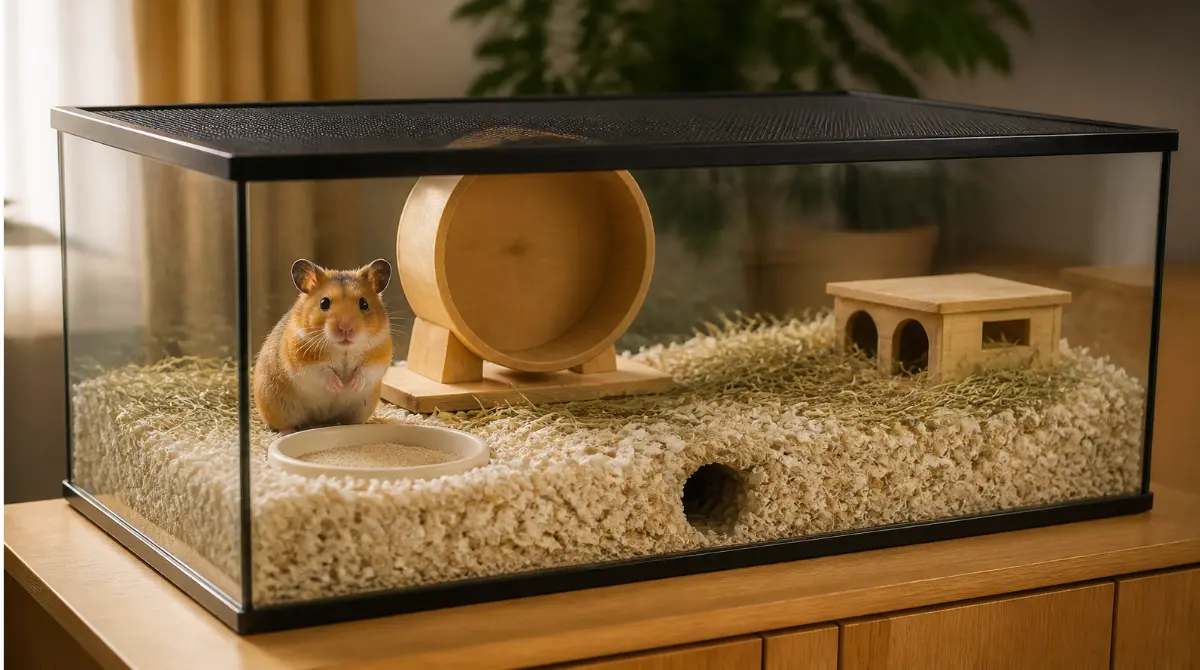
Table of Contents
Care guidance checked on October 26, 2026.
Blue Cross puts the smallest acceptable hamster home at 775 square inches of floor (5,000 cm²), a base of 100 × 50 cm, and gives no smaller figure for dwarf species. Swiss law allows a golden hamster cage of 279 square inches, Switzerland’s own veterinary office recommends 775, and in a controlled study of cage size, golden hamsters did best in the largest cage, 1,550 sq in (10,000 cm²).
Those figures answer different questions. A legal minimum marks the line below which keeping a hamster becomes an offense, while a welfare figure describes the room a hamster needs to dig and nest, so the table below labels which is which and the species each one covers.
Published hamster cage minimums, side by side
Switzerland writes a cage size into law. Its animal welfare ordinance sets 0.18 m² for a golden hamster, for example a base of 30 × 60 cm, and the Swiss Federal Food Safety and Veterinary Office calls that the absolute minimum before recommending a closed enclosure of at least 0.5 m² and about 19.7 inches (50 cm) tall.
| Standard | Country | Law or advice | Floor area | Species covered |
|---|---|---|---|---|
| Swiss animal welfare ordinance | Switzerland | Law | 279 sq in (1,800 cm²), e.g. 30 × 60 cm | Golden (Syrian) |
| Swiss federal veterinary office | Switzerland | Advice | 775 sq in (5,000 cm²) or more | Golden (Syrian) |
| Merck Veterinary Manual | US | Advice | No floor figure given | All hamsters |
| RSPCA | UK | Advice | No floor figure given | All hamsters |
| PDSA, citing Germany’s Veterinary Association for Animal Welfare | UK and Germany | Advice | 775 sq in (5,000 cm²) | All hamsters, no species split |
| Blue Cross | UK | Advice | 775 sq in (5,000 cm²), 19.7 in (50 cm) tall | All hamsters |
| Fischer and colleagues, 2007 | Switzerland | Research | Best welfare at 1,550 sq in (10,000 cm²), the largest size in the study | Female golden hamsters |
Sources: Swiss Federal Food Safety and Veterinary Office, Merck Veterinary Manual, RSPCA, PDSA, Blue Cross, Animal Welfare, 2007.
Two rows are easy to skim past. The Merck Veterinary Manual, the main US veterinary reference, gives no floor area for hamsters at all; it calls for a solid floor and deep bedding, plus a height of at least 6 inches (15 cm), with 8 inches (20 cm) or more preferred so the bedding can go deeper. The RSPCA also leaves out a number and wants a cage that holds a thick layer of bedding and nesting material.
PDSA is candid about the evidence. It notes that there isn’t much research on exactly how big an enclosure should be, then adopts the German veterinary association’s 100 by 50 cm as a minimum and adds that bigger is better.
Why the legal minimums sit so low
A law describes the worst housing a country will tolerate. The Swiss office that enforces the 279-square-inch rule advises 2.8 times as much floor for the same golden hamster, which shows how far apart a legal line and a welfare recommendation can be.
Every figure in the table is a floor area. To convert metric figures yourself, divide square centimeters by 6.4516: 5,000 cm² comes to 775 square inches, and 1,800 cm² comes to 279.
Do dwarf hamsters need a smaller cage?
Roborovski, Campbell’s, winter white and Chinese hamsters are all smaller than a Syrian, and none of the welfare figures above gives them a smaller floor. Blue Cross gives one minimum for hamsters with no smaller figure for dwarfs, and PDSA likewise gives a single figure with no species split.
Some care guides list dwarf minimums of 350 to 450 square inches. That range runs from about 45 to 58 percent of the charity figure.
Evidence cuts neither way. The cage-size research behind these debates studied golden hamsters only, so no study supports a smaller floor for dwarf species, and none shows that dwarfs need more.
Where the dwarf species do differ is in the details around the floor. Their smaller bodies change the bar gap and wheel size that suit them, which the comparison of dwarf and Syrian cage needs sets out species by species.
Syrian hamsters in small cages gnaw the bars more
Gnawing at the cage wire is the behavior most closely tied to cage size in the research. In a study of 60 female golden hamsters housed alone at 279, 387.5, 775 and 1,550 square inches (1,800 to 10,000 cm²), wire-gnawing appeared at every size. Hamsters in the small cages gnawed for longer and more often.

The same hamsters showed a second habit an owner can watch for. In small cages they climbed onto the roof of their wooden shelter and used it as an extra platform more often than hamsters in big cages did, which the researchers read as a sign that they needed more space. Wheel running did not differ between cage sizes.
The authors concluded that welfare seemed better in cages with at least 10,000 cm² of floor than in smaller ones. For a Syrian already gnawing in a cage under that size, the causes of bar-biting and what to change first start with floor and bedding.
What the study did not cover
All 60 hamsters were female golden hamsters, so the results say nothing directly about males or any dwarf species. The study also found no ceiling: its biggest enclosure produced the best result, so it gives no size beyond which more floor stops helping.
Bedding depth, height, wheel and bar spacing
Ten inches (25 cm) of bedding is the minimum PDSA gives for burrowing and food storage. A cage can pass on floor area and still fall short on any of the four figures below.
| Measure | Syrian (golden) hamster | Dwarf species | Source |
|---|---|---|---|
| Bedding depth | At least 10 in (25 cm); Swiss office: at least 5.9 in (15 cm), ideally 11.8 to 31.5 in (30 to 80 cm) | At least 10 in (25 cm) | PDSA; Swiss office (golden only) |
| Wheel diameter | At least 12 in (30 cm), solid running surface | At least 8 in (20 cm) | PDSA; Swiss office (golden, 30 cm) |
| Enclosure height | 19.7 in (50 cm) | 19.7 in (50 cm) | Blue Cross; Merck: at least 6 in (15 cm) |
| Bar or mesh gap | Narrower than 1 cm (about 3/8 in) | Narrower than 1 cm (about 3/8 in) | Blue Cross |
Sources: PDSA, Swiss Federal Food Safety and Veterinary Office, Blue Cross, Merck Veterinary Manual.
Height follows from the bedding: a 10-inch layer alone is deeper than Merck’s 6-inch minimum height, and Blue Cross sets 19.7 inches. The guide to hamster bedding depth covers how to keep that layer from collapsing, and the wheel sizes for Syrian and dwarf hamsters explain how to check a wheel against your own animal.
Shelves and upper levels add interest, but the figures in both tables describe the base. PDSA prefers a larger single-level cage to a tall one with several floors, because hamsters see poorly and can fall from height. Whether a second level can make up any shortfall is covered in how cage levels affect floor space.
Roborovski hamsters are the species most likely to slip through a gap that suits a Syrian. The Roborovski cage and bar spacing guide works through that problem in detail.
Glass tank or barred cage for a hamster
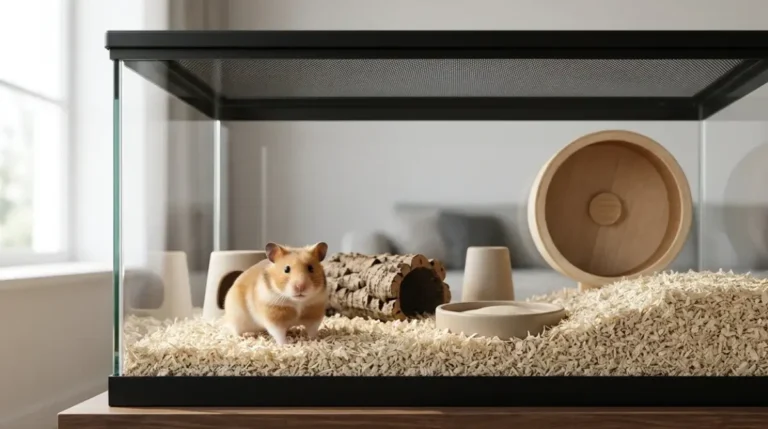
No single answer exists, because the welfare groups split on enclosure type as well as size. RSPCA guidance favors stainless steel bars or mesh sides over solid sides, and plastic over metal. It advises against wooden cages. Blue Cross calls tanks and aquariums ideal, since they hold deep bedding and reduce the risk of escape through bars, provided the tank has a mesh lid for ventilation.
Temperature advice differs as well. Merck gives a range of 64 to 79°F (18 to 26°C), while PDSA wants a steady 64 to 70°F (18 to 21°C). Hamsters are sensitive to bright sunlight, so a tank or cage belongs out of direct sun.
Floor area usually settles the choice before style does. A large storage bin is one way past the 775 figure without a purpose-built cage, and the bin cage build guide covers ventilation and bin depth. Aquarium sizes are sold by volume in gallons, a number that tells you little about floor area, so the 40-gallon breeder tank breakdown works out what that popular size actually offers.
Before you buy: compare the inside of the base with the 775 sq in figure, and check that any bar gap is narrower than 1 cm (about 3/8 in). Outside dimensions include frames and plastic lips a hamster cannot use.
Older cage figures still in circulation
One older care sheet still lists 150 square inches as enough for a hamster. That sits below even the Swiss legal floor of 279 square inches. A widely copied “24 by 12 inches” (288 square inches) clears the Swiss law by 9 square inches but reaches only about 37 percent of the Blue Cross figure.
An 80 × 50 cm minimum (620 square inches) is often credited to the RSPCA. Its current hamster housing page gives no floor figure at all.
Switzerland’s legal minimum is sometimes quoted as 3,800 cm². The Swiss federal office gives it as 0.18 m², which is 1,800 cm², and recommends 0.5 m² (5,000 cm²) as the better target.
One more is a simple slip in arithmetic. A floor of 40 by 15 inches is sometimes described as 700 square inches, but it comes to 600.
If a cage came from a pet store with “large” on the box, the check of whether pet-store hamster cages are big enough shows how to judge it against these figures.
When bar-chewing means a vet visit
Bar-chewing becomes a health problem once it damages the teeth or mouth, and at that point a hamster needs a vet who treats hamsters regularly.
See a vet today if: your hamster has broken or misaligned front teeth, sores or bleeding around the mouth, or is eating less than usual or not at all.
Not every general practice sees hamsters, so ask whether the clinic treats hamsters before you book. Bring the hamster in its carrier with some of its usual bedding, and a note of when you last saw it eat. Leave the teeth alone at home; trimming or filing them is work for the vet.
Other questions about cage size
Can a hamster cage be too big?
None of the standards in the first table sets a maximum. In the 2007 study, the largest cage produced the best welfare results for golden hamsters, in cages furnished with bedding and a wheel.
Is a 40-gallon breeder tank big enough?
It depends on the inside floor of the specific tank, which varies by maker. Multiply its inside length by its inside width and compare the result with the first table; the gallon rating alone cannot answer it.
Measure your cage floor before you buy
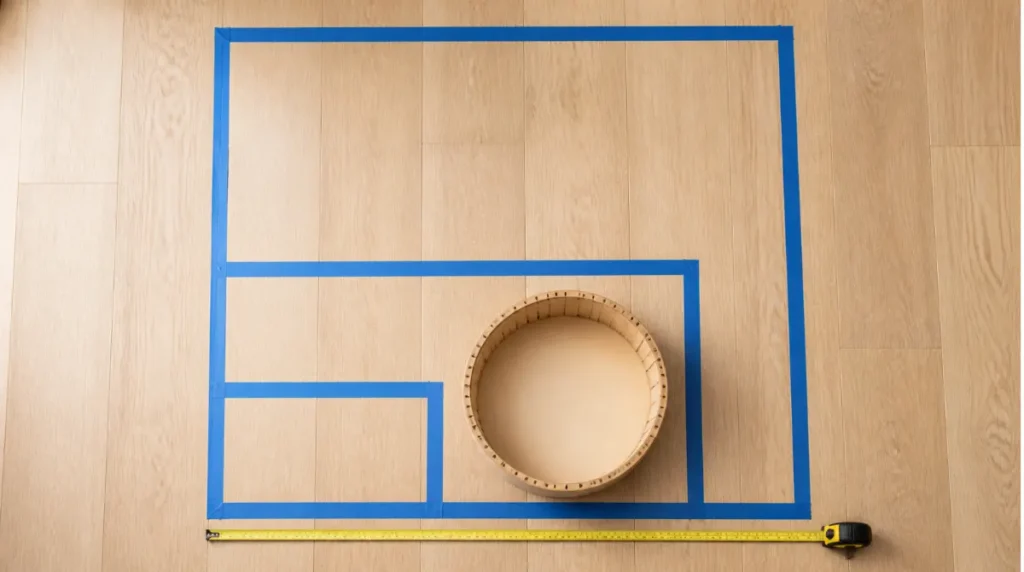
Take the inside length and width of the base in inches, multiply them, and compare the result with the table above; ignore shelves and upper levels. The step-by-step method for measuring hamster cage floor space shows where tapered walls and corner curves cut into the usable area, which is often the difference between a cage that passes and one that doesn’t.