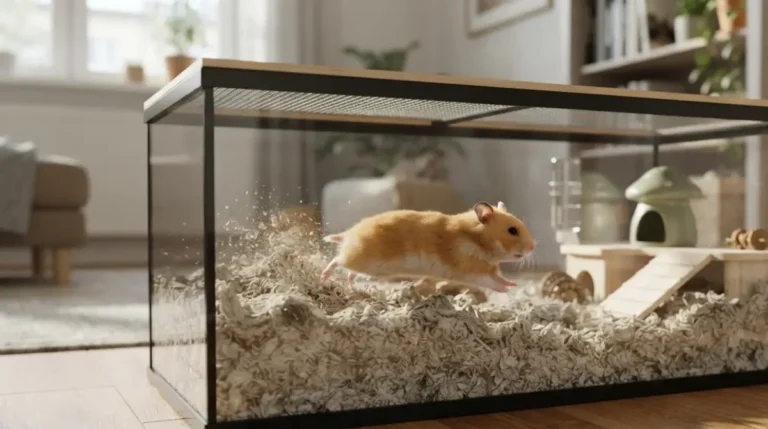
Are Pet Store Hamster Cages Big Enough? The Real Size Answer

Pet store hamster cages sold as “extra large” can still list about 339 square inches, 44% of the 775 sq in minimum. Here’s how to check yours.
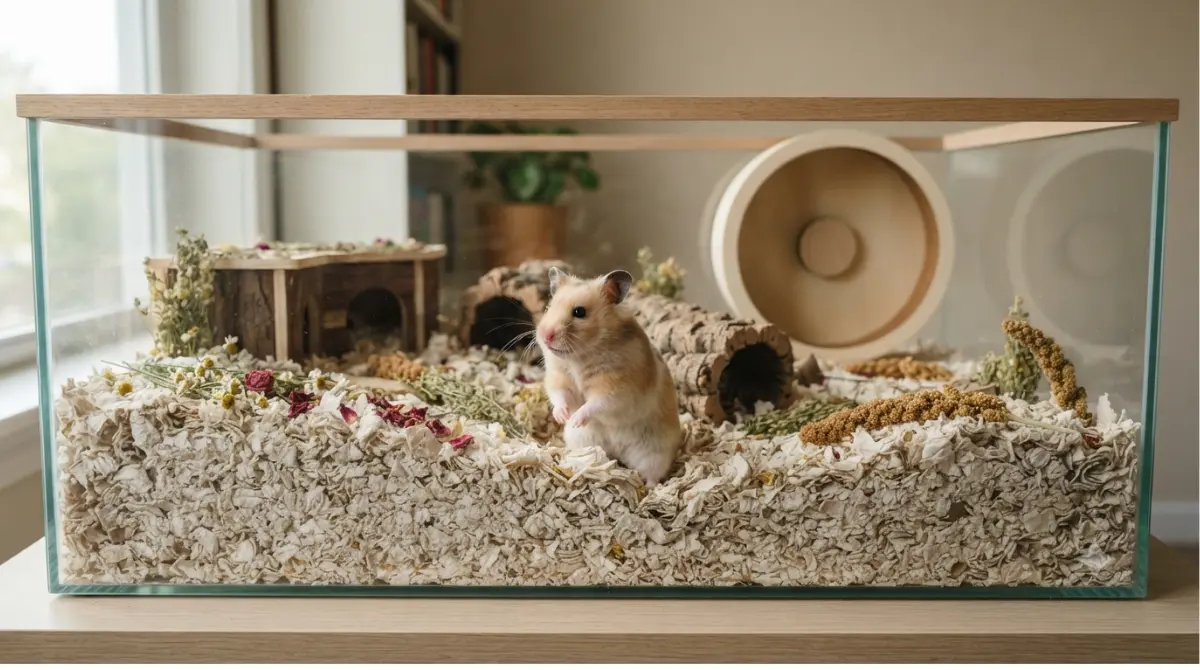
Table of Contents
Are pet store hamster cages big enough?
Usually not. Most cages sold in pet stores and online offer far less than 100 × 50 cm (about 775 square inches) of unbroken floor space. That is the minimum Blue Cross and PDSA now recommend for every hamster species.
If you already own one, you haven’t failed your hamster. Store cages are sized for shelves and price tags, and the box rarely mentions any welfare standard.
The number to compare against
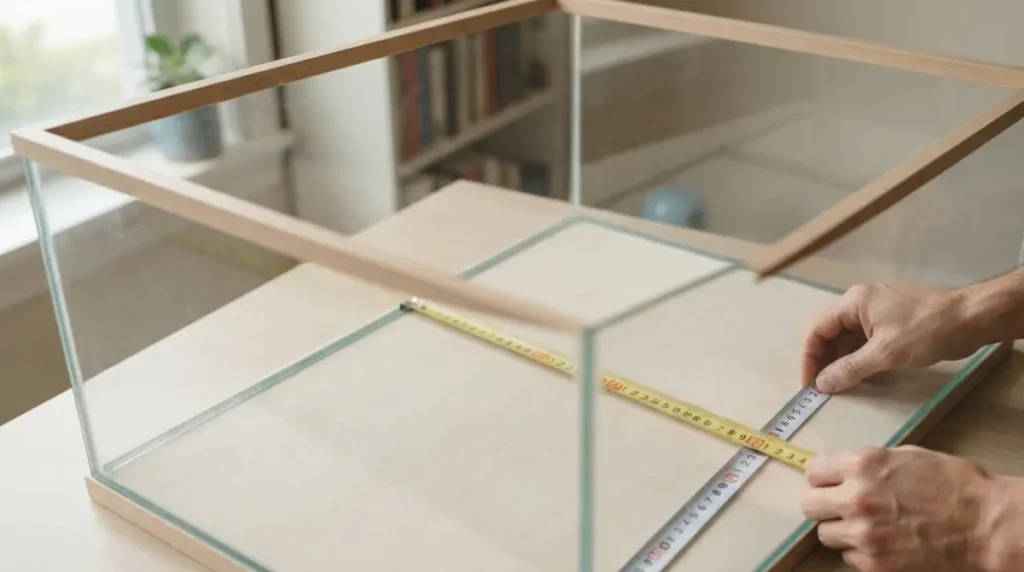
Multiply your cage’s base length by its width in inches. A result under 775 square inches means the cage falls below current UK welfare guidance.
Already bought one? Skip to the fix
- Still shopping: check the listed-size comparison below before you buy.
- Own a dwarf hamster: read the dwarf section; the answer may surprise you.
- Hamster already home: jump to the last section for this week’s fix.
What counts as a big enough hamster cage
Welfare organizations don’t all publish the same number, so here they are side by side. The table covers Syrian and dwarf hamsters separately.
| Organization | Syrian | Dwarf | Key Detail |
|---|---|---|---|
| Blue Cross (UK) | 100 × 50 cm floor, 50 cm tall | Same | Treats this as the smallest acceptable home |
| PDSA (UK) | 100 × 50 cm | Same | Follows the German Veterinary Association for Animal Welfare (TVT) |
| PetMD (US, 2022) | 900 sq in | 700 sq in | Asks more for Syrians |
| RSPCA (UK) | No published minimum | No published minimum | Advises a large cage without a figure |
Sources: each organization’s current hamster care guidance, checked September 2026.
Why levels and tubes don’t count
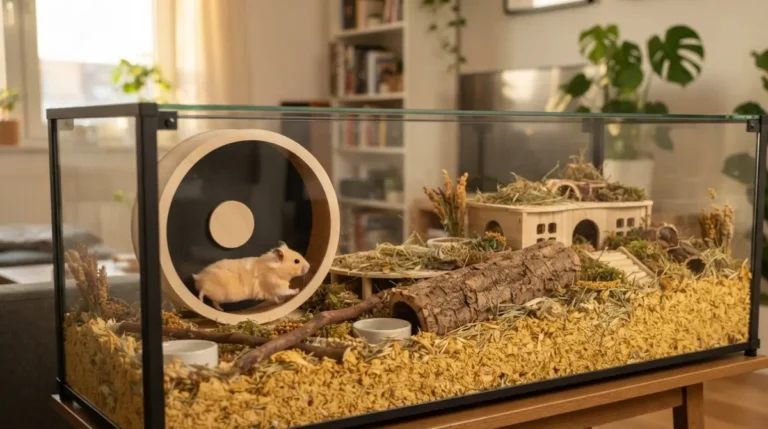
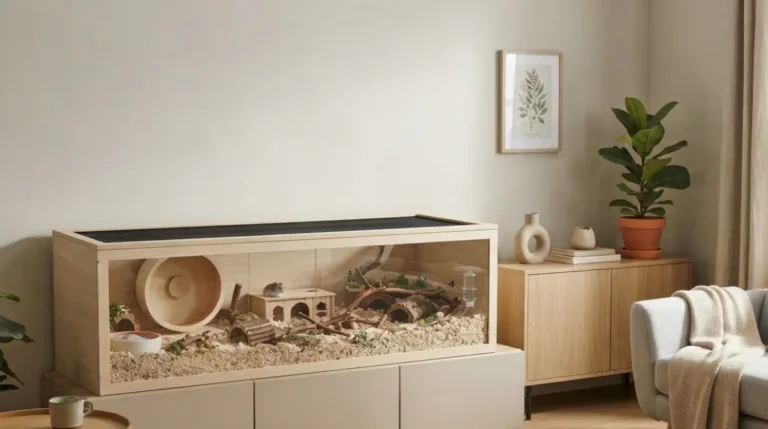
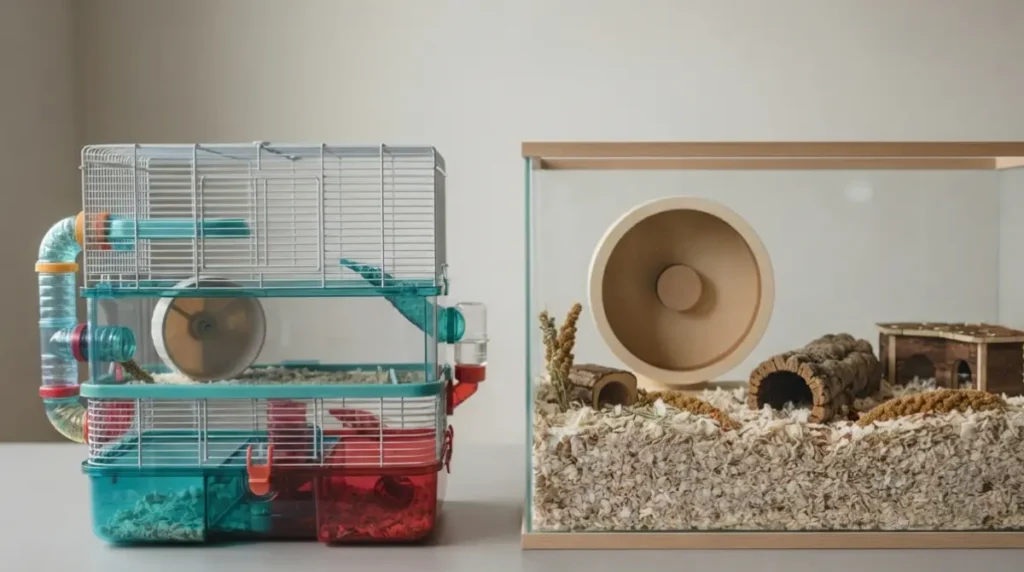
Floor space means one continuous ground level. PDSA prefers single-level cages because hamsters have poor eyesight and can fall from height, and Blue Cross advises against elaborate tube systems. For scale, see what 775 square inches actually looks like.
Why pet stores still sell cages that are too small
Retail cage design follows shelf space and price points, not welfare guidance.
The “starter cage” myth
Some small cages are sold as starters you’ll upgrade later. None of the standards above make an exception for young hamsters, so a starter cage is simply a small cage.
What “extra large” on the box really means
“Extra large” has no regulated meaning on a hamster cage. One tube-style cage listed as extra large measures 23.37 × 14.49 inches. That works out to about 339 square inches, roughly 44% of the 775 minimum.
🔄 Outdated Advice: One major US retailer’s care text still suggests 1–2 inches of bedding. Blue Cross recommends at least 20 cm (about 8 inches) of diggable bedding, and PDSA says a cage should hold at least 25 cm (10 inches). Shallow-based cages can’t hold that.
What a too-small cage does to a hamster
The best evidence comes from studies of Syrian (golden) hamsters. Treat anything said about dwarfs as an extension of that research, not proof.
What the cage-size study found
A 2007 study of golden hamsters in four cage sizes housed 60 females in cages from 1,800 to 10,000 cm², about 280 to 1,550 square inches. Hamsters bit the bars in every size, but those in small cages did it longer and more often. Welfare appeared best in the largest cage.
Why bedding depth matters too
A 2006 study on bedding depth found hamsters on 10 cm of bedding bar-bit significantly more. Hamsters given 80 cm never did, and at least 40 cm appeared to improve welfare.
🔍 Why It Works: Bar-biting is a repetitive behavior researchers use as a welfare warning sign. More space and deeper bedding give a hamster somewhere to put its roaming and digging drive.
What research can’t tell us yet
PDSA notes there isn’t much evidence on exactly how big a cage should be. The 775 figure is a welfare benchmark, not a proven threshold.
Store cages vs 775 square inches: listed sizes compared
This comparison uses sellers’ listed dimensions; we have not measured these cages in person yet.
How we compared
We multiplied each listed length by its width and divided by 775. Listed sizes can include outer edges, so real usable floor may be smaller. Tank gallon numbers measure volume, not floor area, so always measure the base.
The results against 775 sq in
| Cage (as listed) | Listed base | Floor area | % of 775 |
|---|---|---|---|
| Five-level tube cage, sold as “extra large” | 23.37 × 14.49 in | ~339 sq in | 44% |
| Ferplast Favola wire cage | 23.6 × 14.4 in | ~340 sq in | 44% |
| Two-layer acrylic cage | 18.5 × 11.8 in | ~218 sq in | 28% |
| Cycodo 8-in-1 acrylic cage | 14 × 10 in | 140 sq in | 18% |
Listed dimensions, September 2026; confirm against current seller pages.
✅ Do This: Before buying, measure the cage’s floor space yourself using the inside base, not the box label.
Do dwarf hamsters need a smaller cage?
This is where the standards genuinely split for dwarf hamsters such as Roborovski, Campbell’s and winter whites.
Where the standards split
Blue Cross and PDSA use the same 100 × 50 cm minimum for dwarfs as for Syrians. PetMD allows 700 square inches for dwarfs. Older UK guidance commonly quoted 70 × 40 cm, which is about 434 square inches.
Our recommendation and why
We recommend 775 square inches for dwarfs too. Two major UK charities have set that bar, and no dwarf-specific research shows smaller is enough. Blue Cross also notes dwarfs are poor climbers, so floor matters more than height. See our dwarf vs Syrian cage size guide for bar spacing and wheel differences.
Already bought a small cage? What to do this week
This is one of the most common hamster mistakes, and it’s fixable within days.
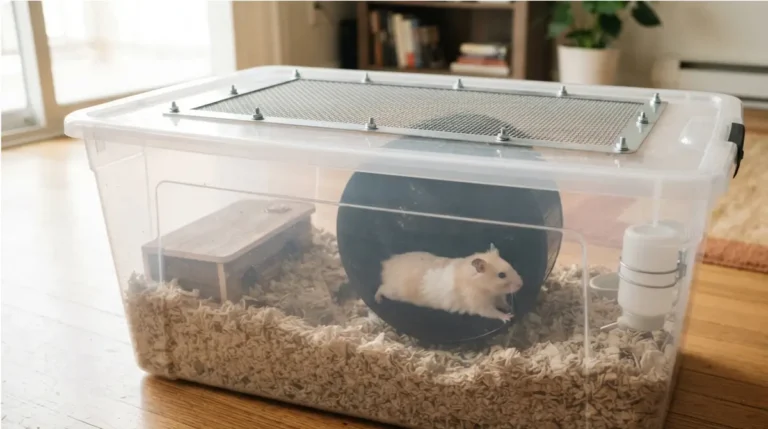
The cheapest upgrade: a bin cage
A DIY bin cage is usually the lowest-cost fix. The bin itself must reach 775 square inches, and many standard storage totes don’t.
Return, resell, or repurpose
Check your store’s return window first. If you’d rather buy ready-made, compare large hamster cages that meet 775 square inches.
Signs your hamster needs the upgrade soon
Frequent bar-biting is the clearest signal, based on the research above.
⚠️ Watch Out: If you notice a facial wound, broken or overgrown teeth, or weight loss, book a vet experienced with hamsters this week. Don’t treat these at home.
Frequently asked questions
1. Are pet store hamster cages big enough?
Usually not. Most pet store hamster cages fall well below the 775 square inches Blue Cross and PDSA recommend.
2. What is the minimum hamster cage size?
Blue Cross and PDSA recommend a minimum hamster cage size of 100 × 50 cm floor space, about 775 square inches, for all species.
3. Do dwarf hamsters need a smaller cage?
Standards differ, but Blue Cross and PDSA give dwarf hamsters the same 775-square-inch cage minimum as Syrians, and we agree.
4. Do tubes and levels count toward hamster cage floor space?
No. Hamster cage floor space means one continuous ground level; shelves, platforms and tubes don’t count toward the minimum.
5. Is 450 square inches big enough for a hamster?
No. A 450-square-inch hamster cage is well under the 775-square-inch minimum that Blue Cross and PDSA set.
6. Why do hamsters bite cage bars?
In a 2007 study, hamsters in smaller cages bit the cage bars longer and more often, a recognized sign of poor welfare.
7. Can a hamster cage be too big?
No evidence suggests a hamster cage can be too big. In the 2007 study, the largest cage showed the best welfare indicators.
8. Does a tank’s gallon number tell me its floor space?
No. Gallons measure a tank’s volume, not floor space. Measure the base length and width, then multiply for square inches.
9. How do I measure hamster cage floor space?
Measure the inside base length and width in inches, multiply them, and compare your hamster cage’s result with 775 square inches.
10. What’s the cheapest way to upgrade a small hamster cage?
A DIY bin cage is the cheapest hamster cage upgrade, but the bin itself must provide at least 775 square inches.
Your next step
Measure the base, multiply, and compare the result with 775 square inches. If you come up short, a bin cage or a larger ready-made enclosure closes the gap. In the research, hamsters in bigger cages showed fewer stress signs, so every square inch you add is worth it.